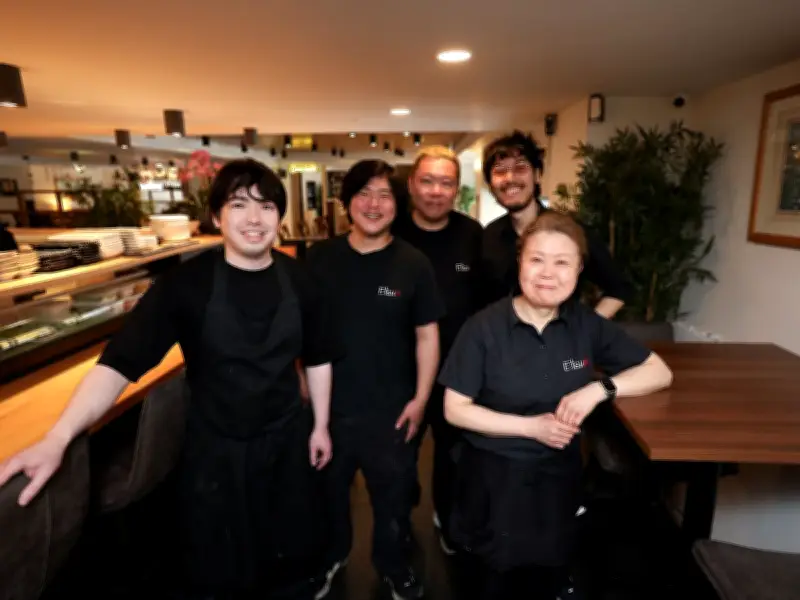
One of Liverpool's most highly decorated dining spots has revealed why it won't serve chips as it stays true to a near 20-year-old mission. Today, Etsu, the Japanese restaurant located in Beetham Plaza, needs no introduction, especially to those who are fans of sushi. However, when it first launched in November 2007, this wasn't the case.
The Story Behind Etsu
The restaurant is the brainchild of David Abe, who is originally from West Derby but is half-Japanese on his dad's side. Takuji originally came to Liverpool in 1967 to work in mental health for the NHS, before becoming one of the first qualified Beatles guides and eventually falling in love with David's mum, Norma, a nurse at Newsham Park Hospital.
David, 47, worked as an auditor for years, but it was an idea during a pint and a catch-up with his friend Hiro that changed the trajectory of his life. The two shared a few beers, just as they had on countless occasions before, when the conversation turned to dinner. Hiro asked David if there was an authentic Japanese restaurant in Liverpool. David's answer was simple: there wasn't one. David said Hiro paused for a moment before asking a question that would change everything: "Why don't you open one yourself?"

What had started as a casual remark slowly became ambition. Over the next 18 months, David immersed himself in Japanese food, culture and hospitality, dedicating himself to learning everything he could about authentic Japanese cuisine, determined to understand not only the techniques but also the traditions and values behind it.
Staying True to Tradition
In 2007, David took the leap. He secured a space with a clear vision: to never simply serve sushi but to bring a genuine piece of his dad's home country to the city. He told the ECHO: "Eighteen or 19 years ago, Liverpool's restaurant scene was very different. We were breaking down barriers by introducing sushi and authentic Japanese food to the city. When we opened, we knew the odds were against us. I think the statistic was that two out of three restaurants fail within their first year, so while we hoped it would succeed, there were no guarantees. We often say we opened the restaurant because we wanted the food ourselves and nobody else was doing it. It really was as simple as that."
"Because of my Japanese heritage, it was important to do things properly. We wanted to stay true to traditional Japanese cooking rather than adapting it just to suit the Western market. One of the biggest reasons we've lasted is that we've always stuck to our principles. We've focused on using the best ingredients we can find and staying as authentic as possible. We've never done chips or anything like that, no matter how many times it was asked. We wanted the food to taste as it does in Japan, and then let that speak for itself."
Evolution and Innovation
David said the restaurant has constantly evolved over the years and has been, as he claims, at the forefront of many new trends. Whether that's bao buns, matcha lattes or other dishes that people hadn't really seen here before, David said he prides the team on being "innovators rather than imitators". He added: "When we first opened, only about 10 to 15% of our orders were sushi. Back then, people often assumed Japanese food just meant raw fish, so we had to show there was so much more to it. Now sushi makes up well over half of what we sell on many nights. It's been amazing to see how much people's tastes have changed over the years."
Those behind some of the restaurant's most popular dishes are chefs Yuhi Muto and Adrian Storey. The latter, from Kobe, a stylish, cosmopolitan port city in Japan's Kansai region, has worked at the restaurant for seven years. He said: "Sushi has gotten so popular, with rice being our key ingredient. We make our own vinegar using a special recipe, and that is a big part of it. Recently, the weekends have been very busy for our sushi. That is what we want."

The 32-year-old, who now lives in the city centre, came to study mathematics at the University of Liverpool. This weekend, while on shift, he will also be keeping an eye on his home country as they face Tunisia in the second round of the group stage matches at the 2026 World Cup. He added: "This Sunday, we are playing against Tunisia, but we drew against the Netherlands and to get a last-minute goal was really good. It was a big point for us. Hopefully we can do the same with Tunisia. I watched the first match in a bar with quite a lot of other Japanese people. It was good to all come together. There isn't much for us, but it makes you miss home. I think Sunday will be 2-0 to Japan."
Co-worker Yuhi Muto has gone even further and said he thinks Japan will hit three goals in the back of the net and concede none. The 27-year-old, from Nagoya, Japan's fourth-largest city and the industrial heart of the country, added: "I'm so happy with how Japan has gone so far. I hope they can get past the final eight - something they have never done before. This is Japan's year."
Yuhi came to Liverpool on a working visa, one that is about to run out. Since 2024, he has found a home towards the top of Bold Street, near St Luke's Bombed Out Church. He said: "I will miss Liverpool when I go home. I am happy to go home but sad to leave Liverpool. The Scouse accent is hard for me to understand but I love it. Everyone is so friendly here. Before I went home, my friend told me I needed to try Scouse. I had it for the first time at The Railway (Tithebarn Street). It was so f****** good. It is very strong-tasting and I was able to have a beer with it."
Award-Winning Success
It is team members like Yuhi and Adrian Storey, among a number of others, who have contributed to Etsu's award-winning success. It has previously won the UK's greatest Japanese restaurant and Restaurant of the Year. Founder David said: "I worked as an auditor for about 10 years. It was a secure career, but Hiro encouraged me to take the risk while I was still young enough to do it. We borrowed money from the bank, from my dad and from a few other places to get started. We pretty much spent everything getting the restaurant open. Then, just a few months later, the financial crisis hit in 2008. The first couple of years were incredibly tough and it would have been easy to give up. Passion probably got us through those early years more than anything else. When you really believe in what you're building, you find a way to keep going and I am so glad we did."