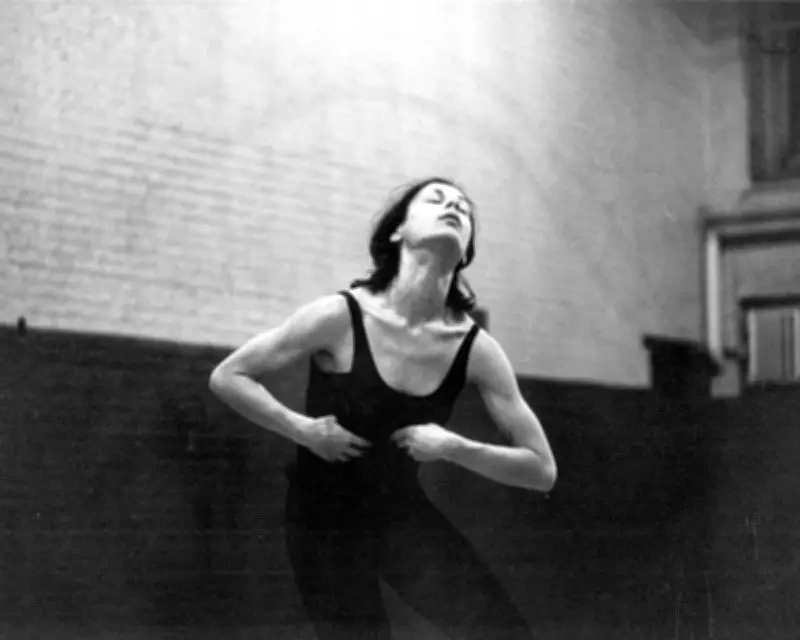
At the back of Tate Modern's Turbine Hall, three people are dancing. Without the vinyl floor and a white line separating them from the audience, you might mistake their movements for an idiosyncratic Tai chi session or, on a different dancefloor, the effects of too many drugs. One rolls on the ground, another stretches arms wide, a third sinks to her haunches and touches her toes. They appear so absorbed in their own actions that they seem oblivious to each other and the audience.
Audience and Atmosphere
On a Friday afternoon, the audience includes art school kids in casual fashions, babies screeching from pushchairs, and schoolkids shouting from the mezzanine. The dancers remain unperturbed. After completing her routine, one dancer walks offstage and disappears through a door; the others follow in their own time. The audience applauds, and a new trio replaces them, beginning the dance again.
The Revolutionary Trio A
Yvonne Rainer's Trio A is one of the most influential works from New York's cultural renaissance between the mid-1950s and mid-1970s. The Tate staging marks the 60th anniversary of its first recital, performed by Rainer alongside David Gordon and Steve Paxton. The work introduced everyday movements into choreography, stripping dance of traditional theatricality—a revolutionary moment that is quietly thrilling to observe.
Each performance lasts about five minutes. If you join halfway, you might think the dancers are improvising, so naturally does each pose follow the last. A second viewing reveals they follow strict choreography—the same choreography—but execute it at their own speed, falling out of sync. Each performer is licensed to move at a tempo that feels appropriate, so some hold poses longer or transition faster. Idiosyncrasies emerge across dancers of different ages and body types.
Rainer's Innovation
Rainer removed psychological drama by insisting performers disregard the audience and each other. The result is a trio acting out precise instructions for no one's benefit but their own. One dancer is languid, another has snap; expressions vary from defined to lyrical. This recalls 18th-century portraits of sitters absorbed in activities—playing a guitar or reading—rather than meeting the viewer's gaze. The idea that we are defined by inner lives, not appearance, is quintessentially modern. Rainer extends this principle to dance: these dancers are not performing for you, yet they remain compelling.
Hypnotic Experience
The experience is hypnotic, especially with repeated viewings afforded by Tate's looping performance over several hours daily. The choreography distributes action evenly; no pose holds greater weight, there is no climax or lull, no triumph or tragedy. It resembles the trancelike music of Philip Glass, another great artist from the same New York scene.
Observing highly trained humans concentrating on executing physical instructions, with varying precision or elegance, feels like a privilege. That this is freely available to anyone in London without exorbitant entrance fees—which elsewhere transform museums into leisure centres for the rich—is to be cherished. Over two hours, the audience drifts in and out as dancers move and change. It feels appropriate that the dancers are allowed to get on with their solitary business as the world revolves around them.