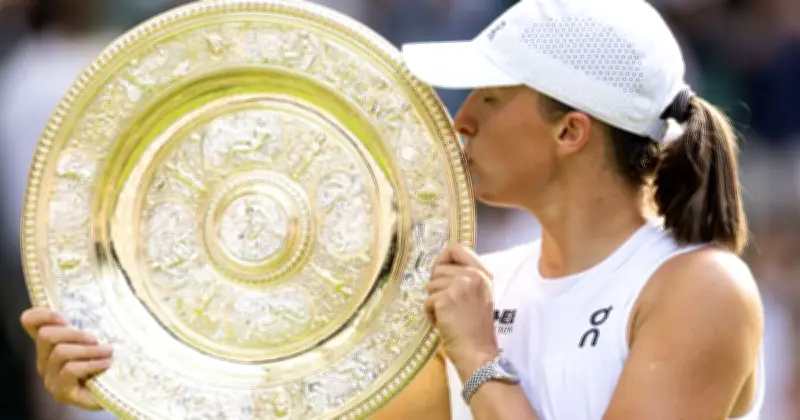
The Wimbledon women's singles finalists will compete for the iconic Venus Rosewater Dish. This Saturday, an all-Czechia showdown takes place on Centre Court as Karolína Muchová faces Linda Nosková for the prize.
How the Trophy Got Its Name
Officially catalogued by the All England Club as the Ladies' Singles Challenge Plate, the trophy earned the "Rosewater Dish" part of its famous moniker from an ancient English post-meal handwashing ceremony. This domestic connection was originally highlighted to blend practical heritage with Victorian prestige, yet the "Venus" portion of the nickname arose purely by accident when nineteenth-century observers misidentified the central figure.
History of the Dish
Manufactured in 1864 by Elkington & Co. of Birmingham, this silver prize is a precise electrotype reproduction of a 16th-century Renaissance pewter basin currently housed in the Louvre museum. The historic trophy was first presented on the lawns of SW19 in 1886 to champion Blanche Bingley, though tournament officials retroactively added the name of the inaugural 1884 winner, Maud Watson, to ensure the lineage was complete.
Underlying Mythological Theme
Because the platter is a direct copy of a classical European antique, its intricate decorative scheme has absolutely nothing to do with modern lawn tennis or the sport's origins. Instead, the entire thematic focus of the piece is completely devoted to ancient Roman and Greek mythology, which is exactly why early organisers mistakenly associated its name with a beloved classical deity.
Details of What It Depicts
The elaborate design features a prominent central boss containing four distinct reserves that showcase classical gods personifying the elemental forces of earth, air, fire, and water. Furthermore, the beautiful outer rim is meticulously adorned with an intricate rendering of the goddess Minerva presiding over the Seven Liberal Arts, which notably include geometry, astrology and grammar.
Philosophical Message
Beyond its striking aesthetic appearance, the detailed engraving on the silver platter serves as a profound visual tribute to the classical virtues of self-restraint and discipline. Rather than celebrating fiery passion, romantic desire, or athletic triumph, the physical artwork explicitly champions temperance and intellectual wisdom as the ultimate human ideals.
Awkward Mistake
The historical blunder attached to the name is that the Roman goddess Venus is absent from the artwork, as the central figure is actually Sophrosyne, the Greek personification of temperance. Victorian-era silversmiths or early All England Club organisers completely misidentified this central female figure holding a lamp and a jug, leading to over a century of mistaken identity.
Dimensions, Weight and Cost
The partially gilded sterling silver salver has a diameter of exactly 18.75 inches and carries a physical weight of 2.3 kilograms. The All England Club originally purchased this remarkable piece for a modest sum of 50 guineas, which stands in contrast to its immense historical and material value today.
Engraving and Replica Versions
The names of champions from 1884 to 1957 are inscribed on the inside of the dish, whereas winners from 1958 to the present day are engraved on the outside. Although the original trophy remains safely locked in the club's museum, the victorious player is awarded a 14-inch, three-quarter size replica including all past winners' names to keep.