Penelope Keith, the formidable actor known for playing brittle, status-obsessed characters, died this week at the age of 86. Her most memorable role was Margo Leadbetter in the 1970s sitcom The Good Life, whose command of a room depended as much on her diva-level wardrobe as on her pristine home counties vowels. From the first sight of Margo in a screamingly loud chiffon tangerine kaftan, it was obvious she was the one to watch for her style.
Costume Budget and Shopping Habits
In the 2025 documentary The Good Life: Inside Out, now on Apple TV, Keith explained that most of the series' costume budget went on Margo because of her frequent outfit changes. Keith spent Mondays, her only day off, in Harrods and occasionally Harvey Nichols trying on pieces. She recalled, "All those hours in there I spent, trying on those lovely floaty clothes."
Acid Brights and Color Television
As a child of the 1970s, I remember my grandmother remarking on the marvel of color television. The BBC and ITV began broadcasting in full color in 1969, and not all families had switched by the time The Good Life aired from 1975 to 1978. Margo was resplendent in acid brights like orange and yellow and jewel shades like turquoise and amethyst, which made a splash on color TVs. The clash with the muted wardrobe of other characters worked even in black and white. The visual contrast between glitzy Margo and humdrum Barbara, played by Felicity Kendal, was central to the show. While Margo dressed up even for tradesmen, Barbara wore jeans and old shirts. Despite Margo's style, Barbara was often considered "the sexy one," winning the inaugural Rear of the Year award in 1981. Margo's rear was shrouded in mystery, which perhaps made her a style icon in the end.
Maxidresses and Kaftans
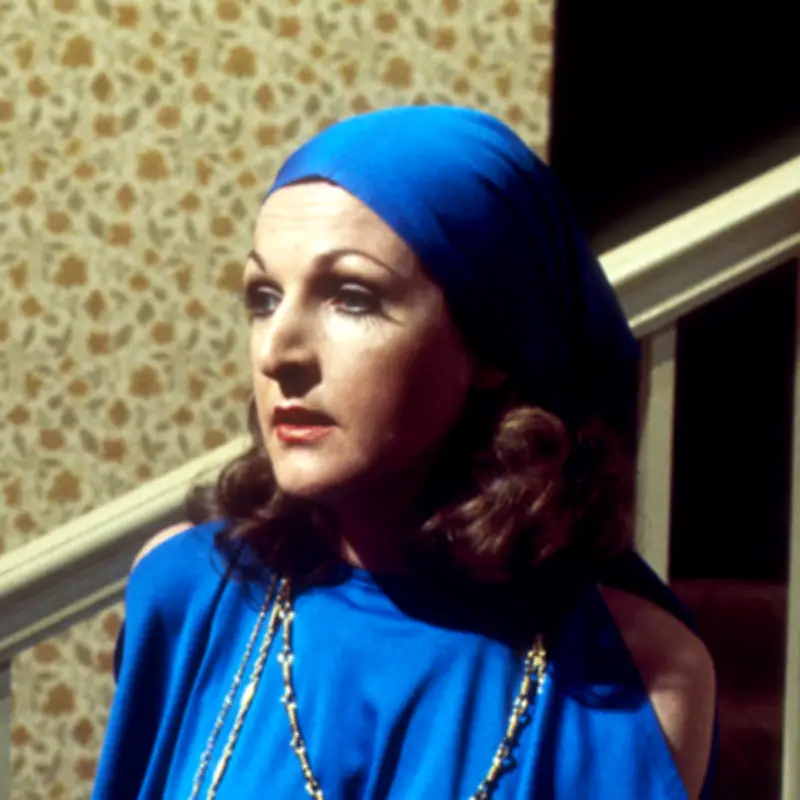
Margo's signature style was the maxidress or kaftan. An electric blue dress used for a single phone scene was by Frank Usher; many others were Harrods' own label. Keith noted, "I don't think I would have worn them. But Margo loved them." One dress, a white silk kaftan with pink print, was Keith's own. This look influenced Beverly in Abigail's Party (1977), requiring one to waft into a room with cheese and pineapple bites, though Margo would likely regard them as common.
Rock-Solid Grecian Hairdo
Margo had wonderful 1970s hairdos, typical of women using Carmen heated rollers. Barbara's hair was air-dried and free-flowing, ideal for milking the goat Geraldine. Margo's hair barely moved; for social events, it was heavily lacquered and styled in an elaborate Greek goddess look to match her kaftans. In real life, Keith had no-nonsense hair and found Margo's upkeep exhausting: "My hair changed four to five times every episode, which for 25 minutes was quite a lot of time spent in hair and makeup."
Headbands as Conformity
Despite the 1970s festival culture, Margo was not a festivalgoer. She wore headbands not to celebrate counterculture but to conform, finishing an outfit or showcasing matching fabric. In one episode, she appeared in a full leopard kaftan with matching headband, which later reappeared with other outfits. This may be the true origin of leopard as a neutral.
Country Weekend Separates
Over four series, Margo wore separates and sporty outfits, including jodhpurs and a tracksuit in an episode filmed live before Queen Elizabeth II. Her off-duty uniform included tweed skirts with camel polo necks, Missoni-adjacent co-ords, and slacks. This style informed Keith's next character, Audrey fforbes-Hamilton in To the Manor Born (1979-1981). If Margo was a psychedelic Margaret Thatcher, Audrey was dressed-down Maggie with camel wrap coats and tweed waistcoats. Diana, Princess of Wales channelled the same look on her 1981 Balmoral honeymoon.
Jolly Game Gal Headwear
Margo had various hats for gardening and public occasions like meetings of the Surbiton Ladies Conservative Association. She wore hats not to stand out but to fit in. A sou'wester or Christmas paper hat showed her desperation to prove she was "game for a laugh." This was social commentary: within a few years, hats were no longer essential in public settings. Margo represented the last of a dying breed. RIP, great lady.