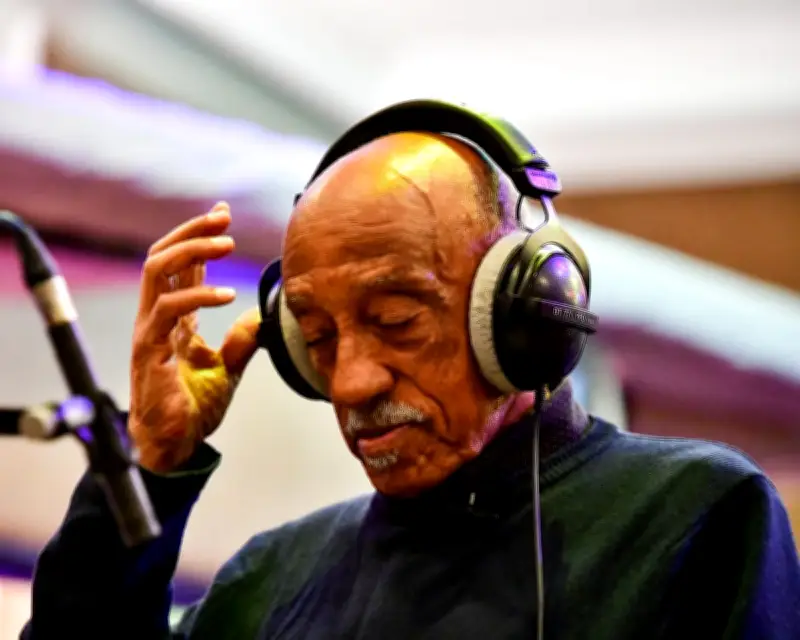
The 82-year-old father of Ethio-jazz, Mulatu Astatke, recalls his early days in London's 1960s jazz scene, where he befriended Ronnie Scott and saxophonist Joe Harriott. After innovating a new genre blending Ethiopian scales with jazz and Afro-Latin rhythms, he faced rejection upon returning to Addis Ababa. 'Stop,' he was told during one performance. 'No more!' He bowed and walked off, vowing, 'One day, I'll come back and show you.'
From rejection to global acclaim
Decades later, audiences worldwide have embraced his music. Days after his June performance at London's Royal Festival Hall, expected to be his last in the UK, Astatke reflects on the journey. 'Ethio-jazz is a beautiful science,' he says, describing the fusion of pentatonic Ethiopian scales with western jazz and funk, layered with traditional instruments like the krar, masenqo, and kebero, as well as religious chants dating to the fourth century.
Early life and musical formation
Sent to a boarding school in Wrexham, north Wales at 16 to study aeronautical engineering, Astatke picked up the trumpet and was encouraged toward music. He later studied at London's Trinity College of Music and Boston's Berklee College of Music, where he became its first African student. In the late 1960s, he shuttled between New York, where his Ethiopian Quintet recorded Afro-Latin Soul 1 & 2, and Addis Ababa, recording for Amha Records. 'I really wanted to be different, I wanted to be myself, I wanted to be Mulatu,' he says. 'Once I created Ethio-jazz, I became myself.'
Golden age under Selassie and beyond
Returning to Addis with his own vibraphone and electric keyboards, Astatke found a golden age of nightlife under Emperor Haile Selassie. In 1973, he performed with Duke Ellington, who told him he 'never expected this from an African.' Ellington loved the Ethio-jazz. The era ended when Selassie was deposed by a Marxist regime in 1974, leading to a repressive period. Astatke is reticent about politics: 'I have no involvement with the military, I have no involvement with politics... I live peacefully. That's how I survive.'
Honouring indigenous roots
Astatke insists on giving credit to Ethiopia's indigenous communities, whom he calls 'bush people.' He notes that the Derashe tribe in southern Ethiopia uses diminished scales similar to those of Charlie Parker. 'Who is first? Is it Charlie Parker or this tribe?' he asks. He compares the masenqo to the cello, and points to similar pentatonic scales in Japanese music, questioning who created them first. He recalls students at an Ethiopian university who could not name local mountains but knew German and Russian composers. 'We don't do any research, we go more to Europe instead of doing research on African people,' he says.
Ongoing projects and legacy
In the 1990s, Astatke visited indigenous communities—the Derashe and the Anuak in Gambella—where he was welcomed and stayed in huts. 'The bush people created Mulatu,' he says. His manager shows videos of performances with these communities. Astatke plans to return to Addis Ababa, where his African Jazz Village, opened in 2013, continues to spotlight local musicians. His next album will feature musicians from 'the bush' and Addis, though it remains unnamed. 'Promoting Ethiopia, promoting our cultural people to the world, that's what makes me so great and happy,' he says. 'It took me years and years, but finally we made it.' His final words: 'Give respect to Africa, and the bush people.'