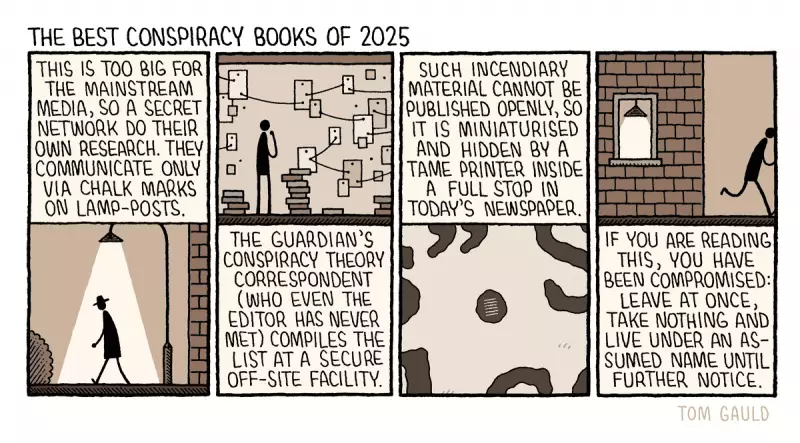
Acclaimed cartoonist and illustrator Tom Gauld has turned his distinctive eye to the literary world of shadowy plots and hidden truths with a new cartoon for The Guardian. The single-panel illustration, published on Sunday, 7th December 2025, provides a humorous and insightful overview of the year's most prominent conspiracy theory books.
Decoding the Year in Conspiracy Literature
Gauld's cartoon acts as a visual digest of the genre's key trends and offerings from 2025. His signature minimalist style and dry wit are deployed to categorise and gently satirise the various tropes and subjects that have captivated readers fascinated by alternative narratives. The work is presented as part of his regular contribution to The Guardian's books section, where he frequently distills literary themes into sharp, engaging comics.
The illustration itself is the core content of the piece. It features a curated selection of fictional book titles and covers, each representing a different strand of contemporary conspiracy thought. Through this fabricated catalogue, Gauld comments on the nature of the genre, the recurring patterns in its storytelling, and its enduring place in popular culture. The date of publication, 7th December 2025, firmly anchors the cartoon as a year-end review of that year's publishing output in this particular niche.

The Artistic Lens on Hidden Truths
Tom Gauld is renowned for his intellectual yet accessible cartoons, often exploring the worlds of books, publishing, and academia. His approach in this piece is not to promote any specific theory but to observe the phenomenon of conspiracy literature as a cultural artefact. The cartoon invites readers to reflect on why certain narratives gain traction and how they are packaged and consumed.
By presenting this overview in a graphic format, Gauld makes a potentially dense and controversial subject immediately approachable. The visual medium allows for layered humour—both in the invented book titles and in the subtle details of the artwork itself. This aligns with his established reputation for finding the comedy and humanity in specialised, sometimes opaque, subjects.
The piece serves as both entertainment and a soft critique, offering a moment of shared recognition for readers familiar with the genre's conventions. It underscores how illustration and cartooning can be powerful tools for cultural commentary, capable of condensing complex ideas into a single, impactful image that resonates with a broad audience.