
The Wildlife Photographer of the Year 2026 competition has announced its winners, with Federico Veronesi of Italy taking the overall title for his powerful image of an elephant carrying a dead calf. The winning photographs will be showcased at the Natural History Museum in London from 16 October 2026 until July 2027.
Overall Winner and Behaviour: Mammals
Veronesi's winning image, titled "The Aftermath," won the Behaviour: Mammals category. He witnessed the elephant carrying a dead calf, a rare glimpse into complex animal behaviours. Veronesi was tracking elephants when he came across an unusual pattern of drag marks in a dry riverbed in Namibia. A female emerged with the calf, its leg wedged between her tusk and trunk. Behaviours centring on death have been observed in Asian and African elephants, including vocalisations, guarding the dead, inspecting and handling bones, and carrying the deceased.
Category Winners Across the Natural World
Michał Michalski of Poland won the Natural Artistry category with "Escape Artistry," using a slow shutter speed to create the illusion of trees still swathed in autumn foliage. A field of unharvested sunflowers had attracted mixed flocks of birds, especially goldfinches and bramblings. As they took to the sky, startled by a sparrowhawk, Michalski blurred the movement against a backdrop of leafless birches.
Alex Visbal of Colombia won Wetlands: The Bigger Picture with "The Great Divide," documenting how a single engineered line can reshape an entire wetland. The distinctive pink colour on the left is caused by microbes that thrive in extremely saline water, which happens when an area is cut off from a supply of fresh water. The ecology of the lake in Utah is in sharp decline due to industrial use, upstream diversions and climate change. Since the image was taken, the state has brought the area under conservation management.
Agorastos Papatsanis of Greece won Plants and Fungi with "Shedding Light," using ultraviolet light to reveal the glowing yellow stems of 'beautiful bonnet' mushrooms growing from a decaying log. On the lower slopes of Greece's Mount Olympus, he experimented with UV illumination until it revealed the strongest fluorescent response from the mushrooms.
Alex Lindbloom of the US won Oceans: The Bigger Picture with "Night-Time Catch," finding a whale shark investigating the catch of a bagan, or mobile net-fishing platform, in the inky waters off Papua. He started searching for sharks around dawn when the nets were still in the water. Initially lacking natural light for his drone's camera, he found these sharks illuminated by the bagan's bright lights.
Aaron Sanders of the UK won Animal Portraits with "A Watchful Eye," glimpsing a common octopus behind a curtain of kelp in the waters off Cornwall. Sanders had been diving off Porthkerris Beach when he noticed the footprints of octopus suckers through a thin blade of kelp, and a single eye slowly emerging. 'We remained perfectly still, watching one another with a seemingly shared curiosity,' he says.
Sitaram Raul of India won Behaviour: Invertebrates with "Shifting Sand," encountering a scorpion burrowing into one of the shifting dunes of the Thar desert. Exploring the dunes at night, he saw many scorpions searching for prey. As sunrise approached, they started burrowing to avoid the intense heat. Raul timed the exposure so that the excavated sand was suspended in mid-air.
James Lewin of the UK won Animals in their Environment with "The Meeting Place," watching a young bull elephant spray a group of zebra as they congregate in Kenya's Chyulu hills. He chose to soften the harsh light using a camera converted to infrared, creating a dream-like scene.
Young and Rising Star Awards
Alexis Tinker-Tsavalas of Germany won the Rising Star Award with "Afternoon Snack," revealing the exquisite beauty of a robber fly that had impaled a flesh fly with its needlelike mouthparts. The bubbles forming in the victim's eyes indicate that the robber fly has injected digestive enzymes that liquefy its internal tissues before they are sucked out.
Kutub Uddin of Bangladesh/UK won the Portfolio Award with "Secret Worlds," revealing a magical and often surreal world of slime moulds. In the image "Tiny Dancers," an immature Cribraria aurantiaca is at a tiny and often overlooked stage in its life. Uddin became interested in slime moulds in 2024 and devotes much of his time to revealing this hidden world, exploring his local woodlands in West Sussex.
Francisco Negroni of Chile won Photojournalism with "Warning Sign," recording a dead puma tied to a fence and presented as a hunting trophy in Patagonia. The province of Santa Cruz in Argentina banned the hunting of pumas in 2025, but illegal persecution continues. Livestock predation is one of the major causes of human–puma conflict, and it's suggested that enclosing sheep at night and using guard dogs can significantly reduce the loss of livestock without resorting to hunting.
Konrad Gräeter of Germany won the 15-17 Years category with "Birdsong Painted in Light," highlighting a male blackbird singing in a vineyard early one April morning. He had to crouch down low on the steep slope of the vineyard and point his camera through a gap in the foliage to frame the blackbird within its landscape.
Anton Sorokin of the US won Behaviour: Amphibians and Reptiles with "Protective Pose," finding a California newt laying its eggs as it clasps vegetation that already holds another newt's egg clutch. The newts interlock their back feet to protect the clutch, which is vulnerable to predation by other newts.
Oscar Whitfield of Zimbabwe/UK won the 11-14 Years category with "Labour of Love," noticing the arduous exertion of a dung beetle pushing its precious cargo. Breaking up dung and burying it prevents the conditions required for methane production, reducing the quantity of greenhouse gas emissions.
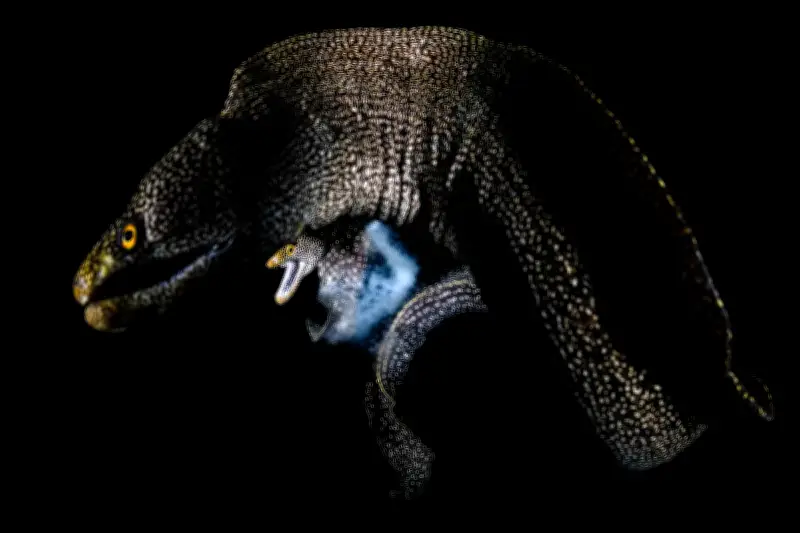
Tony Wu of USA/Japan won Under Water with "Making Morays," providing a first-time glimpse into the mating ritual of two Abbott's moray eels at the apex of their spawning arc. This is likely the first time the courtship and spawning have been documented, and observations from Wu's work with biologists are feeding into published scientific studies.
Isak Pretorius of South Africa won Behaviour: Birds with "Scenes from the Swamp," chancing upon two elusive shoebill storks among wetland vegetation. Fewer than 5,300 mature shoebills survive across their entire range and their numbers are decreasing.
Loren Elliott of the US won the Photojournalist Story Award with "Wily Coyotes of San Francisco," opening a window into the lives of the often-misunderstood coyotes living in the environs of San Francisco. About 100 of these urban-adapted wild canines live alongside more than 800,000 human inhabitants.
Seth Forestson of the UK won Urban Wildlife with "Urban Jungle," spotting a common water monitor carrying its fish supper in a Bangkok park. Common water monitors have successfully adapted to living in cities across south and south-east Asia.
Amelie Davis of the UK won the 10 Years and Under category with "Flight of the Bumblebee," highlighting a common carder bee suspended in mid-air as it flies in to land and feast on a flower in Surrey. Without her camera, she borrowed her dad's smartphone and was able to record the delicate detail of a single wingbeat.




