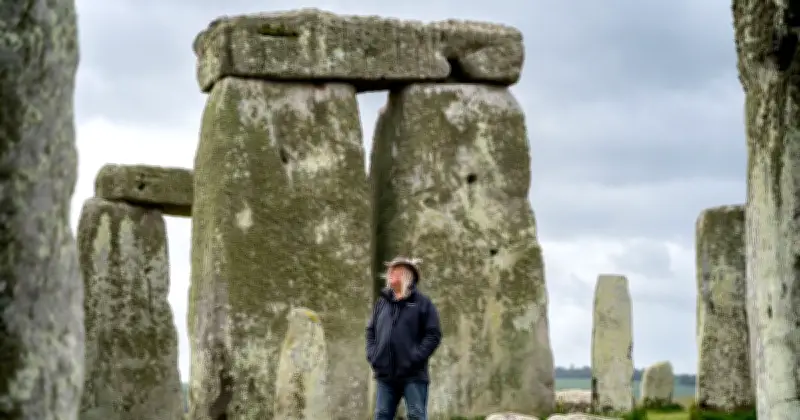
An archaeological team has made a groundbreaking discovery near Stonehenge that rewrites everything known about the famous attraction. The ancient rocks at Stonehenge are among the most famous tourist attractions in the UK, drawing thousands annually from around the world. The summer solstice celebrations on June 21 will see countless people flocking to the site in Wiltshire to witness the sun rising behind the Heel Stone.
Discovery of a Lifetime
A team from Wessex Archaeology, led by Phil Harding, has announced the discovery of an ancient structure just 5 kilometers from Stonehenge. This find may rewrite our understanding of the ceremonial landscape. The structure, radiocarbon dated to roughly 5,000 years ago, shows evidence of the earliest known alignment with the solstice in the area, predating Stonehenge by 500 years.
The Astonishing Find
Located in Bulford, Wiltshire, the site is contemporaneous with the earliest phase of Stonehenge. Unearthed as part of the Ministry of Defence's Army Basing Programme, it likely served as a focal point for religious gatherings, with evidence of feasting and large-scale public celebrations of the solstices.

Phil Harding stated: "In a few days, Stonehenge will be filled with people celebrating midsummer solstice. But few realize that 5,000 years ago on a nearby hillside, people were doing the same thing—revering the sunrise on midsummer's day. This discovery is one of the greatest of my career."
Structure and Significance
The find centers on two wooden poles positioned 120 meters apart, aligned to point directly at the rising sun during the summer solstice and the setting sun during the winter solstice. Today, only the pits remain, but their alignment was verified by skyscape archaeologist Dr. Fabio Silva using ancient sky reconstructions, showing alignment within a single degree of accuracy.
This modest construction served as a gathering place before more elaborate monuments were built. Researchers suggest a similar structure may have existed during Stonehenge's earliest phase but was likely destroyed by later construction. Excavations at Bulford between 2015 and 2017 uncovered 48 pits dated to around 2950 BC, containing pottery, animal bones, flints, and charcoal, indicating large congregations.
Why It Changes Everything
Dr. Matt Leivers of Wessex Archaeology said: "The discovery at Bulford is fundamental because it's the earliest example of people building things here that aim directly at the solstice. When we talk about the solstice, we're talking about religion—how prehistoric peoples understood the cosmos."
Dr. Fabio Silva added: "This discovery helps us understand Stonehenge not as a singular creation, but as part of a longer conversation between people, the land, and the sky. The alignment shows communities engaged with solstices centuries before the sarsen stones were raised."
The site was found during excavations south of the Salisbury Plain Training Area ahead of housing construction for military personnel. Richard Osgood of the MoD's Defence Infrastructure Organisation remarked: "When we started excavations, none of us could have guessed what we would find. This has completely rewritten our understanding of the ceremonial landscape around Stonehenge."