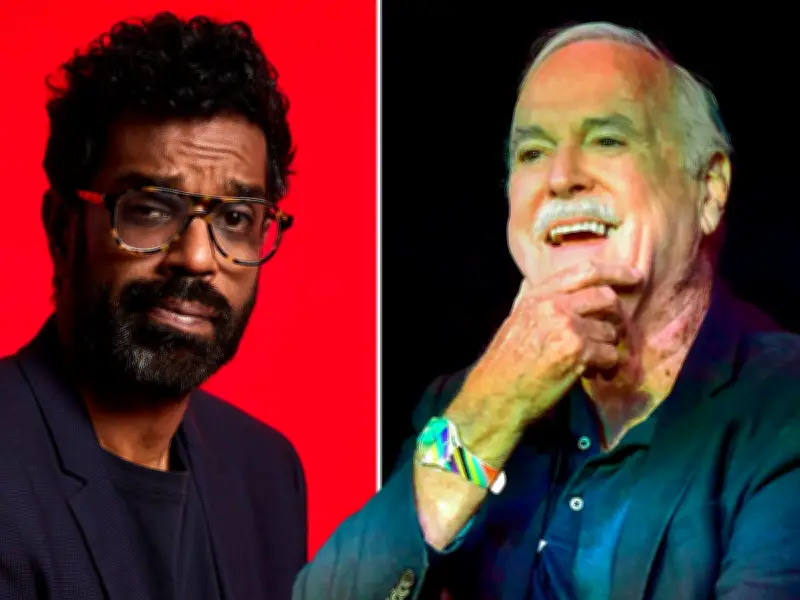
Forty years after John Cleese stood in a pub and asked what the BBC had ever given us, Romesh Ranganathan fronts a re-imagined version of the campaign for a new generation. The three-minute promotional film, debuting tonight during the World Cup final, features 90 famous faces and aims to showcase the value of the BBC as licence fee sales fall and charter renewal looms.
Romesh Revisits the Question
Romesh starts in Walford's Queen Vic pub, where Chris Martin is on the piano, sparking a song. “Sure it’s great if you’re a fan of Ian Beale or if The Traitors has any appeal,” he says as Claudia Winkleman and Pudsey Bear appear, noting the BBC raises £2.5bn for charity. “But what has the BBC ever done for me?”
As he emerges into Albert Square, where Alan Carr plays the EastEnders duff-duffs on drums, Romesh remembers the BBC introduced the nation to “someone called Adele.” When Ruth Jones mentions her admiration of BBC Radio Cymru, he retorts: “Yes, but I live in Crawley, how does that benefit me?”

A Journey Through BBC Programmes
Admitting there are shows he “wouldn’t dare to belittle,” he finds himself shot at by angry Daleks from Doctor Who and on a hospital trolley inside Casualty’s Holby General. Finding Black Ops star Gbemisola Ikumelo in an interview room, he demands: “While you’re giving your suspect the third degree - ask them, what has the BBC ever done for me?”
Arriving in a school where a whole class tells him “BBC Bitesize helps kids learn,” he sniffs: “I’m 48, why’s that my concern?” In the newsroom, he claims not to care if BBC News journalists “verify news thoroughly.”
Stars Point Out His Own BBC Work
Anchor Clive Myrie, Radio 2’s Sara Cox and comedian Chris McCausland point out that Romesh himself presents The Weakest Link, has a Radio 2 weekend show and fronts a hiphop podcast on BBC Sounds. But he’s not finished: jumping onto a moving camera, he insists Mary Berry, Glastonbury, Graham Norton’s sofa and the Gladiators mean nothing to him. He is similarly dismissive of BBC radio stations, Wimbledon, natural history shows and CBeebies.
He acknowledges “they do a lot of British storytelling” as he stumbles into a scene with Call the Midwife’s Jenny Agutter and Helen George. He’s told he’s “fired” as he says “stuff The Apprentice” along with Match of the Day.
Louis Theroux Delivers the Climax
He is finally brought up short by Louis Theroux, who grasps a big on-off switch. “You know none of this has to exist if we don’t want it to,” Louis tells him. Romesh backtracks, mumbling: “Well, no look, I’m not saying that…” Handed a folder, he informs viewers: “It says here the money we pay for the BBC creates over £6.5bn for the economy - which actually sounds pretty good.”
He finishes on the Strictly Come Dancing floor; as the pros twirl, he repeats: “But what has the BBC ever done for me?” Judge Anton du Beke answers: “Strictly?” but is given short shrift.
Comparison to the 1986 Original
In the 1986 original, John Cleese posed almost the same question, answered by Sir David Attenborough, Sue Lawley, Alan Whicker, Sir Terry Wogan, Moira Stuart, Sir David Jason and Sir Bob Geldof. Then a licence fee cost £58, which Cleese called “diabolical.” Four decades on, the two Sir Davids both feature again: Attenborough’s voice highlights natural history, while Only Fools and Horses star Jason appears in person. Others in the 2026 version include Cate Blanchett, Clare Balding, Paul Merton, Gloria Hunniford, Greg James, Anita Rani, Stacey Solomon, Nick Robinson and Michaela Strachan, along with many Strictly pros and half the EastEnders cast.
Behind the Scenes and Context
Kerrie Bright, the BBC’s Chief Customer Officer, said the six-day shoot was a challenging feat. “As Romesh travels through some of our most iconic programmes, sets and studios, he encounters 90 familiar faces, each helping to answer that question in their own way. And while the finished film lasts only a few minutes, bringing it to life was quite an undertaking. How do you coordinate nearly 100 celebrities across a six-day shoot, taking over everything from the Queen Vic to BBC News? The honest answer is: with a lot of planning, a lot of spreadsheets and a lot of patience.”

Last week the BBC’s annual report revealed that more than 500,000 people have stopped buying a TV licence, following more than 300k last year. Bright said the campaign aims to remind people of the BBC’s value. “Forty years after the question was first posed, we're asking it again. And as Romesh discovers, the answer isn't any one programme, service or personality. It's millions of moments that inform, educate, entertain and bring people together.”
She added that the BBC contributes £6.7 billion to the UK economy and supports more than 79,000 jobs. “As the UK's largest single investor in original content, we help support creative businesses, freelancers and production talent across every nation and region of the UK. These contributions aren’t often talked about with audiences - we want to ensure the BBC gets credit for the fundamental impact it has on society, as well as the things it makes.”