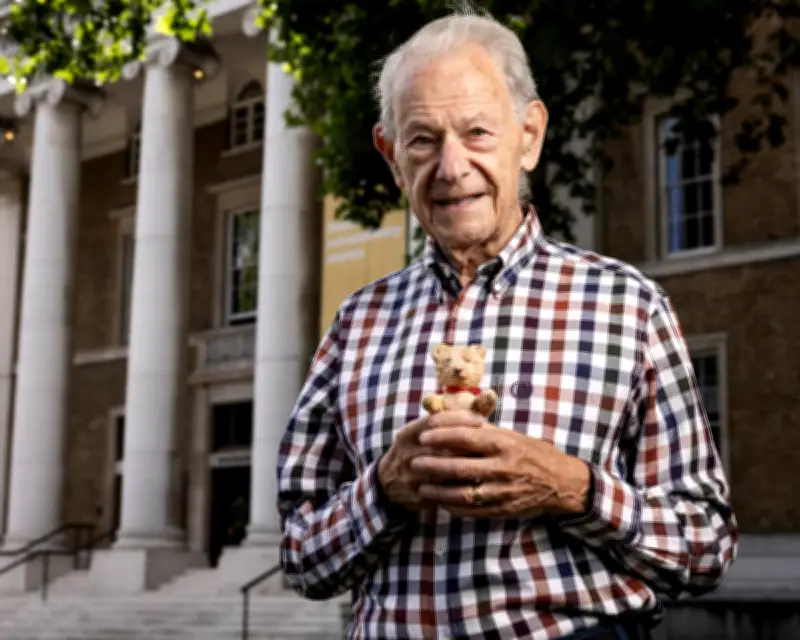
John Hajdu, now 89, was three years old when his parents gave him a small teddy bear. Eight decades later, that bear is the only surviving object from his childhood. From 31 July, it will go on public display for the first time at the Imperial War Museum (IWM) in London, as part of a new exhibition titled Childhood in War.
The exhibition examines how conflict shapes children’s lives, combining hundreds of objects with immersive environments. Visitors can explore a recreated Second World War bedroom, a full-size railway carriage, a wartime classroom, and a Cold War living room and kitchen. Testimonies from children living through conflicts in Ukraine, Sudan, Afghanistan and elsewhere accompany the displays.
Hajdu’s Story: A Childhood Interrupted
Before the war, Hajdu’s family was well-to-do and middle-class Jewish. By 1944, after years of antisemitic persecution in Hungary, his father was sent to a labour camp. Hajdu and his mother were forced into a designated yellow-star house. “We could only take with us what we could carry, and that meant just a few pieces of clothing and teddy,” he says. “There was absolutely no chance of being a kid. I had no other toys or books. We were only allowed out in the afternoon wearing the yellow star. I couldn’t meet other children. We weren’t allowed in parks, cinemas or swimming pools or cafes. I was completely isolated.”

In October 1944, Hajdu’s mother was arrested and taken to Mauthausen concentration camp in Austria. Believing she would never return, his aunt rushed him into the cupboard of a non-Jewish neighbour. “I had teddy in my pocket,” he recalls. “I was in complete darkness and had to keep completely quiet. It seemed like a very long time, which was an incredibly frightening experience for a seven-year-old.”
He later moved with his aunt into the Budapest ghetto, sharing a flat with more than 20 strangers. “There were no children. We survived on horse meat and bread. Dead bodies lay piled up on the streets, having died of cold, starvation or disease. I was always hungry. Again, I had teddy in my pocket.”
Liberation and Reunion
The ghetto was liberated by Soviet troops in January 1945, just before retreating German forces planned to destroy it. Miraculously, Hajdu was reunited with both parents. His mother survived Mauthausen after US troops liberated the camp, but returned with broken ribs, smashed teeth and lasting psychological scars. “I was convinced I’d never see my parents again,” he says.
A decade later, after the Soviet suppression of the Hungarian uprising, Hajdu and his mother walked 40km (25 miles) and crossed an icy river under cover of darkness to reach Austria. They arrived in Britain in 1957 on a Red Cross train, with teddy travelling with them.
Exhibition Details and Contemporary Voices
The exhibition includes a reconstructed classroom showing how war disrupts education, with objects from conflicts including the Second World War, Northern Ireland, Afghanistan and the former Yugoslavia. There are comics warning children about landmines and unexploded ordnance. Visitors can climb into an evacuee train carriage containing letters sent home and Kindertransport objects, such as a red knitted jumper given to Jochewet Heidenstein by her parents before she and her sisters fled Berlin for Britain.
Contemporary accounts appear alongside historical stories. A 360-degree virtual tour of an underground school in Ukraine, created by one of its pupils, is featured. Poems written by Ukrainian children for Unicef’s Poems for Peace project are displayed, along with drawings by children in Sudan that were later submitted as evidence of alleged war crimes to the International Criminal Court. A poem by a 15-year-old Afghan girl describes the moment the Taliban returned to power in Kabul in August 2021: “I witnessed how that day darkened not only Kabul’s sky, but also the dreams and hopes of so many.”
The exhibition also examines how childhood can become politicised, with material from the Hitler Youth and Soviet Komsomol movements.

Curator’s Perspective
“We wanted to talk about the impact of war on children’s lives,” says curator Fran Singleton. “With more conflicts in the news at the moment, it felt like the right time to create an exhibition that offers families a space to come together and discuss these important topics.”
For Hajdu, allowing teddy to leave his home for the first time has been surprisingly difficult. “Teddy did, and still does, mean so much to me. It was my only connection to a family life I barely remembered when I was three,” he says. “I find it difficult to look at the desk where he normally sits.”
Now a grandfather of four, Hajdu spends much of his time speaking in schools about surviving the Holocaust. As the number of survivors dwindles, he hopes younger generations will continue telling these stories. “I tell them, ‘When you go home, talk to your grandparents and parents. Find out whether they’ve gone through traumas, whether it’s in Asia or Africa.’ My small story is an example that you can survive. Unfortunately, people are suffering all over the world. We are getting older, and fewer and fewer Holocaust survivors are here to tell these stories. It’s absolutely vital that the younger generation takes on what we’re doing.”