Sonic Memorial Installation Explores WWII Trauma and Japanese-American History
Los Angeles-based artist Jacqueline Kiyomi Gork has created a profound sound installation that serves as a memorial to the silenced histories of Japanese-Americans during World War II. Her exhibition, titled Gama 1213-B, opens at Canary Test in downtown Los Angeles, exploring the parallel experiences of Japanese internment camps in California and the caves of Okinawa used as bunkers during the war.
Personal History Informs Artistic Exploration
The exhibition draws deeply from Kiyomi Gork's family history. In 1945, during the Battle of Okinawa, her great-uncle served as a US soldier on the island while his family was incarcerated at Tule Lake internment camp in northern California. "Our bodies bear traces of all we've endured," reflects the artist about the intergenerational trauma that informs her work.
Kiyomi Gork explains that the caves of Okinawa served dual purposes during the conflict: "They were almost as bunkers to protect people, but they were also spaces of mass suicide because of Japanese propaganda." Local Uchinanchu who sought refuge there were instructed by Japanese soldiers to kill themselves rather than face what they were told would be violent capture by US forces.

Breaking Decades of Silence
The artist notes that the camps have been difficult to address due to generations of silence and shame. "I grew up with an inherited shame around being Japanese," she reveals. "There are a lot of problematic western expectations around what being Japanese is. It was a topic that I never felt comfortable addressing in my home or in myself until I got older."
Kiyomi Gork's family only began discussing the eerie similarities between historical internment camps and modern immigrant detention centers during Donald Trump's first presidential term. The outbreak of war in Gaza further compelled her to create work addressing current conflicts through her family's historical relationship to trauma.
Transforming Sound and Space
Visiting the Okinawa caves proved transformative for the artist. Sitting alone in the damp spaces, she listened to water trickling below. "People generally like the sound of water," she observes, "because we need it to survive, so the sound of it is enhanced by that mortal need." Yet in the caves, the water sounded "menacing and unnerving" given the space's violent history.
With over twenty years of experience working with sound, installation, and sculpture, Kiyomi Gork typically explores how sound affects movement and movement affects sound. However, Gama 1213-B represents a departure from this approach. "It's less of a choreography in the space and more of letting the sound happen around you," she explains.
Material and Sonic Investigations
The exhibition's title combines the Uchinaaguchi word for cave (gama) with her grandfather's barrack number at Tule Lake (1213-B). The installation features several key components:
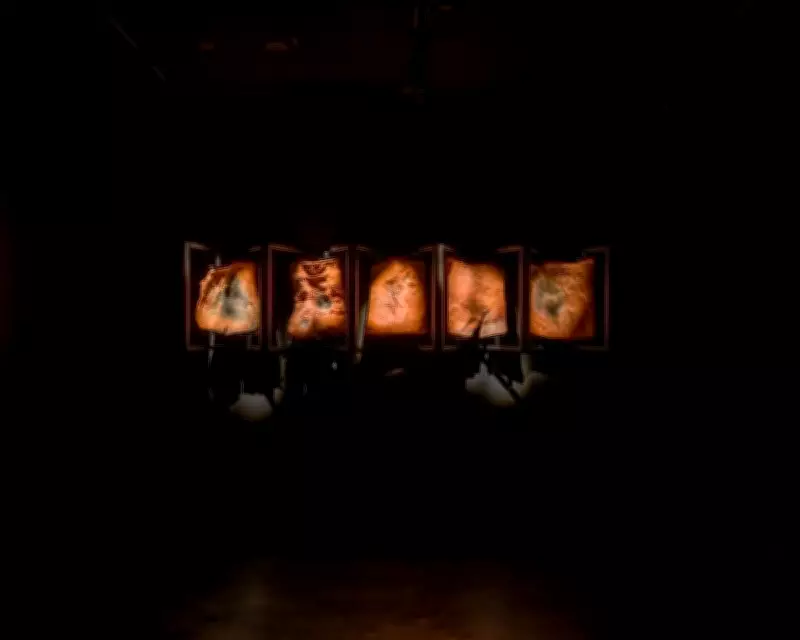
- Ceramic tiles created from clay sourced from Okinawa caves, using molds based on 3D scans of cave surfaces
- An ambisonic sound piece recreating the sonic environment of Tule Lake
- A selection of books from Kiyomi Gork's research and her grandparents' collection
The ceramic tiles are inset within a gridded metal folding screen, mimicking the cave's multifaceted surface that possesses so many angles for sound to bounce off that echoes are effectively deadened.
Recreating Silenced Environments
For the Tule Lake sound piece, Kiyomi Gork visited the site—now an airplane field with little acknowledgment of its history—and recorded the wind and open air. She processed these recordings through a virtual barrack model to simulate what it might have sounded like inside the structures.
"I've gone through a lot of video footage about the camps," the artist says. "But no one really talks about how it felt or how it sounded." Both her sculpture and sound piece consequently exist in a liminal space between documented physical structures and imagined experiences.

Embracing the Unknown
Kiyomi Gork describes this exploration of her Japanese-American and Uchinanchu roots as an unfinished, potentially endless project. "It's more about the unknown than anything," she explains. "About being OK with not knowing. Or being OK with the fact that there is this huge silence, and honoring that."
The exhibition serves as both a sonic and sculptural memorial to individuals on both sides of the Pacific. "For me, at least, it's through time," Kiyomi Gork says. "This is a time-based work, so it's through spending time with it, almost like a meditation, that one can sit with and acknowledge what happened."
Gama 1213-B will be on display at Canary Test in Los Angeles from February 12 through March 20, offering visitors an opportunity to engage with these complex histories through sound and material exploration.