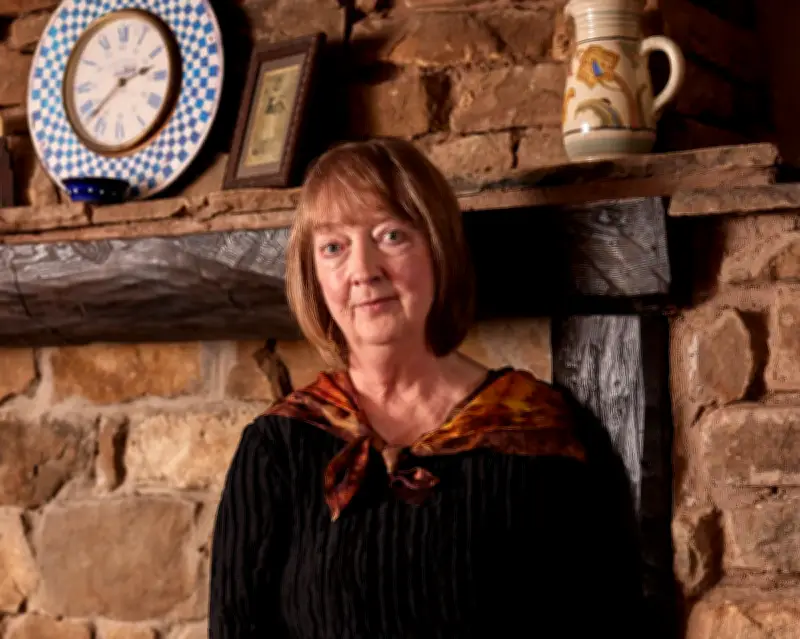
Sharon Blackie, the author of cult hits like If Women Rose Rooted and Hagitude, lives in a remote house in the Yorkshire Dales, surrounded by three border collies, six sheep, nine hens, and her husband David Knowles, a former RAF Tornado pilot. Her home overlooks the ruins of a castle said to have been built by King Arthur's father, fitting for a writer dedicated to bringing fairytales to modern readers.
A Mission to Revive Folklore
Blackie runs spiritual retreats and workshops at nearby Broughton Sanctuary and publishes a Substack called The Art of Enchantment. Her books blend memoir, mythology, and eco-feminism, arguing that the world men have made is failing and that women need to change themselves and the stories they tell. She draws on archetypes from Plato, Baba Yaga, and Jung to help women rediscover their power and connection to nature.
Blackie, a 65-year-old former academic and psychotherapist, insists fairytales are more needed than ever. "The world feels incredibly precarious," she says. "Fairytales tell you how to get on with your life." Her new book, Ripening, serves as a guidebook for our times, emphasizing that heroines leave home with catastrophe at their heels but thrive through character.

Reclaiming Stories from Disneyfication
Blackie follows in the tradition of Angela Carter and Marina Warner, aiming to reclaim stories from Disney. Her heroines are more likely to rescue than be rescued, discovering agency through courage and wit. She pushes back against wicked stepmother and evil witch tropes, restoring the wise old woman to society's heart. Frustrated with Greek and Roman myths where women are secondary, she explores Celtic folklore from her half-Irish, half-Scottish ancestry.
Her favorite mythical being is the Cailleach, an old woman associated with winter and wilderness, whom she calls "a very powerful role model for today's challenges." The Selkie and the miller's daughter are rich metaphors for female narratives of rebirth and transformation.
Finding Power in Age
Blackie wrote Hagitude approaching 60 because she saw no place for older women in contemporary culture. "I wasn't ready to give up," she says. While she welcomes new openness about midlife women, she worries the conversation focuses on clinging to youth. "If you try to cling on to a stage of life that has passed, it's not functional," she says. "Oestrogen is gone, so you think, 'My whole life is not about being nice.'"
Growing up in industrial north-east England as the daughter of a single mother, Blackie never identified with golden-haired princesses but with wise old women. Her father was violent and left when she was four; her mother became an alcoholic. Their house was infested with cockroaches. She escaped through reading and later studied psychology at Liverpool University.
Overcoming Fear and Finding Courage
After disillusionment with academia, Blackie worked for a tobacco company but hated corporate life. She fled to America and back to the cigarette giant, driven by a need for safety. In her mid-30s, living in Kentucky, she realized she was frightened of life. The day after John F. Kennedy Jr. died in a plane crash, she booked flying lessons. Getting her pilot's license was a turning point. "It changed everything," she says. "If I can do that, then I can do anything."
She handed in her notice, bought a croft in Ullapool, Scotland, retrained as a psychoanalyst, and took an online creative writing course. She met her second husband David, and together they set up Two Ravens Press. After 12 years, they moved to the Isle of Lewis, where she had a view of St Kilda from her kitchen window. "There is only you, the sea, and the sky," she writes. She sees her four years there as "a grand love affair."
Place as Teacher
Blackie has moved from Ireland to Wales to the Lake District, always deep in the countryside. "Place has been by far the biggest teacher of my life," she says. While her insistence on following the thread is seductive, she acknowledges it requires courage. "You don't have to go into the forest for seven years," she says. "It's about finding a way in whatever life you're living to step back and take stock. But yes, you have got to make the leap."

She criticizes late capitalism's compulsion for "more, more, more" and modern psychology's focus on individualism. "The comfortable life causes spiritual decay," she quotes Colin Wilson. She doesn't like to talk about privilege, noting that everyone suffers. "When I grew up, life was really hard, but you did have a sense of what it was to live a good life. Community was everything."
Confronting Cancer and Renewal
During the pandemic, Blackie was diagnosed with aggressive non-Hodgkin lymphoma, caught just in time thanks to a private scan. She is approaching five years in remission. "It was brutal, but it also changed everything," she says. "You're completely stripped bare. I came out of it thinking, 'All these cells have been killed. Now it's all new.'"
She has no regrets about not having children. Her day starts at 4am, when she feels she owns the world. "It's the dark. It's the silence. That sense that nobody else is up. Then you have room for all the images and ideas that feed into the books."
Walking down to the river, she points out pink aubrieta on crumbling castle walls. "Why would you not talk to the river?" she asks. "It wasn't woo-woo back in the day. It goes back to Plato and Pythagoras, a sense of everything being interconnected."
When asked if she will stay, Blackie replies, "Every time I feel as if I need to make a big psychological shift, there has been a reason to move. I'm not feeling that here." Perhaps she has finally found her way home.