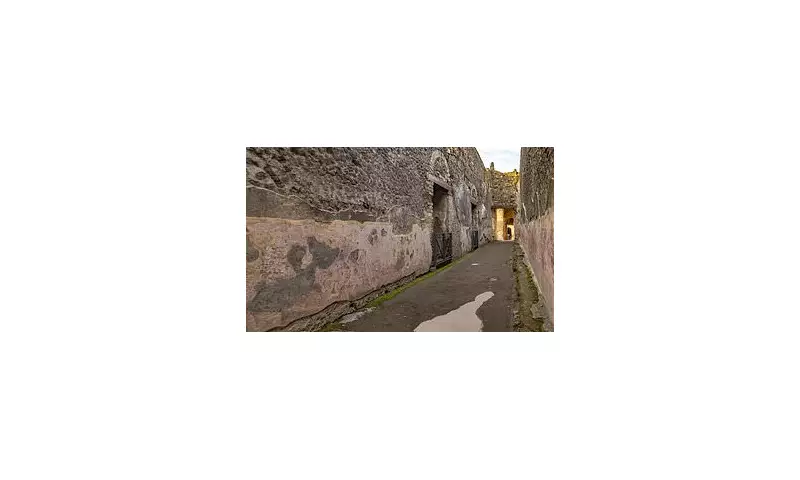
The daily existence of ancient Romans might appear worlds apart from contemporary life, yet freshly uncovered graffiti demonstrates that human nature remains remarkably constant across millennia. Archaeologists have identified 79 previously unseen inscriptions scratched into the walls of an alley in Pompeii that likely served as a public urinal. Spanning themes from romantic affection to crude bodily functions, these 2,000-year-old messages could easily be mistaken for modern-day pub bathroom scribbles.
Unearthing Hidden Histories in the Theatre Corridor
The ancient doodles were discovered in Pompeii's Theatre Corridor, a narrow passage measuring 27 metres long and 3 metres wide that connected the city's two theatres. This sheltered space provided citizens with respite from harsh winter weather and scorching summer sun. Evidence of guttering along one side suggests the corridor doubled as an open-air urinal, explaining the candid nature of some inscriptions.
Advanced Technology Reveals Lost Messages
While archaeologists first noticed traces of graffiti when the alley was excavated in 1794, new technology has enabled researchers to uncover drawings previously invisible to the naked eye. In a groundbreaking paper, scholars from the Sorbonne in Paris and the University of Quebec employed Reflectance Transformation Imaging. This technique uses specialised camera setups to shine bright lights at walls from multiple angles, allowing computer programs to detect minute details imperceptible to human vision.

The comprehensive survey documented over 300 pieces of graffiti in the Theatre Corridor, including the 79 newly discovered specimens. These findings contribute to the approximately 10,000 messages and designs found throughout Pompeii, offering unparalleled insights into ordinary Roman life since they were created by common people rather than professional artists working for the elite.
Messages Spanning Romance to Raunchy Tales
The graffiti reveals a fascinating spectrum of human expression. One tantalising fragment reads 'Erato Amat...', translating to 'Erato loves...'. Although Erato was a common name for female slaves and freedwomen, the identity of her beloved remains lost to time as the plaster deteriorates.
Another more poetic inscription declares: 'Methe, slave of Cominia, of Atella, loves Cresto in her heart. May the Venus of Pompeii be favourable to both of them and may they always live in harmony.' A hurried message perhaps written by someone rushing from the theatre reads: 'I'm in a hurry; take care, my Sava, make sure you love me!'
Not all messages were charming. One particularly baffling example states: 'Miccio, your father ruptured his belly when he was defecating; look at how he is Miccio!' Curiously, the name Miccio appears carved four times in a small section of the alley.
Artistic Expressions and Historical Revelations
Beyond written messages, the scratchings include drawings ranging from crude doodles to remarkably detailed illustrations. Archaeologists discovered an impressive sketch of two gladiators locked in combat, with their weapons, armour, and shields depicted with surprising accuracy. The unique poses suggest the anonymous artist may have witnessed an actual gladiatorial contest and was recreating the scene from memory.
One piece of graffiti has even helped archaeologists refine the timeline of Mount Vesuvius's catastrophic eruption. A message believed to be from a builder notes they 'had a great meal' on October 17, supporting theories that medieval historians confused October and August, potentially placing the actual eruption date on October 24 rather than the traditional August 24.
Broader Context of Roman Graffiti Discoveries
Pompeii isn't the only location where archaeologists have uncovered revealing Roman graffiti. At Vindolanda, part of Hadrian's Wall, researchers found an exceptionally rude carving depicting a large phallus and declaring someone called Secundinus 'a sh***er'. Such phallic engravings aren't uncommon along Hadrian's Wall, with 13 examples now documented at the historic site.

Gabriel Zuchtriegel, Director of the Park of Pompeii, emphasises the importance of technological advances: 'Technology is the key that is shedding new light on the ancient world and we need to inform the public of these new discoveries.' These findings continue to reshape our understanding of daily life in ancient Roman society, proving that some aspects of human expression truly are timeless.