Bed rot, doomscrolling, and a single goldfish named Pao Pao greet visitors at the entrance to Are you lonely tonight? I’m so lonesome I could cry, a new exhibition at the Australian Centre for Contemporary Art (Acca) in Melbourne. The show, which runs until 30 August, brings together 11 artists including Hollywood actor Lucy Liu, Ghanaian artist Gideon Appah, LA artist Seth Brown, and Melbourne-born Polly Borland to explore the nuances of loneliness in the digital age.
Curators Define a Kaleidoscopic Epidemic
Co-curator Myles Russell-Cook, Acca’s artistic director and CEO, describes loneliness as a pervasive yet elusive condition. “We have a loneliness epidemic that resists definition. It’s a kaleidoscope,” he says. The exhibition is the first in a series on “art and emotion,” with future shows planned on joy and rage. It aims to distinguish loneliness from being alone and connectivity from genuine connection.
Russell-Cook owns several fish and named the exhibition’s goldfish after the hypothetical last goldfish on Earth in Kelly Yu’s short film Endling, playing in the next room. “He’s part of my family, he’ll be coming back to the big tank,” he notes.

Patrick Pound’s Museum of Loneliness
Inside, Aotearoa artist and archivist Patrick Pound presents The Museum of Loneliness, a new commission featuring dozens of found objects from his collection of more than 70,000 photographs. Items include an Ikea orangutan soft toy that became famous as a companion to a rejected baby macaque at a Japanese zoo, a baby Jesus figurine, LPs, VHS tapes, and a DVD of Steve Martin’s The Lonely Guy. A tiny miniature of a man, barely noticeable, represents the loneliest figure. A discarded single-serve Mentos wrapper nearby is not part of the museum, but a Lonely Planet edition titled Israel & the Palestinian Territories is.
Pound, who spends hours scrolling eBay, reflects on his habits: “To spend six hours a day on the internet is sort of a tragic thing to do. It’s not that nice a lifestyle. But I’ve also made a community there. I’ve grown an international community of sellers, buyers, collectors as friends, maybe.”
The Physicality of Loneliness
Co-curator Sophie Prince describes her own catatonic responses to loneliness. “I definitely go kind of catatonic. I lie down a lot. I try to blank out the brain chatter that isn’t helpful,” she says. “Loneliness is a chemical experience too. If you can practice things that help your body readjust, you can take more intellectual, conceptual or creative steps to play with the weirdness of your brain.”
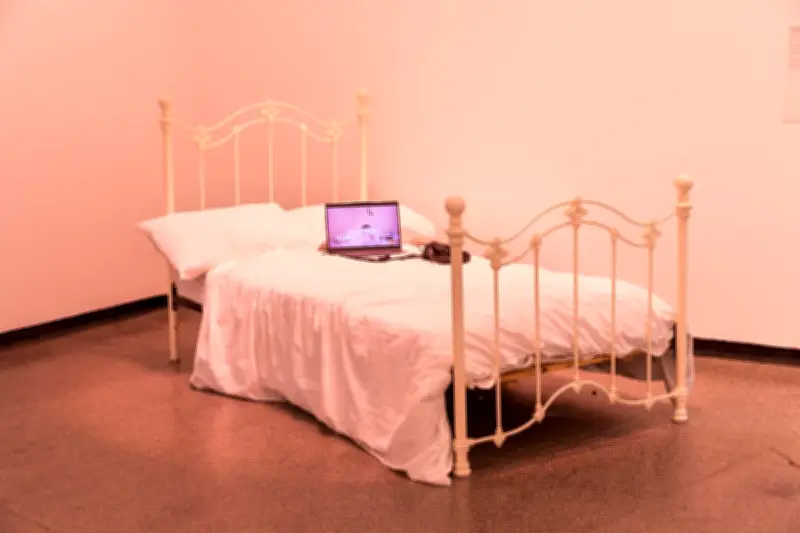
Lucy Liu’s three large paintings draw on the Japanese erotic art tradition of shunga, depicting a woman’s intimate moment of self-pleasure in bed. Natasha Matila-Smith’s If I die, please delete my Soundcloud features a single bed with rumpled white linen, a laptop, and headphones. On the screen, a woman bed rots as text cycles: “Men on dating apps … I don’t care if they ski or mountain climb or go to the gym or partake in adventure sports. I just wish they had a personality.”
Technology and Heartbreak
Seth Brown’s mechanical mustard bottle, Frank, endlessly swipes Instagram in search of a perfect AI-generated bun, highlighting the intersection of technology, love, and loneliness. Kayla Mattes’ seven-metre-long textile Lonely Planet, an Acca commission, took a year to complete, including more than seven months of physical weaving. The work, made after a breakup, features viral memes, Yoga With Adriene, emoji reactions, the cover of the Magnetic Fields album 69 Love Songs, and an online poll: “What are you most worried about?”
“I was making Lonely Planet as more and more ridiculous, horrible things were happening in America,” says the LA-based artist. “I was thinking about that as a heartbreak, for the state of the world. There’s a loneliness within doomscrolling.”

A Hopeful Letter Exchange
The exhibition’s most hopeful work comes from 26-year-old Melbourne artist Melissa Nguyen. Her commission, A letter to my mother; A letter to your mother, comprises three towering white-on-white canvases with photographs painted in rabbit skin glue. The works explore her mother Trinh’s flight from the Vietnam war as a child. One image comes from the only photograph of Trinh from that time, taken at Indonesia’s Galang Island refugee camp when she was about 12.
Trinh didn’t see her own parents for 14 years and felt a gulf with her daughter after Nguyen moved from Adelaide to Melbourne. A letter exchange changed everything. “I knew she was lonely but she never shared it,” says Trinh. “I told her about everything I went through [as a refugee]. I never thought she’d share all her feelings with me.”