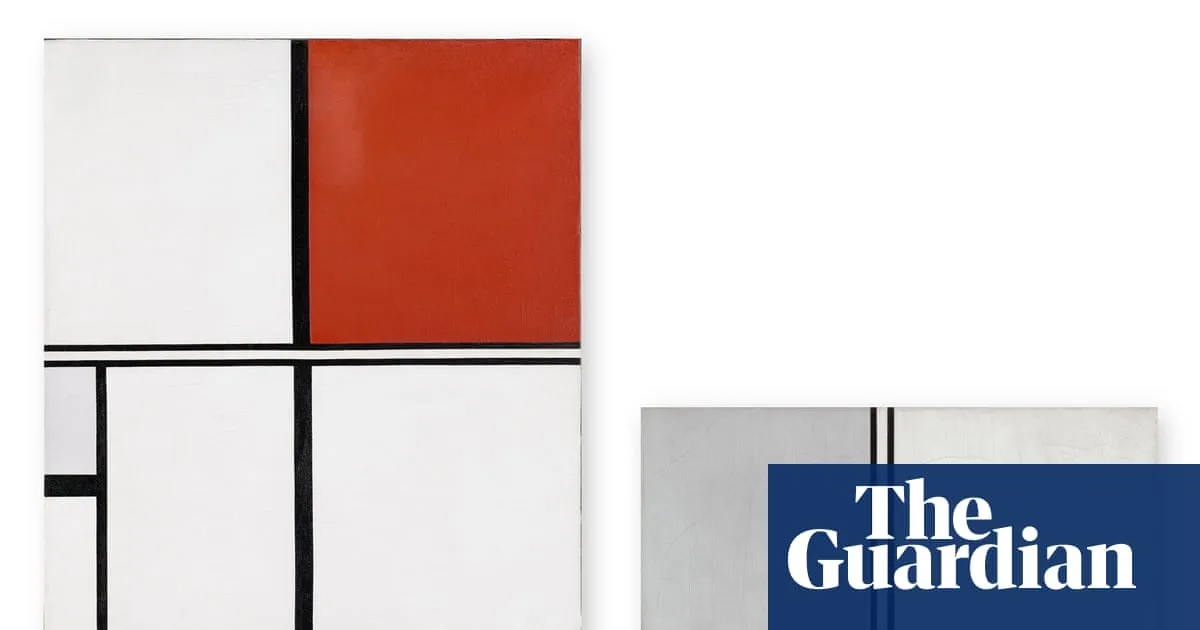
For decades, the towering figure of Dutch painter Piet Mondrian has dominated the narrative of 20th-century abstract art. His iconic grids of black lines and bold primary colours are celebrated worldwide. Yet, a quiet revolution is underway in art history, centred on a long-overlooked British artist named Marlow Moss, whose pioneering ideas may have significantly shaped Mondrian's later work.
The Dramatic Reversal of Fortune
In a telling symbol of this shift, the prestigious Kunstmuseum in The Hague now displays three paintings by Moss prominently at the front of its gallery. A strikingly similar piece by Mondrian, the global superstar, is positioned behind a pillar. This is a stark contrast to 1972, when the museum acquired Moss's work specifically to illustrate Mondrian's influence on lesser-known artists.
The art world now widely acknowledges that the influence flowed both ways. A key point of convergence is the use of the 'double line' – parallel lines that add tension and dynamism to geometric compositions. While Mondrian is famed for this technique, evidence suggests a rich artistic dialogue with Moss, who was also experimenting with the concept in the early 1930s.
Seven decades after her death in Cornwall at age 69, Moss is enjoying a major revival. Her 1944 painting White, Black, Blue and Red sold for £609,000 at Sotheby's London in 2023, doubling its estimate. Major exhibitions are now showcasing her legacy: her paintings and sketches are on view at the Kunstmuseum Den Haag until 10 May, and her sculptures will be featured at Berlin's Georg Kolbe Museum from 2 April.
A Pioneering Life and Artistic Dialogue
Born Marjorie Jewel Moss in London in 1889, she later adopted the gender-neutral name Marlow. In the late 1920s, she moved to Paris, becoming part of the avant-garde Abstraction-Création group. It was there she met Mondrian, introduced by her partner, the Dutch writer Netty Nijhoff. Moss and Nijhoff were a distinctive pair, often seen in men's suits and hats in Parisian cafes.
Art historian Florette Dijkstra, author of a new Moss biography, notes that Mondrian was deeply impressed by Moss's experimentation. "He was impressed by her experimentation with the ingredients of 'neoplasticism'... and her use of the 'double line'," Dijkstra explains. Mondrian, intrigued, even wrote to Moss to enquire about her conceptual approach to the double line, which she saw as a way to avoid the "conclusion and restriction" of a single-line grid.
Clairie Hondtong, curator of The Hague exhibition, emphasises a move away from simplistic narratives of theft. "We're moving away from the 'Who did it first?' narrative, focusing instead on the interchange of knowledge," she says. The exhibition allows visitors to compare Moss's 1932 work White, Black, Red and Grey with Mondrian's 1937 Composition of Lines and Colour.
Rediscovery and a Lasting Legacy
Moss's relative obscurity was compounded by tragedy when a house in Normandy containing much of her work was bombed in 1944. Her current revival was sparked by a remarkable discovery: a suitcase full of her sketches, recently acquired by the Kunstmuseum. These works reveal her meticulous, mathematical planning process, a contrast to Mondrian's more intuitive method.
Lucy Howarth, author of the only English-language biography on Moss, argues for evaluating the artist on her own merits. "She is one of the few top-tier non-figurative British artists from between the wars," Howarth states, noting Moss was the only British and female artist featured in all five Abstraction-Création journals.
While Mondrian found fame in grid-like New York and entered the pantheon of art history, Moss spent her later years between Cornwall, Paris, and the Netherlands, dying in 1958. Today, her rediscovery is reframing art history itself, challenging the myth of the solitary male genius. As Howarth concludes, examining artists like Moss – often women and queer – complicates but ultimately enriches our understanding of modern art's evolution.