His legendary poem once caused car crashes, and now Lemn Sissay wants to see it returned to a wall in Manchester. Pieces of rubble from the pub currently adorn the poet's bookshelves.
The Poem's Legacy
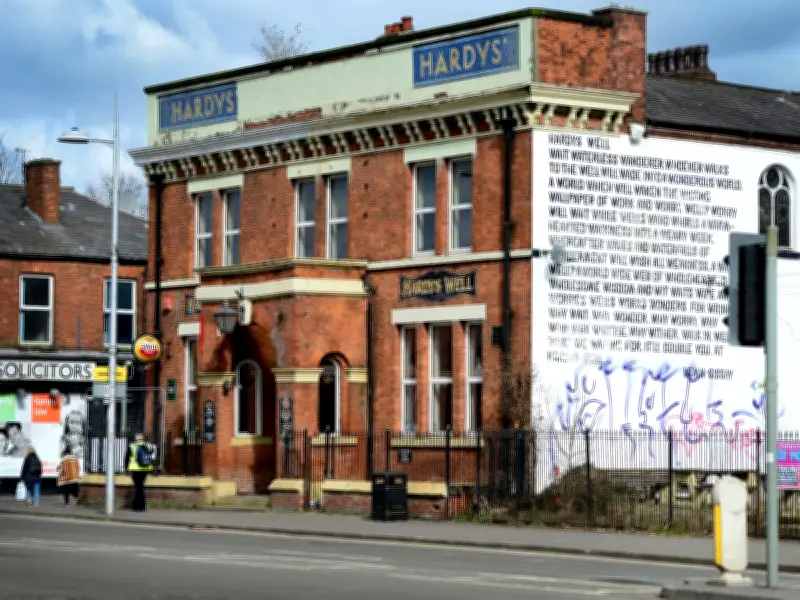
His poem, which once adorned the gable end of Hardy's Well on Wilmslow Road, is still the work Lemn Sissay is most often recognised for, despite the pub being demolished three years ago. The former University of Manchester chancellor says he can be anywhere in the world and people will mention the importance of the work, which adorned the gable end of the pub for almost 30 years. It is so iconic that even his friend Peter Hook, the New Order bassist, says he would like a piece of the rubble as a memento.
Now, Sissay has told the Manchester Evening News he would love to see his iconic Hardy's Well poem returned to a wall in Manchester.

A Landmark Chosen by the People
“The beauty of the Hardy's Well poem is that you can't force a landmark onto people. People choose a landmark,” he says. “That's what a landmark is, it's not got anything to do with corporate, this, that or the other.”
Sissay's famous poem was designed as a tongue-twister for drinkers to try to recite after a few pints. The vast majority of its 98 words begin with a 'w'. At the time it was created, in 1994, it was possibly the first major piece of public poetry in the country. It adorned the Rusholme pub on the city's famously dense Wilmslow Road for decades.
Legend has it, traffic calming measures had to be introduced near the junction with Dickenson Road to prevent crashes, as so many people were slowing down to read it. But the much-loved local landmark came crashing down in 2023 after a devastating fire at the pub.
The Fire and Demolition
The blaze broke out at Hardy's Well at around 11.45pm on May 24, 2023. Less than 48 hours later, it was demolished after being deemed unsafe. Since then, there has been a gaping hole at the corner of Wilmslow Road and Dickenson Road and the site is currently used as a surface level car park.
After the demolition, someone retrieved four pieces of the rubble for Sissay. He uses them as bookends. But his friend Peter Hook is apparently keen to have one. “Peter, I've got one for you, if you really want it,” the poet says.
Documenting the Moment
Sissay says the Manchester Evening News coverage of the Hardy's Well demolition was in some ways just as important as the poem itself. “It documents the moment,” he says. “Whatever landmarks happen in our towns we register when they've been taken down, who they've taken down by and why. It's on the record. This mattered to people. You get documentary evidence of that. And you've got this beautiful shot of it actually being broken and taken to the dirt by the big claw. So it's kind of wonderful for me as an artist.”
“Honestly I could be anywhere in the world where somebody will come to me and say ‘I went to university and I saw this poem every day’. Or ‘I worked at the BBC and I would go to see it every day and that route was so important’.”
A Dream of Return
“My dream is that it would be put on a wall on Oxford Road or Wilmslow Road that's as big as the Hardy's Well wall, and that it could return. It has to be somewhere with prominence.”
A Hardy's Well regular during the 90s, Sissay was challenged to write something for the gable end by the landlord while drinking one night in 1994. Shortly afterwards, it was meticulously transcribed onto the side of the pub in large black lettering. The poem became an iconic local landmark, much-loved by south Manchester commuters who saw it as they travelled up Wilmslow Road towards the city centre each day.
A Proud Achievement
Sissay says the poem is one of his proudest achievements. “It sort of made a person engage with the environment,” he says. “It's not just a poem in a public space. It's concrete poetry. Concrete poetry started in the 1950s, and it's poetry in public spaces. It's the use of language for the love of the language, not just of what language is saying. The pattern of the words, the rhythm of the word, is as important as what they're actually saying.”

“Seeing the poem go was sad, but I had to accept that that's what happens. Things get broken down and built up again. But there's no reason why some inspiring person can't go ‘I'm having that’. Talk to me if you can use it.”