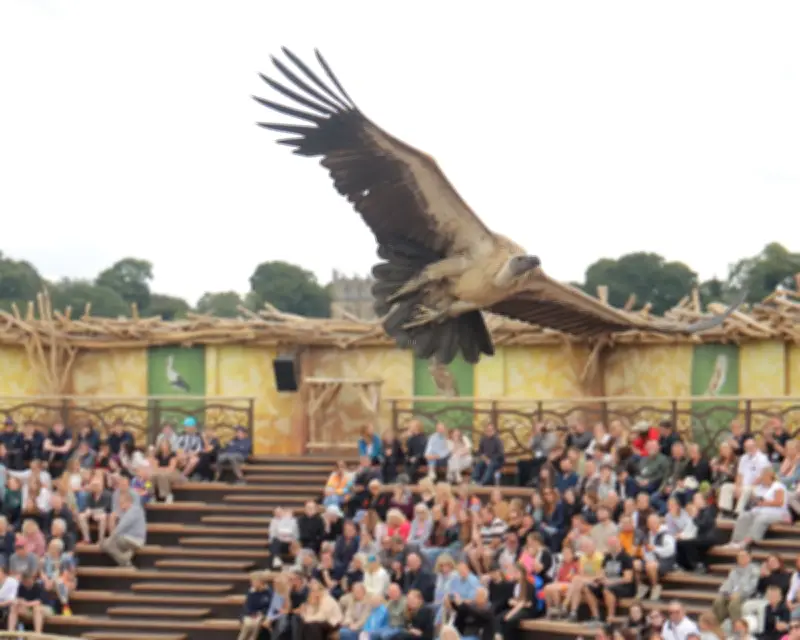
Booming Hans Zimmer-style cinematic music reaches a crescendo, shaking my bones. Two turquoise macaws swoop within an inch of my hair and join a sky filled with nearly 250 birds. Hawks, kites, pelicans, and an owl soar and swoop around a pagan-looking wooden circle. Peacocks fuss at the makeshift river below, coaxed by two actors telling the story of humans’ relationship with nature. Grey clouds roll in, dark with rain. After all, we are risking an open-air performance in north-east England. I’m at a preview of Kynren: the Storied Lands, the latest gloriously unrestrained project in the market town of Bishop Auckland, 12 miles south of Durham.
From Mining Town to Cultural Hub
I grew up near Bishop Auckland, which was once an important coal-mining and railway town. Last time I was here, its centre was dominated by discount stores. If, in 2003, you’d told teenage me that the high street would become an ode to art, history and culture, I would have laughed. Well, I would have grunted and turned up the Nu metal on my MP3 player.
This madcap renaissance is down to one couple. In 2012, investment banker Jonathan Ruffer rescued Francisco de Zurbarán’s celebrated series Jacob and His Twelve Sons from the sale of Auckland Palace. Needing somewhere to house the paintings, he ended up buying Auckland Palace too. He and his wife Jane Ruffer could have followed centuries of previous owners, closed the doors and kept the paintings to themselves. Instead, they set up a charity and opened up the palace and its beautiful gardens to the public. Thus began the complete renovation of Bishop Auckland.
Auckland Palace and Galleries
The palace itself is a vision of grand, gothic architecture dating from the late 12th century. In St Peter’s chapel, the stone archways and a painted wooden ceiling make you feel as if you have stepped into the middle ages. The lifesized Zurbarán paintings remain on the dining room walls as a stream of visitors peruse the preserved stately rooms, guided by volunteer attendants.
“We employ 201 staff,” says Harry Sinclair, public relations officer at the Ruffers’ Auckland Project, as he guides us through the estate. “Around 80% come from a 10-mile radius, so we’re very much leading the circular economy. It’s about regenerating the town through its culture and heritage.”
After procuring the palace, the project grew arms and legs, becoming the Auckland Project, a regeneration charity dedicated to remodelling Bishop Auckland. As well as running the palace and gardens, the initiative built two art galleries and a lookout tower, and preserved a local heritage railway and Roman fort.
The galleries – one dedicated to mining art from County Durham, the other to the golden age of Spanish art – are not the ramshackle, fossil-packed local museums of my childhood school trips, but sleek galleries with ink-black walls and , boasting works by El Greco and Velázquez. Back outside, the drizzle clinging to my skin brings me back to Earth, but the striking viewing tower dominating the centre like the skeleton of a cathedral is another sight I never thought I’d see in Bishop Auckland. “Altogether we call it a slightly bonkers day out,” says Sinclair.
Kynren: The Storied Lands
He tells me about the 59-bedroom hotel the project is building on the market place. He says it should increase footfall and dwell time in the town centre, with 1.5 million visitors expected each year from 2029. The hotel could create up to 95 jobs. There are already self-catering cottages in a neat line outside Auckland Palace and boutique accommodation at the Park Head Hotel.
But most ambitious of all is the jaw-dropping Kynren project. In 2013, the Ruffers bought Flatts Farm – about 100 hectares (250 acres) outside Bishop Auckland – and every summer since 2016, have hosted a glorious night show telling 2,000 years of English history to audiences of up to 8,000 people. More than 1,000 local volunteers work to create an extravaganza with horseback cavalry, sword fighting, working steam locomotives and boats gliding across a human-made lake, culminating in a dazzling firework display.
And next week, Kynren: the Storied Lands is opening during the day, too, as a live-show theme park for the first time. The arena, where my sneak peek at the new Lost Feather show takes place, is impressive. Huge wooden branches are stacked haphazardly into a circular nest so convincing I expect an eagle chick the size of a bus to emerge. During the show, birds pop out of hidden doors above the audience and swoop overhead, coaxed by handlers in medieval-style tunics.
It doesn’t always go to plan. One kestrel flies off into the nearby forest, and a tawny owl refuses to perform; its wide yellow eyes staring out at an audience delighted by its misbehaviour. Each mishap only adds to the joy of the experience. “That’s the beauty of live performance,” Anna Warnecke, CEO of Kynren, says. “There’s an electric sense of adrenaline that you don’t get from watching the same thing on a screen.” She’s right. By the end of the show, we’re holding a collective breath and there’s heartfelt applause and laughter when the kestrel returns from the distant woodland to the gloved arm of its handler.
Six Live Shows and More
The Lost Feather is one of six live shows running throughout the day until mid-September. The other five performances are in equally elaborate auditoriums. The Legend of the Wear (a re-telling of the local Lambton Worm myth) features live action water stunts on a lakeside stage. At Land of the Vikings you walk through a working village, interacting with actors to the sound of clanging metal from the forge before distant drumming signals the start of the show in the boat-like arena. Expect big beards, the clash of shields and axes, fire, and a lot of Viking roaring.
“We wanted to create a visitor destination,” Anna says. “People aren’t going to travel that far for a single 90-minute show like Kynren. So the daytime performances give people a reason to spend all day here.” There’s certainly plenty to stay for at Bishop Auckland these days. Apart from epic bird shows and recreated Viking raids, a fascinating palace, Spanish masterworks, a Roman fort, deer park and heritage railway line, the original Kynren spectacular still runs on Fridays and Saturdays between July and September.
This is not just a “slightly bonkers day out”; it’s a testament to unbridled ambition. I think even my sulking 16-year-old self would be secretly in awe of what Bishop Auckland has achieved.