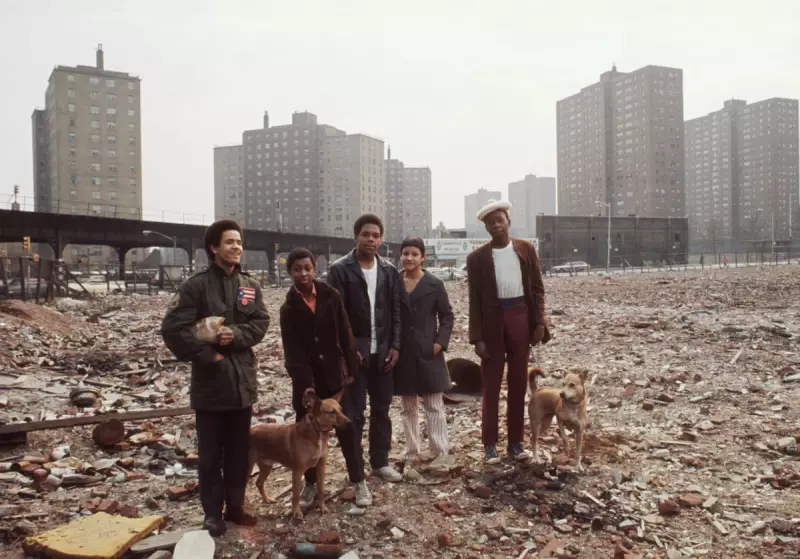
In the summer of 1985, photographer Camilo José Vergara captured a scene that would become an iconic document of a specific time and place in New York City's history. His photograph, taken at the intersection of East 138th Street and Brook Avenue in the South Bronx, depicts a group of young men with a pack of dogs, standing before a graffiti-covered wall and the shell of a burnt-out building.
A Moment Frozen in Time
The image, titled simply Bronx Dog Walkers, is a complex study of urban life during a period of significant neglect and hardship for the borough. Vergara recalls the moment vividly: he was driving through the neighbourhood when he spotted the group. He stopped his car, rolled down the window, and asked for permission to take their picture. The young men agreed, posing confidently with their animals against the stark backdrop of urban decay.
The photograph is meticulously composed. The subjects stand in a loose line, their postures relaxed yet watchful. The dogs, a mix of breeds including what appears to be a Doberman and a German shepherd, are a central focus. Behind them, the wall is a canvas of vibrant, colourful graffiti, a stark contrast to the hollow, windowless brick building that occupies the upper portion of the frame. This building, Vergara notes, was a common sight—a charred ruin from a fire, its interior completely gutted.

More Than Just a Snapshot
For Vergara, a Chilean-born documentary photographer who has dedicated decades to chronicling American cities, this image transcends a simple street scene. He interprets the dogs as more than pets; they were symbols of protection and status in an environment where official security was often lacking. The young men, in his view, were not causing trouble but finding a way to belong and assert a presence in a landscape that many had abandoned.
The location itself is significant. The South Bronx in the mid-1980s was infamous for disinvestment, arson, and poverty. Vergara's work, of which this photo is a key part, served as a vital visual record of these conditions. He didn't just photograph the decay; he photographed the life that persisted within it. The graffiti, often seen as vandalism, is presented here as a form of vibrant, grassroots expression amidst the grey and brick.
The Legacy of an Urban Document
Today, Bronx Dog Walkers is recognised as a powerful piece of social documentary. It avoids stereotype or pity, instead presenting its subjects with dignity and a sense of agency. Vergara's approach was one of respectful observation, not intrusion. He credits his ability to capture such scenes to his method: driving, stopping, asking, and then quickly composing the shot.
The photograph now stands as a historical artefact. The specific intersection it depicts has undoubtedly changed, part of the long and complex evolution of the Bronx. Yet, the image continues to speak powerfully about community, resilience, and the ways people carve out identity and security in challenging urban environments. It remains one of Camilo José Vergara's most celebrated works, a poignant and unflinching look at a New York City neighbourhood in the 1980s.