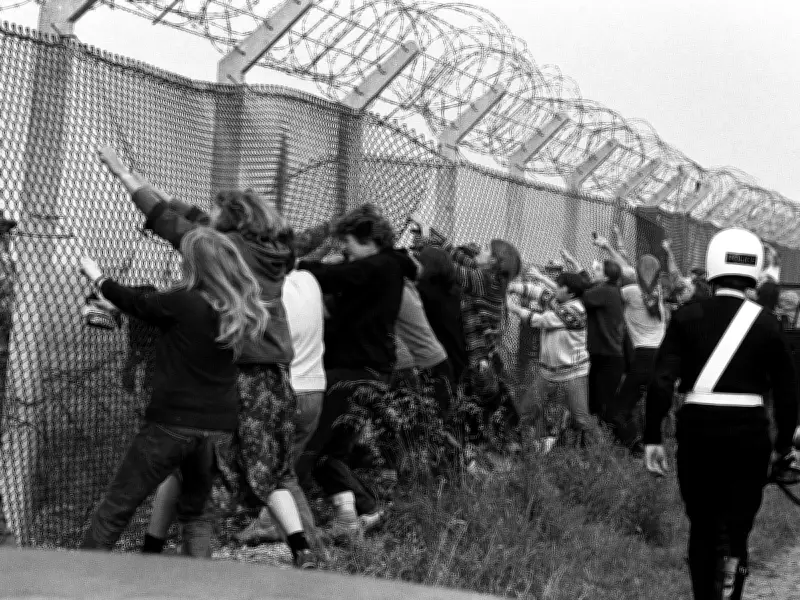
September marks 45 years since a small group of women walked from Wales to a military base in Berkshire, chained themselves to the fence and refused to go home. What began at Greenham Common lasted 19 years and its reach ran far beyond the wire. They had come to stop American cruise missiles being sited in Britain.
"Wherever there is injustice, you will find a Greenham woman trying to address it," says Rebecca Mordan, who runs the feminist production company Scary Little Girls and wrote the oral history Out of the Darkness: Greenham Voices. She was taken to the camp as a child by her mother and has since recorded testimony from more than 100 of the women.
The March That Started It All
The march that started it set off from Wales in August 1981. Organised by Ann Pettitt, a member of the Campaign for Nuclear Disarmament, she wanted the base to become a name nobody could avoid. "We wanted it to be talked about everywhere," Ann said. "We wanted it to arouse alarm of the highest degree. It's not just blast, you know, and flash that kills you - radiation goes on killing and affects the unborn and the youngest the worst."

When the marchers reached the base, someone suggested chaining themselves to the fence as the suffragettes once had. The eldest of them, Eunice Stallard, then in her sixties, settled the argument. Eunice said: "I was 60 then, and I wasn't really frightened of anything. We chained ourselves onto the fence. We said we'd stay there until we had a dialogue."
A Women-Only Community Takes Shape
Local people brought tents and food and a camp took shape, almost by accident. Jill Raymond, who lived at the camp on and off for nearly two decades, said the weapons were only ever half the story. "Actually, it was about reclaiming the land and reclaiming the common. And that's why a lot of women stayed."
By early 1982 the women living at the fence had decided the camp should be women only, thrashed out in a furious meeting. Lynne Jones, then a medical student, chaired it. Lynne said: "I remember standing up and shouting louder than anyone else, saying, 'look, we're having a row. I don't mind how we decide, but it'd be nice if we made a nice decision. So I'll facilitate if you like.'"
Sarah Green, who lived at Greenham for four years, said the camp was a working community rather than a huddle of tents. "We always had a fire going there. We had a welcome tent," Sarah said, describing the little tents, the teepees and a shelter where every visitor was given tea.
Embrace the Base and Global Impact
The image that fixed Greenham in the public mind came in December 1982, when tens of thousands of women joined hands right around the nine mile perimeter fence in an action they called Embrace the Base. Rebecca was there, aged five, holding on with her mother. She said: "That's the biggest women-only action since suffrage. It was huge."
The government mocked the women in public and watched them very closely in private. Michael Heseltine, Defence secretary from 1983, still bristles at the memory, saying: "These peace loving ladies in camp defending us all from nuclear holocaust were seen in a very different light because they were a mob. I was on one knee with this swirling, shouting mob."
Rebecca said the ridicule hid how seriously the camp was taken behind closed doors. She explained: "Those women were in and out there every day. They ridiculed them in the press, but they took them very seriously politically, because they were costing them a fortune." The women's words reached the men whose fingers were on the button and, by the end, even the American president was borrowing their language. She said: "You've got Ronald Reagan using slogans off the women's banners and placards to position himself as a president of peace."
When Soviet leader Mikhail Gorbachev signed the 1987 treaty that began winding down the Cold War, Rebecca said he was asked by the world's press how he could ever trust the Americans. Rebecca said: "Gorbachev replied 'I wouldn't trust them, I trust the Greenham women. I trust the women of the UK and America to hold their politicians to account.'"

The Legacy of Greenham Common
The missiles the women had marched against were covered by the 1987 Intermediate Range Nuclear Forces Treaty. The first left Greenham in 1989, the last cruise flight went on 5 March 1991 and the United States Air Force pulled out in 1992. But the last of them did not leave until September 2000, by which time they had won back the common itself, now partly a business park and partly open land returned to the public.
Rebecca said Greenham methods live on in today's protests, through groups like Extinction Rebellion and the camps that fought lying the HS2 rail line through ancient woodland. She said: "They talked about something called Carry Greenham Home. Anyone can be a Greenham woman. You don't have to be here at Greenham to do it, you're carrying Greenham home with you."
She added: "Suddenly every dining table in the country is discussing, 'Should we have nuclear weapons? What is our role internationally? What protects us, what makes us vulnerable?' That's the spirit of Greenham. That doesn't go back in the bottle."
Out of the Darkness: Greenham Voices 1981-2000 by Kate Kerrow and Rebecca Mordan with foreword by Frankie Armstrong is published by History Press, price £14.99.