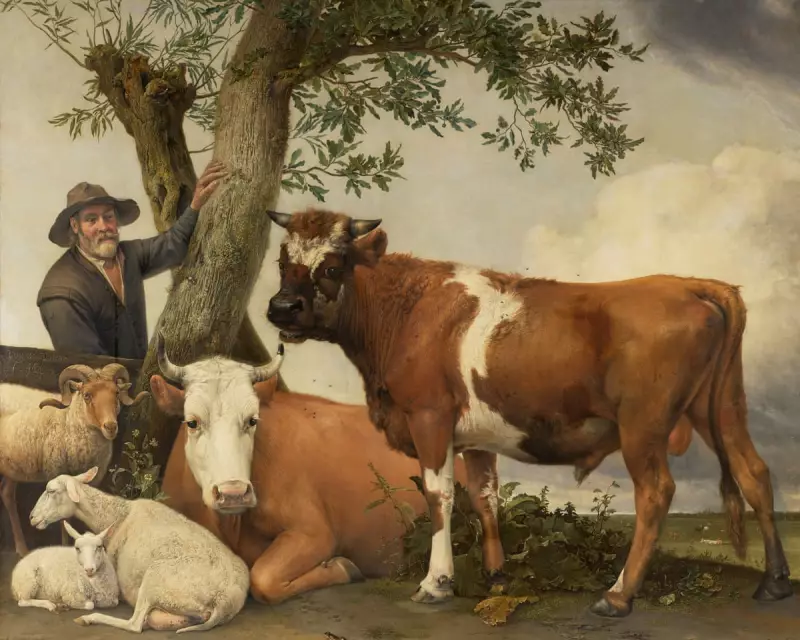
Conservators at the Mauritshuis museum in The Hague have uncovered a surprising secret hidden for centuries beneath the surface of a Dutch Golden Age masterpiece. During an extensive restoration of The Bull by Paulus Potter, experts discovered the animal was originally painted with significantly larger and lower-hanging testicles.
An Artist's Revision for Polite Society
The research team, working for 18 months, used X-ray analysis to peer beneath the painting's final layers. They found that the artist, Paulus Potter, made numerous compositional changes as he worked. The most striking alteration was to the bull's rear anatomy, which was substantially reduced in scale from the initial sketch.
Abbie Vandivere, a paintings conservator at the museum, explained the findings. "We found that Potter made lots of changes as he worked," she said. "[The bull's] balls were bigger and lower, his whole back end was shifted – but, indeed, the balls are the biggest change."

The prevailing theory is that Potter modified his work to align with 17th-century sensibilities. Created in 1647, the painting's more explicit original form may have been deemed inappropriate for display. This notion is supported by another of Potter's commissions from the same period.
A History of Controversial Commissions
Potter's contemporary reputation for earthy subject matter is highlighted by a rejected etching. Around the time he painted The Bull, he was commissioned by Amalia van Solms, Princess of Orange, to create a piece for a royal palace. The resulting work, Pissing Cow, now in the Rijksmuseum, was turned down for being too vulgar.
"It is assumed that he got the order from Amalia van Solms," said conservator Jolijn Schilder. "It was turned down by her because she thought it was too filthy a subject to show a pissing cow above her mantelpiece." This incident suggests Potter was no stranger to tailoring his work to the decorum of his patrons and the era.
The research also consulted modern cattle experts, who confirmed that historical breeds did indeed possess "giant, pendulous testicles," validating Potter's initial, more anatomically accurate sketch.
A Masterpiece's Turbulent Journey
The painting's history is as dramatic as its hidden composition. Paulus Potter died young in 1654 from tuberculosis at just 28 years old. Centuries later, his work became a prize for invading forces. In the late 18th century, when the Netherlands became a French vassal state, 192 artworks were looted by Napoleonic troops, with The Bull considered a particular gem.
"It was taken to Paris and was immediately very popular," Schilder noted. The French were struck by the Dutch artist's decision to paint a simple cow on a life-size scale, a honour typically reserved for historical or regal subjects.
Following Napoleon's defeat at Waterloo in 1815, the Dutch demanded the painting's return. Quentin Buvelot, a senior curator at the Mauritshuis, found that French officials attempted to thwart the repatriation by removing all the taller ladders from the Louvre. Despite this, the monumental work, measuring 236cm by 339cm, was eventually returned in a triumphal procession.
The completed restoration, which was carried out in a public gallery behind a glass box, is now on display. While the X-ray images revealing the bull's original form are shared with visitors, the painted-over anatomy remains modestly concealed under Potter's final, more decorous layer of paint.