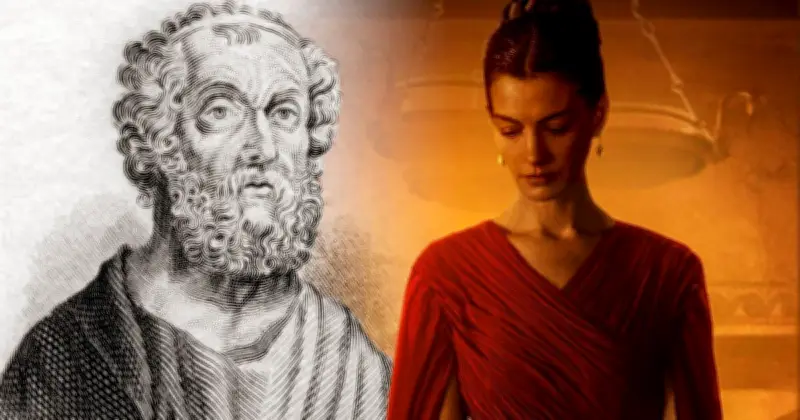
Dr Emily Hauser, a leading young historian and author of Mythica: A New History of Homer’s World, Through the Women Written Out of It, has criticized Christopher Nolan's upcoming film The Odyssey for its portrayal of female characters. She argues that the film perpetuates the epic's traditional sidelining of women, rather than drawing on historical evidence that reveals the powerful roles women played in the Late Bronze Age, the era that inspired Homer's poem.
Nolan's Film Misses the Mark on Homer's Women
In Nolan's adaptation, Anne Hathaway plays Penelope as a passive, compliant wife, and Lupita Nyong'o portrays Helen as downtrodden and defeated. Hauser contends that these depictions do not align with the original epic, where women like Penelope are cunning and strategic. 'It just goes to show that there are always new things to say about the Odyssey, and its women,' Hauser writes. 'There are always new clues you can dig up about the real women behind the legends that have been made to serve the stories of men.'
Historical Roots of Female Characters
Hauser points out that while Homer's characters are fictional, they may have been inspired by real women from the Late Bronze Age (approximately 13th–12th centuries BCE). She cites evidence from archaeology, including ancient DNA, weaving tools, and burials, that reveals women's roles in plant-based medicine, weaving, and ritual. For example, Circe's transformation of Odysseus' men into pigs using a potion reflects women's historical knowledge of herbal lore. 'It’s this connection between plants and power – the power to hold a soul between life and death, the power to heal and the power to harm – that might have been remembered in someone like Circe,' Hauser explains.

Calypso: A Different Perspective
Hauser also reinterprets Calypso, played by Charlize Theron in Nolan's film. In Homer, Calypso is blamed for detaining Odysseus for seven years, but Hauser suggests that Calypso's weaving—which would have taken years to produce a single sail—may have been her way of helping Odysseus leave. 'What if she was – instead – simply weaving, as hard and fast as she could, to get Odysseus off her island?' Hauser asks, highlighting how historical context can change the narrative.
Penelope: More Than a Waiting Wife
Hauser emphasizes that Penelope in the original poem is 'remarkably clever and cunning – a real match for Odysseus,' and that she actively considers marrying one of the suitors. Nolan's film, however, reduces her to a passive figure waiting for Odysseus' return. 'It’s one of the Odyssey’s most enduring legacies that women like Penelope have been forced to the sidelines to wait till Odysseus came home,' Hauser writes, 'a legacy Nolan’s film perpetuates.'
A New History Through Women
Hauser's book Mythica aims to recover the stories of real women from the Late Bronze Age, using archaeological findings to challenge the male-centric myths of Homer. 'Using new stories from the real bones and teeth, the ancient weaving tools and the millennia-old burials of women that history is unlocking all the time, we can move past the myths of men that the Odyssey tells,' she concludes. Dr Emily Hauser is the author of Mythica: A New History of Homer’s World, Through the Women Written Out of It (Penguin, £10.99), out now.