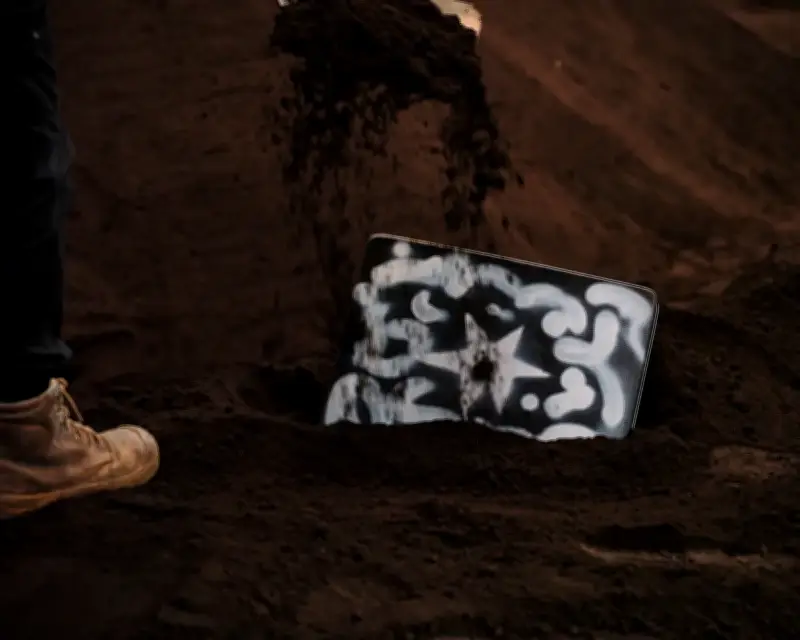
A Hitachi earthmover buried a suitcase in a mound of dirt inside Carriageworks as part of Heap, an exhibition and installation that combines art with an archaeological dig. The event features 80 artworks by eight Australian artists, commissioned by the Festival of Dangerous Ideas (Fodi).
Heap takes place in Carriageworks' cavernous foyer and serves as the centrepiece of a program of panels, performances and screenings inspired by this year's theme: revelation. During installation, a bronze mushroom, a canister of kangaroo apple and a spider costume were buried under 120 tonnes of earth. Already interred were a human figure cast in hardened dirt and a funerary urn.
Artworks as dangerous ideas
Each artwork represents a dangerous idea, something that has potential to change the world if taken seriously, according to festival director Danielle Harvey. Audiences are invited to get their hands dirty in excavating these ideas, as a prompt to think deeply about issues such as climate change and colonisation.

Harvey conceded that Heap draws on a very obvious metaphor, but a powerful one. "We're a country built on mining and excavating, so what we find in the dirt and the lens that we [put on it] – whether it's interesting or dangerous, and how we value it – is super interesting in an Australian context."
Unlike the mining industry, diggers will be required to relinquish any treasure they unearth, with the artworks progressively added to a nearby display. "We need to find new ways to get people to pay attention to these issues," Harvey said. "Art feels like a really important way to progress and expand some of these conversations."
Artists' provocations and perspectives
Sophie Penkethman-Young's artwork involved 25 tiles bearing the text of a labour agreement between herself and the 3D printer she used to make them. She limited use of her 3D printer to a standard work week of 38 hours, capping output at one tile per day. "What would it mean if I really stood by my ethics? This is the silliest take I could do," she said.
Wiradjuri artist Brook Andrew's dangerous idea is a series of canisters bearing medicinal and edible plants native to the Americas, the Middle East and Australia, each accompanied by an explanatory note. Andrew worked with botanical specialists and Indigenous medicine people to source the specimens and stories, which include Lebanese wild thyme, Australia's murnong, and several types of hallucinogenic Brugmansia. "Opening ourselves up to knowledge systems that are thousands of years old" is inherently dangerous in this highly pharmaceuticalised era, said Andrew, adding that the way we frame plants is often "built around racism, around ignorance."
Aretha Brown, working with members of her queer women's collective Kiss My Art, reimagined the Australian flag through a queer, Gumbaynggirr lens. The result, a quilt, was sealed in a suitcase before burial. "I don't think [the Australian] flag properly represents us – and I think it's actually divisive," said Brown. "What could a new Australian flag look like? And how do you go about changing it? Is it something that happens after we become a republic? Is it something that happens when we change Australia Day? I think these are pretty dangerous ideas."
Poetic and personal statements
Tim Silver's human figure cast in hardened dirt is a statement on emotional distress and withdrawal. Tarryn Gill's urn, made from gold fabric and bearing the multiple faces of Janus, the Roman god of thresholds, is a statement on mortality and mutability. Gill was inspired by Freud's theory of the self as a collection of fragments we unearth over time, and by the recent death of her cat. "I wanted to make something similarly reverent, but my own funerary ornament," she said. "I've been thinking about what Jung says about middle age: you've spent all this time building achievements and staking your claim on the world, and then … [you realise] that's not really what life's about. What do I do with the time I have left? Time is actually what is dangerous."
Heap is open at Carriageworks, Sydney on 22 and 23 August, as part of the Festival of Dangerous Ideas, which runs until 30 August.