The Colombian artist Beatriz González, whose powerful and haunting work spent six decades interrogating themes of power, conflict, and collective memory, has died at the age of 93. Her death marks the loss of a pivotal figure in Latin American art, whose unique visual language transformed images from mass media into profound social commentary.
A Legacy Forged in Memory and Violence
Among her most significant public works is the immense installation Auras Anónimas (Anonymous Auras), created in 2009. González transformed Bogotá’s decaying Central Cemetery columbarium, a mausoleum built in 1943 for the poor and unidentified, into a vast memorial. On each of the 8,957 tombstones, she silkscreened one of eight silhouetted motifs depicting two figures carrying a body. This poignant work serves as a permanent tribute to the nameless victims of Colombia’s protracted political violence and drug wars.
González’s career began with a focus on imagery sourced from the popular press. Her early breakthrough came with Los Suicidas del Sisga (1965), a suite of three paintings based on newspaper photographs of a couple who died by suicide. She was drawn to what she described to the Tate in 2015 as “the plain quality of the printed image, the simplification of the facial features.” Her sources expanded to include pictorial encyclopaedias, religious calendars, and the naive art found on buses and in markets.

From Painted Furniture to Political Confrontation
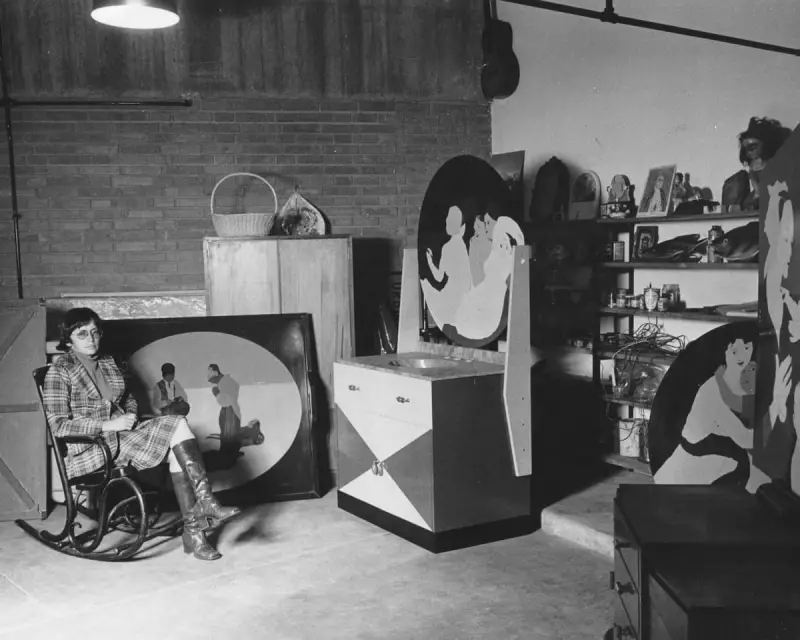
In the 1970s, González began applying her paintings to second-hand furniture sourced from Bogotá’s junk markets. This practice was a sharp critique of the middle-class fetishisation of Western culture. She repurposed items like mirror stands and dressers, adorning them with versions of masterpieces such as the Mona Lisa or Filippo Lippi’s Madonna and Child. For the 1978 Venice Biennale, where she represented Colombia, she created Telón de la Móvil y Cambiante Naturaleza, a kitschy copy of Manet’s Le Déjeuner sur l’Herbe painted on a large, concertinaed curtain.
The political dimension of her work intensified dramatically following the 1985 siege of the Palace of Justice in Bogotá by the M-19 guerrilla group, which left nearly a hundred dead. “It was as though a veil had been lifted,” she said. This trauma directly inspired works like Señor Presidente, Qué Honor Estar Con Usted en Este Momento Histórico (1987). Based on a press photo of President Belisario Betancur, one version chillingly replaces a ceremonial bouquet with a charred corpse.
International Recognition and Personal Freedom
Born in Bucaramanga in 1932, González initially studied architecture before switching to art at the Universidad de los Andes in Bogotá, graduating in 1962. Her first solo exhibition was held in 1964. She credited her artistic freedom to the support of her family and her husband, architect Urbano Ripoll, whom she married in 1964 and who died in 2024. “I could create without caring if my work was commercial or popular,” she noted.
While serving as chief curator at the Museo Nacional de Colombia from 1989 to 2004, her international reputation grew. Major retrospectives of her work were held in Caracas (1994) and New York (1998). The last decade saw her canonisation accelerate, with significant exhibitions at Berlin’s KW Institute, Madrid’s Reina Sofía, and Miami’s Pérez Art Museum. A major retrospective is scheduled to open at the Barbican Art Gallery in London next month, having travelled from the Pinacoteca in São Paulo.
Beatriz González’s work, often using a bright, “shocking and out of tune” palette to depict anguish and mourning, ensured that the pain of history was not forgotten. She is survived by her son, Daniel, and two grandchildren, Antonio and Valentina.