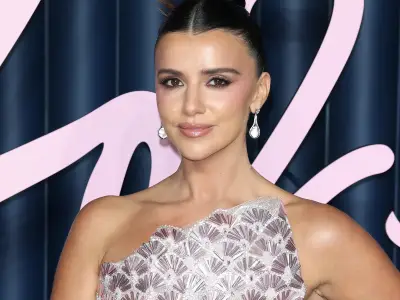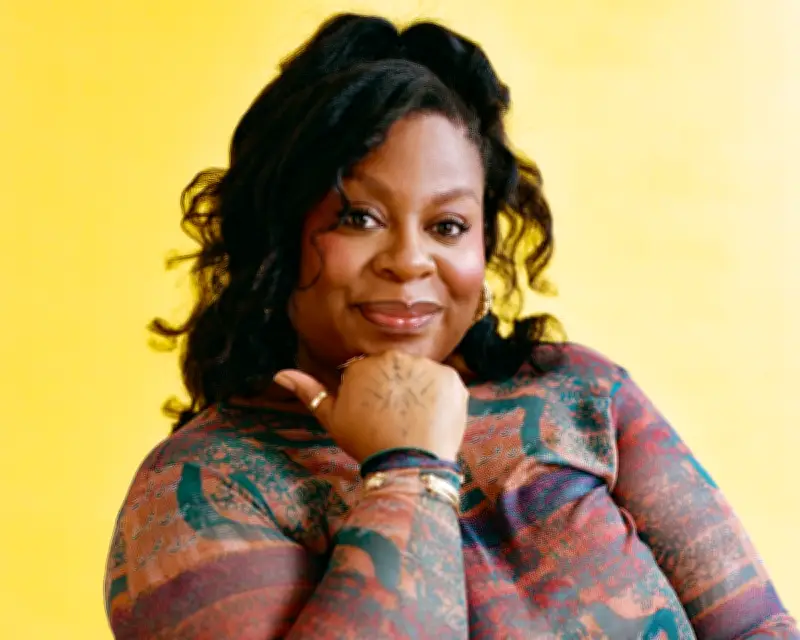
Candice Carty-Williams has spent years deflecting questions about whether she is Queenie. It is an understandable assumption: her bestselling debut novel followed Queenie Jenkins, a twenty-something south London journalist navigating heartbreak, racism, and terrible men. Like Carty-Williams, Queenie is Black, from south London, and works in media.
When we meet at her bright pink office in Peckham, I avoid the predictable question. But sitting opposite the 36-year-old, I see why the comparison persists. She is warm, quick-witted, and refreshingly free of self-importance. Her hair is wrapped up, under-eye patches working to depuff her face.
“I find Queenie quite annoying actually,” Carty-Williams laughs, preempting any inquiry. “I think a lot of people do. But I quite like that.”

It has been seven years since Queenie exploded onto the British publishing scene. Released in 2019 with the tagline “the Black Bridget Jones” – coined by Carty-Williams herself – the novel sold over half a million copies, won Book of the Year at the British Book Awards in 2020 (making Carty-Williams the first Black writer to do so), and was adapted for television by Channel 4.
Carty-Williams attributes its success to relatability. “I think she’s just a drama queen,” she says. “And people are very interested in that.”
Now, nine years after signing her book deal, she returns with a sequel. The new novel finds Queenie in her early 30s, older and supposedly wiser, but still capable of detonating her own life. She is trapped in a situationship with a noncommittal man she calls “TFL man,” while trying to rekindle things with Frank, the love of her life. Her friends – “the Corgis” – return, and at work she investigates Black maternal healthcare, uncovering troubling information about her own fertility.
For a long time, Carty-Williams resisted writing a sequel. “When I first signed my book deal in 2017, my editor said, ‘We’ll do a two-book deal for you,’” she explains. “But I didn’t want to do a sequel right away. My editor told me to flex a little and try something else.”
Instead, she wrote People Person (2022), about a sprawling family of half-siblings and their wayward Jamaican patriarch. “That was fun,” she says. “But I did rewrite it twice because I’m not very good at landing on things.”
Returning to Queenie only made sense if she could find a story that “blows her life up again.” But because “a lot of Black women read her, I had to be careful about what I’m putting her through, because I’m putting them through it too. People feel very attached to her. So I was like, ‘Let’s come back when she’s in her 30s.’”
One of Queenie’s triumphs was its refusal of Black exceptionalism. Queenie is not polished, noble, or aspirational. She makes bad choices, has terrible sex, and sends regrettable messages. She is self-sabotaging and self-involved. Readers either adore her or cannot stand her. The same is true of Queenie 2.0, and Carty-Williams delights in both reactions.
“I like having fun with my readers,” she says. “And I don’t want to write boring people – you’re alone writing a novel for years. You need to entertain yourself.”
“No one has it all together,” she continues. “I don’t, and I’m 36. I’m OK to go on the journey with her.”
The book tackles motherhood and Black maternal healthcare head-on. Interestingly, while Queenie longs for motherhood, Carty-Williams increasingly suspects she does not want children herself. “I think in my 20s I assumed I would,” she says. Laughing, she adds: “Now? I just don’t think I can be bothered.”
Marriage, similarly, holds little appeal. “It would feel like a trap,” she says insouciantly. “I like being a singular person.”
The themes were partly sparked by her own experiences undergoing fertility testing after a period of prolonged stress. Everything was fine, she says, but doctors immediately discussed IVF and egg freezing. “And I was like: whoa, whoa, whoa. I don’t even know if I want children.”

Researching Black maternal healthcare for the novel proved both shocking and infuriating. She mentions the campaign group Five X More, named after the statistic that Black women in the UK were five times more likely to die during pregnancy, childbirth, or the postnatal period than white women (the gap has narrowed but remains nearly threefold).
In the book, Queenie encounters a Black woman told she is “big and strong” and can “handle the pain” while losing worrying amounts of blood; another whose midwife attributes a difficult labour to her “African pelvis”; and a third denied pain relief despite watching other women receive it.
“When Queenie’s researching in the book, that’s basically my research,” Carty-Williams says. “I put it in almost verbatim because I was so astounded. There’s basically no training around women of different backgrounds. A lot of this stuff is avoidable.”
Carty-Williams grew up in south London, her childhood defined by constant movement. “We were just renting and in council houses constantly,” she tells me. “I’ve lived in, like, 20 houses.”
Her mother is of Jamaican-Indian heritage, while her Jamaican father arrived in Britain at 16 and worked as a taxi driver. He met her mother when he picked her up from shifts as a hospital receptionist. It later emerged he already had three children with a different woman. Books were few at home, but “I lived in the school library,” she says. “I’d read, like, a book a day.” Her mother, who is dyslexic and dyspraxic, stopped reading aloud to her when she was very young. “Then I just took over. I became obsessed.”
Writing did not initially feel viable. “I wanted to do English literature at university, but teachers told me I wouldn’t get the grades. They suggested media studies instead.” In the end she achieved two As and a B. “They predicted me three Cs,” she says. “I was in all the lower sets because I talked too much. Apparently, I had behavioural issues. A lot of it was that I was just bored.”
After getting an internship at a Brixton publisher, she eventually worked in marketing at 4th Estate. There, in her early 20s, she began to understand the industry’s shape – and what was missing.
“I was, like: there isn’t anything written by anyone like me,” she says. That frustration became the 4thWrite prize, a scheme for unpublished Black, Asian, and minority ethnic writers run with the Guardian. “The prize is one of my babies,” she says. “Everyone was really receptive to it. But I also recognised things weren’t moving fast enough. So I was, like: OK, I’ll just write the book myself.”
In 2024, five years after Queenie’s publication, the TV adaptation arrived. When I ask what it was like to be showrunner and lead writer, she pauses. “I’m trying to think of the best way to talk about this,” she says. “Because I’ll get in trouble.” Another pause. “It was probably the worst professional experience of my life. I tried to quit three times. And because of that, I don’t want to develop anything for the screen ever again.”
It should have been a dream scenario: as soon as the novel became a bestseller, television companies jostled to adapt it. Carty-Williams met about 13 production companies before choosing one. “I guess what I thought development would be … did not come to fruition.”
She felt her novel was constantly second-guessed, the subtlety of the Black experience reduced to crude stereotypes. At one meeting, someone suggested opening the show with a white character using the N-word within the first five minutes “to really grab people.” “I was, like, this shit ain’t for me,” she says. “That’s not the story I’m telling.”
“I love collaboration,” she continues. “But when people who do not look like you are questioning a character who looks like you, it feels bizarre … you feel crazy.”
The irony is difficult to miss. Queenie became a literary phenomenon precisely because readers recognised something truthful in its depiction of a young Black British woman. Yet in adapting it, Carty-Williams often defended that truth against people who fundamentally mistrusted it.
The toll was severe. “It made me really physically sick … really paranoid,” she says. But by production, she felt unable to walk away. “There were so many people’s jobs on the line. I remember thinking, you’ve just got to take this one on the chin.”
The adaptation received mixed reviews. Some praised its performances and emotional ambition; others were less convinced. A Guardian review described the series as “strangely preoccupied with whiteness,” with depictions of Black womanhood “so basic that it is hard to imagine Black female audiences being impressed by its insights.”
Was she happy with the finished result? “No,” she answers immediately. However, she is quick not to render the whole experience a write-off. “I worked with some incredible people. I would work with them again, but a lot of it was just difficult and painful.”
The experience also left her thinking about the industry that produced the book, echoes of which are reflected in the sequel.
The publishing landscape Queenie entered in 2019 feels different now. In the aftermath of Queenie’s success and the racial reckoning of 2020 – “black square summer,” as Carty-Williams dubs it – publishers scrambled to acquire novels by Black writers. “There was definitely a wave. [After Queenie came out] people were literally pitching books by saying: ‘We’re going to market this like Queenie.’”
In the sequel, Queenie faces media types who indulge in aggressively meaningless diversity language. “It was inspired by what I’ve gone through,” she says. “People saying things to my face like: ‘We need an urban injection’; ‘We need something Black-facing.’ What does that even mean?” Now, much of the institutional enthusiasm has evaporated. “All the diversity schemes disappeared. Because organisations realised people would get annoyed about them.”
The impact of Queenie on Carty-Williams’s own life was profound. She bought a house, a huge milestone after her peripatetic childhood. The novel also brought stability. “Honestly, my biggest expenditure is therapy. That’s the biggest luxury.” She has little interest in literary celebrity. “I don’t go on holiday a lot; I work a lot. I like a quiet life.”
What comes next? She wants to try other forms, like a book of essays – but not yet. “Can I do it in my 40s?” she asks, laughing. “I feel like I’ll have lived a bit more then.” For now, she is circling ideas for her next novel, including one about parasocial relationships.
Longer term, she talks about returning to publishing as her “end goal” – but not as she once knew it, with all the emotional labour around representation. “I’ve done a lot of the work. And I’m tired of it. It’s a lot for one person to do. I’d want to go in there and be able to enjoy my work, but also to keep representing and make sure that good things are published.”
And Queenie? Will we see a return to the character who changed everything? She pauses and smiles. “Yeah, I have to. I don’t know when that will be.” She leans back. “I’d like to because I’ll miss her and I’ll miss everyone. There are still things to work out – Queenie and Frank’s status, Kyazike, Cassandra.”
“But again,” she adds, “we have to have something to blow her life up.”
Queenie Is Working on It is published on 2 July by Trapeze. The 4thWrite prize longlist will be announced on 31 August, the shortlist by 30 September, and the winner in October.