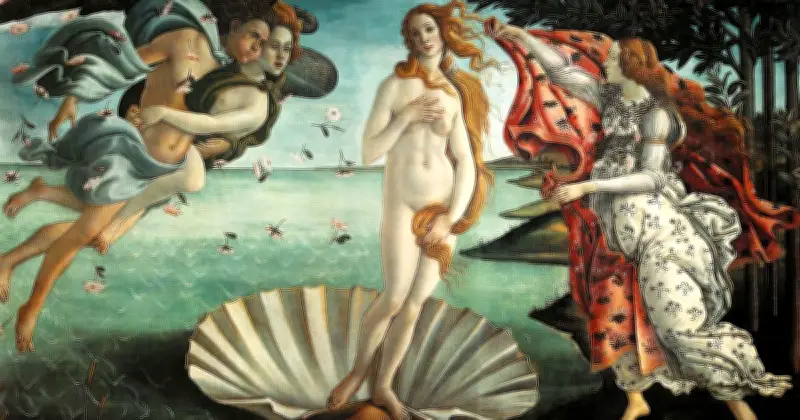
A mysterious detail in Botticelli's famous painting 'The Birth of Venus' may finally be explained by a new study. Researchers from the United Kingdom and Italy believe the artwork contains hidden clues about the tragic health condition of the muse, Simonetta Vespucci, who died at just 23 years old.
Painted in the mid-1480s, 'The Birth of Venus' depicts the goddess Venus arriving on a shell, surrounded by figures. One notable feature is Venus's slightly misaligned eyes, which scholars have long debated. Now, a team from Queen Mary University of London (QMUL) and Universita Campus Bio-Medico di Roma suggests this 'side-eye' could be a sign of a pituitary adenoma, a usually benign brain tumour.
Clues in the Painting
The study, published in the journal Endocrinology, Diabetes & Metabolism, expands on a theory first proposed in 2019. Researchers used a facial recognition algorithm on five portraits of Simonetta to confirm the diagnosis. They also noted that Venus appears to be lactating in the painting, despite Simonetta having no children. This, along with other facial changes, may indicate a prolactin-growth hormone secreting adenoma.

Historical Evidence
Historical letters describe Simonetta collapsing at a ball and suffering from headaches, hallucinations, vomiting, and fever in her final days. These symptoms align with a rapidly expanding pituitary tumour, a condition not discovered until the 1930s. Professor Paolo Pozzilli, senior author of the study, stated: 'This could show the real physical symptoms of a prolactin-growth hormone secreting adenoma.'
The study provides a fascinating intersection of art and medicine, offering a plausible explanation for both the artistic choices of Botticelli and the untimely death of his muse.