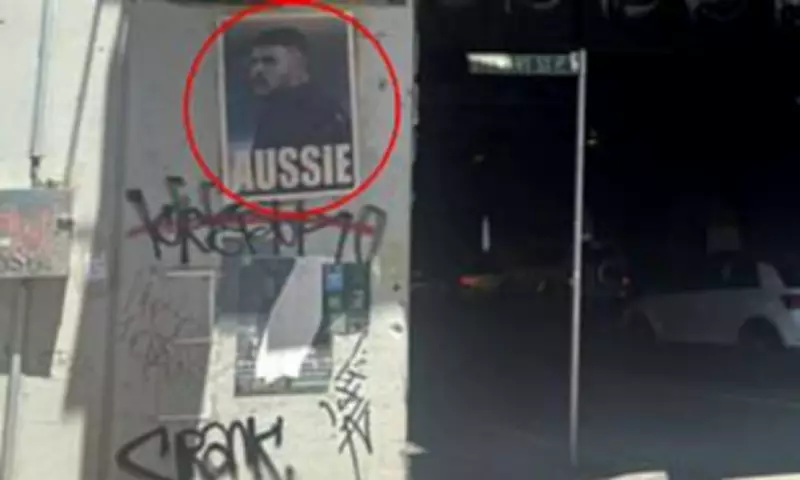
High-profile artist Peter Drew has launched a scathing attack on copycat poster creators, branding them as "gutless" for appropriating his iconic design to feature alleged Bondi Beach shooter Naveed Akram. The controversial posters, which have appeared around Melbourne in recent weeks, show Akram with the capitalised word 'Aussie' in a clear imitation of Drew's celebrated artwork.
Copycat Campaign Sparks Outrage
Approximately forty posters have been spotted across Melbourne featuring Naveed Akram, who is currently facing fifty-nine charges including fifteen counts of murder and forty counts of wounding with intent to murder. The alleged offences relate to the December fourteenth incident when Akram and his father reportedly opened fire on a crowd celebrating Hanukkah by the Sea at Bondi Beach.
The copycat posters represent a poor-quality imitation of Drew's distinctive artistic style, utilising the same font and colour palette that has become synonymous with his work. This unauthorised adaptation has drawn widespread condemnation from both the artistic community and local authorities.

Artist's Vision Versus Copycat Agenda
Peter Drew rose to prominence in 2016 with his poster series celebrating the diversity of Australian identity as a direct response to rising anti-immigration sentiment. His original works feature historical figures including Afghan cameleer Monga Khan, a young Jewish boy, and more recently, the great-grandfather of New South Wales Nationals leader Gurmesh Singh.
Speaking to 3AW Drive host Jacqui Felgate, Drew expressed his profound disappointment with the copycats, stating: "I think it's pretty gutless... Fundamentally the difference between me and them is that I believe in Australia and I love Australia."
The artist elaborated on the philosophical divide between his work and the imitators' agenda: "I think they don't believe in Australia, and they can't make a positive poster about Australia. They can only make these negative posters that nobody wants."
Political and Community Response
City of Melbourne Lord Mayor Nick Reece described the Akram posters as defying comprehension, labelling them "sick" and confirming that the council would not tolerate such hateful material. He emphasised: "This has been clearly a deliberate and organised exercise to shock and spread hate, and we are not going to tolerate it at the City of Melbourne."
Similarly, City of Yarra Mayor Stephen Jolly confirmed he had instructed council officers to immediately remove a poster displayed on Punt Road. The swift response from municipal authorities underscores the seriousness with which they view this inflammatory campaign.
Historical Context of Appropriation
This incident marks not the first time that Drew's distinctive artistic style has been co-opted for controversial purposes. In 2016, copycat posters emerged featuring convicted sex offender Rolf Harris and Melbourne teenager Jake Bilardi, who gained notoriety for joining the Islamic State terrorist organisation.
Drew challenged his imitators directly during his radio interview: "I challenge them to make something positive that people actually want, and I challenge them to put their name to it as well, if they have any courage."
Community Solidarity and Australian Values
Executive Council of Australian Jewry president Daniel Aghion told The Age that the posters were "devastating and disrespectful" both to the Bondi victims and to Peter Drew's artistic legacy. He offered a powerful counter-narrative: "The Bondi terrorists will fade into history and their names will be forgotten. The people who will be remembered are the victims, the survivors, and the heroes who rushed in to help. They represent the true Aussie spirit."
Drew further distinguished between his patriotic vision and what he perceives as the copycats' distorted perspective: "I'm a patriot. I think most of the people listening are patriots. People who love Australia, we love it the way it is - and we want to keep it being a welcoming, peaceful place. But they have a different idea of Australia, which is based on a fantasy of Australia that never was."

The artist concluded with a powerful defence of his original artistic vision: "The photographs in my posters are of people that lived here 100 years ago. They lived here. They worked here. They died here. Some of them were born here as well. And if they're not Aussies, then who are we to say what is."