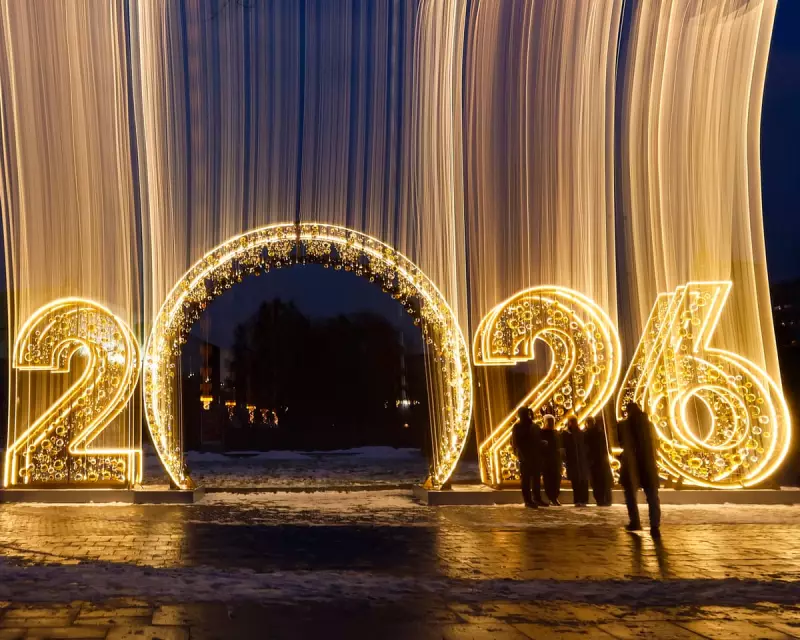
As the curtain falls on 2025, mathematicians and puzzle enthusiasts across the UK are taking a final moment to appreciate its unique numerical properties. The year just passed held a special distinction in this century: it was a perfect square.
A Square Year to Remember
The mathematical charm of 2025 lies in the fact that it is the square of 45. This places it in a neat sequence of square years: 1936 (442), 2025 (452), and 2116 (462). Even more delightfully, the number 45 itself breaks down into 20 and 25, creating the dazzling pattern where (20 + 25)2 equals 2025. It was a brief, perfect moment of numerical harmony for the ages.
But as the calendar turns, a new challenge awaits. The focus now shifts to the number 26 and the coming year of 2026. In his latest Monday puzzle column, Guardian mathematician Alex Bellos invites readers to test their problem-solving skills with a deceptively simple task.

The "Auld Lang Signs" Challenge
The puzzle presents an example: the number 26 can be made using six 1s with the expression (1+1) × (1+1+11). The new challenge is to find expressions equal to 26 using a specific set of digits. The rules allow for the four basic operations—addition, subtraction, multiplication, and division—along with brackets, exponentiation (like 11), and concatenation (joining digits, such as making '11' from two 1s).
The full list of challenges is to create expressions equal to 26 using:
- Five 9s
- Six 8s
- Six 7s
- Six 6s
- Four 5s
- Six 4s
- Four 3s
- Four 2s
Bellos, who has been setting puzzles in his alternate Monday slot since 2015, will reveal the solutions at 5pm UK time. He has requested no spoilers, instead encouraging readers to share their favourite facts about the number 26 while they ponder the problems.
The Magic Behind the Numbers
The puzzle draws inspiration from the work of Inder Taneja, author of the website numbers-magic.com. Taneja has explored the properties of the coming year in his paper 26 and 2026 in Numbers and Magic Squares, which is filled with further numerical curiosities.
This blend of playful challenge and deep numerical theory highlights the enduring appeal of recreational mathematics. It turns the page from a year defined by a neat square to one inviting creative calculation. For those with a puzzle to suggest, Bellos remains on the lookout and can be contacted by email.