As a new term begins and with a new prime minister in office, the question of what students study in English lessons is back in focus. For the first time, the UK has a prime minister who studied for an English degree. While many of his predecessors favoured history, classics or philosophy, politics and economics, reading fiction is seen as vital preparation for life, helping young people understand others and the times they live in.
Novels encourage empathy, allow readers to stand in other people's shoes and navigate complicated emotions, while also entertaining and bringing joy. The creative industries contribute around £145.8bn each year to the UK economy, described as the country's soft superpower.
Decline in reading for pleasure
There has been a marked decline in recent years in the number of children reading for pleasure. The National Literacy Trust has designated 2026 the National Year of Reading. After a 20-year low in 2025, when 32.7% of eight-to-18-year-olds said they enjoyed reading in their free time, that figure has risen to 36.1%.
GCSE English is also undergoing a long-overdue curriculum renewal, prompting the question of whether what is studied in school helps young people fall in love with reading – or puts them off for life.
Since GCSEs were first introduced in 1986, four main examination boards have been established in England and Wales, with surprising unanimity in the choice of books most schools teach. In 2025, the charity End Sexism in Schools released a report, Manopolies, revealing that 76% of students study An Inspector Calls by JB Priestley for their modern text from a possible 21, and 93% study either A Christmas Carol by Charles Dickens or The Strange Case of Dr Jekyll and Mr Hyde by Robert Louis Stevenson for their 19th-century novel from nine possible texts. Only 5% of students in England and Wales study a female-authored text at GCSE.
Authors' suggestions for the curriculum
While diverse modern works by inspirational women are on the lists of the four exam boards, schools are disincentivised to change texts due to costs and additional work. No exam board wants to remove popular texts because of commercial disadvantage and developmental costs. It is essential that the Department for Education, as part of this review, mandates the regular changing of set-text lists and stipulates that students study works reflecting the gender balance and diversity of society.
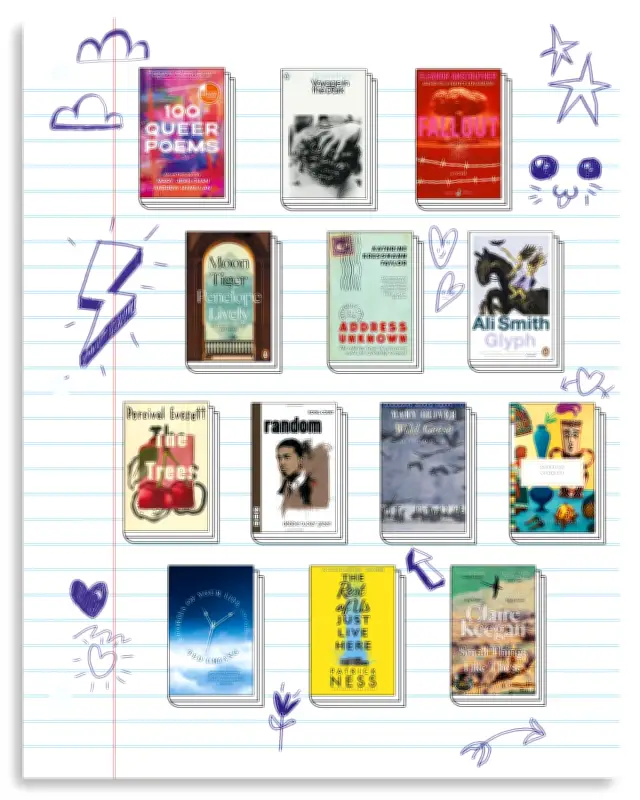
Writers including Kate Mosse, Ben Okri and Samantha Harvey have offered their suggestions for texts to inspire a passion for fiction in young readers. Nussaibah Younis recommends The Trees by Percival Everett, a satire on racism and generational guilt. Frank Cottrell-Boyce suggests Ted Chiang's science fiction collection Stories of Your Life and Others, noting that short stories work well in the classroom because reading is best when shared.
Patrice Lawrence recommends the play Random by Debbie Tucker Green, which follows a Black working-class London family after their teenage son is stabbed and killed. David Mitchell picks The Rest of Us Just Live Here by Patrick Ness, a novel about five teens navigating a difficult year, which proves that great fiction can be as compelling as a video game.
Hollie McNish, after helping her daughter revise for GCSE English, suggests Wild Geese by Mary Oliver, noting that the set texts she studied shared themes of blood, death and violence. Ben Okri recommends African Stories, an Everyman anthology he edited, bringing together 36 classical African stories written in or translated into English.
Brevity and diversity in set texts
Kamila Shamsie chooses Small Things Like These by Claire Keegan, noting that the most often assigned GCSE texts have a word count under 30,000, which allows space for Keegan's brilliance. Andrew McMillan suggests 100 Queer Poems, co-edited with Mary Jean Chan, emphasising the importance of LGBTQ+ representation in school libraries and curricula.
Kit de Waal recommends Fallout by Eleanor Anstruther, a fictionalised account of the Greenham Common protest seen through the eyes of a rebellious 15-year-old girl. Geoff Dyer picks Voyage in the Dark by Jean Rhys, praising the writer's novels for their quality and brevity. Samantha Harvey suggests Moon Tiger by Penelope Lively, a life story and love story about a woman on her deathbed ransacking her memories.
Benjamin Myers recommends Address Unknown by Kathrine Kressmann Taylor, an epistolary novel about two business partners from 1932 to 1934, challenging notions of friendship, loyalty and antisemitism. Raymond Antrobus picks Glyph by Ali Smith, a novel that threads a story through three wars and asks what it means to watch history repeat itself.