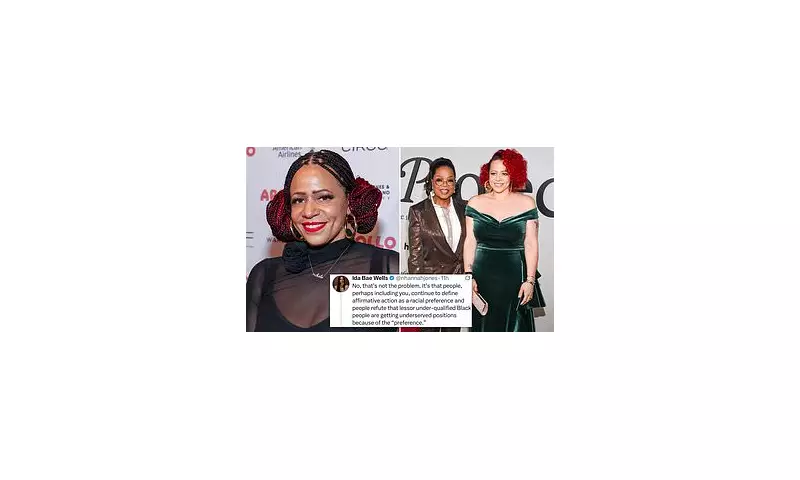
Award-winning journalist Nikole Hannah-Jones, the creator of the contentious 1619 Project, has found herself at the centre of online mockery after committing two glaring spelling mistakes in a social media post defending affirmative action.
The Controversial Post and Its Errors
The incident occurred on Friday when the 49-year-old writer, a staffer for The New York Times, took to the platform X to respond to a claim by journalist Matthew Yglesias. Yglesias had suggested that some supporters of affirmative action undermine their own arguments by denying the practice exists.
In her reply, Hannah-Jones wrote: 'No, that's not the problem. It's that people, perhaps including you, continue to define affirmative action as a racial preference and people refute that lessor [sic] underqualified Black people are getting underserved [sic] positions because of the "preference."'

Users swiftly identified two misspellings: 'lesser' was written as 'lessor' and 'undeserved' as 'underserved'. Critics also highlighted a grammatical error, noting she misused the word 'refute' when 'insist' would have been correct.
Backlash and Deletion
The reaction was immediate, with many expressing astonishment that the errors came from a Pulitzer Prize-winning journalist who holds a tenured position at Howard University and a seat in the American Academy of Arts and Sciences.
Despite initially telling a commenter she 'stands behind' her view and had no plans to remove the post, Hannah-Jones later deleted it. Her X profile states she 'left' the platform following Elon Musk's 2022 acquisition, but she has evidently returned.
The episode has reignited discussions around Hannah-Jones's high-profile work and public statements. She previously criticised 'rich white people' after the Supreme Court outlawed affirmative action in 2023—a policy established 62 years prior by President John F. Kennedy.
Context: The 1619 Project and Ongoing Debates
Hannah-Jones won the Pulitzer in 2020 for her work on The 1619 Project, a New York Times initiative launched in 2019 that reframes American history by placing the consequences of slavery at its core. The project has faced significant criticism from historians and politicians across the spectrum for its historical interpretations.
Key assertions from the project include the claim that a primary reason colonists sought independence from Britain was to protect slavery—a line later amended to 'for some of the colonists' after historian pushback. It also argued the American Revolution was fought to preserve slavery and questioned the revered status of Abraham Lincoln.
Hannah-Jones, who owns a $1.7 million Brooklyn townhouse, has been a vocal figure on racial issues. She has claimed Latino 'anti-blackness' helped elect Donald Trump, criticised anti-theft measures in stores, and publicly supported former Harvard President Claudine Gay after plagiarism allegations.
The Supreme Court's decision to end affirmative action agreed with critics who argued the policy had achieved its purpose and was later disadvantaging white and Asian applicants. Hannah-Jones's latest online misstep has further fuelled the fierce cultural and political debates she so often inhabits.