Families of Venezuela's Political Prisoners Demand Release Amid 'Farce' of Drip-Feed Freedoms
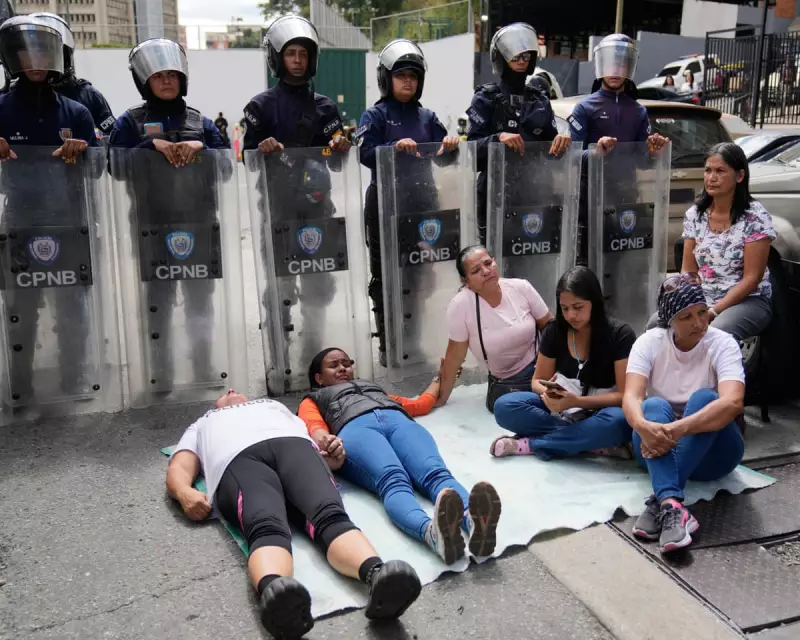
In the tense aftermath of Nicolás Maduro's dramatic seizure by US forces, relatives of Venezuela's political prisoners have gathered outside the Zona 7 detention centre in Caracas, lying down in protest before riot police. This poignant act underscores their desperate plea for the immediate release of hundreds still incarcerated, as critics decry the regime's sluggish and selective freeing of detainees as a mere political manoeuvre.
A Waiting Game Outside Prison Walls
For over a fortnight, about twenty women, including some in their seventies, have camped outside the east Caracas jail, refusing to leave without their loved ones. Mileidy Mendoza, 30, whose partner Eric Díaz is held inside, voiced her frustration: "I'm staying right here ... we aren't going anywhere without our relatives." She highlighted the urgency, referencing a recent death in custody, and questioned the delays: "What are they waiting for? For someone else to die?"
The releases were announced on 8 January, just days after Delta Force commandos captured Maduro and took him to New York. Acting leader Delcy Rodríguez hailed this as evidence of "a new political moment" in a nation that has descended into dictatorship amid economic turmoil. However, human rights groups report that only around 250 prisoners have been freed, leaving more than 600 political detainees languishing in Venezuelan jails.

Critics Label Releases a 'Drip Drip' Strategy
Orlando Moreno, a human rights activist in hiding, argues that the piecemeal approach is a calculated attempt by Maduro's successors to reduce international pressure without enacting real change. "There hasn't been a true liberation of prisoners. There have been some releases," he said, noting that new arrests, such as Alfredo Márquez's on 12 January, continue unabated. "While some are going out the front door, others are coming in through the back."
Among those still imprisoned is prominent opposition figure Juan Pablo Guanipa, who played a key role in the movement believed to have defeated Maduro in the 2024 election. His son Ramón, a 29-year-old psychology student, recounted a brief visit: "The first thing he said to me was that he wouldn't bow down to these people, not even behind bars." Despite rumours of his father's release, Guanipa remains in custody, with Ramón speculating: "I assume something happened along the way. There was some kind of hitch."
Anonymous Citizens Caught in the Dragnet
Not all prisoners are high-profile; many, like Eric Díaz, are ordinary citizens ensnared in the regime's crackdown on dissent. Mendoza explained that Díaz, a father of two, worked for the government until his arrest in November for an unexplained crime called "phone pairing." She lamented the broken promises: "When they announced [the release] we thought they were all going to be freed. But it's just been a farce."
Outside the prison, families have set up makeshift camps, with wooden crate tables stocked with Venezuelan pastries and coffee, symbolising their resilience amid despair. These scenes starkly contrast with joyful reunions shared on social media, where released prisoners embrace loved ones after years apart, wrapped in the national flag.
International Scrutiny and Regime Survival Tactics
Experts like Javier Corrales, author of Autocracy Rising, caution that the releases do not signify an end to repression. "Releasing [political] prisoners is always an amazing thing ... But it means nothing ... in terms of ending the repression," he stated. The interim administration, led by Rodríguez, has reshuffled her cabinet but retains key figures like interior minister Diosdado Cabello and defence minister Vladimir Padrino López, who are accused of orchestrating the crackdown.

Orlando Pérez, a Latin America expert, suggests the regime's strategy is to offer cosmetic concessions to satisfy the US, particularly under Donald Trump's pressure, without genuine democratisation. "These are not the actions of a regime that's in the process of democratising. They're the actions of a regime that's in the process of trying to pragmatically consolidate power under a new context," he explained, calling it a "survival mechanism."
Hope and Hardship in the Encampments
Beyond Caracas, in towns like Guatire, families have pitched tents outside maximum security prisons such as Rodeo I. Massiel Cordones, whose son José Ángel Barreno Cordones is serving a 30-year sentence for alleged treason, travelled seven hours to join the vigil. "I won't lie, staying here is exhausting, but because I have this hope that my son is going to get out, the days just fly by," she said, relying on local solidarity for food and shelter.
At night, protesters unite in prayer and sing Venezuela's national anthem, its lyrics echoing their cries for freedom: "Down with chains!" and "Let's scream out loud: 'Death to oppression!'" For these families, the wait continues, with Cordones summing up their collective yearning: "The only thing truly missing for us is to see our children released – to see those doors swing open and freedom arrive."