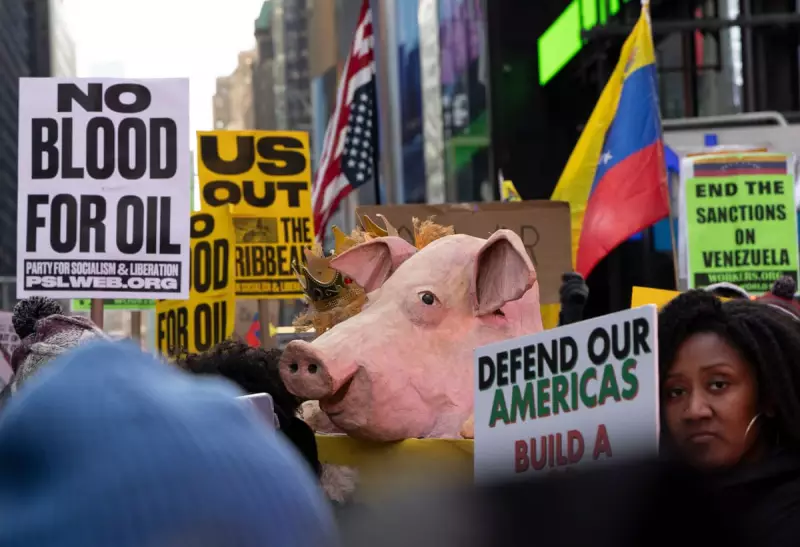
In Manhattan, demonstrators gathered to protest against recent US military actions in Venezuela, including the bombing and capture of President Maduro. This visible dissent highlights growing concerns about international intervention strategies, but it represents just one facet of a broader, more insidious conflict.
The Quiet War: Sanctions as Geopolitical Weapons
Across borders, cultures, and faiths, ordinary people universally seek fundamental human needs: the ability to earn a living, secure shelter, feed their families, and nurture their children's futures. These are not radical aspirations, yet they are increasingly sacrificed on the altar of geopolitical ambition. When governments prioritise power and profit over the populations they claim to serve, the consequences are profound, particularly when control over another nation's resources, markets, or political direction becomes the objective.
By 2026, the pattern has become unmistakable. Warfare is no longer confined to conventional battles with bombs and soldiers; it has evolved to include its quieter, yet equally destructive sibling: economic sanctions. These coercive measures encompass a broad spectrum of restrictions, including trade and investment barriers, financial controls, banking blacklists, asset freezes, and visa and travel limitations.

The Human Cost of Coercive Diplomacy
Deployed under the language of democracy and human rights, sanctions are routinely weaponised against weaker states that deviate from Western governance and market capitalism orthodoxy. The consequences for societies that often pose no genuine threat, but simply refuse political subordination, are devastating. Sanctions are not benevolent instruments wielded by guardians of human rights; they represent a form of economic warfare where civilians become collateral damage.
Although sanctions are frequently marketed as "targeted" measures aimed at elites, corrupt officials, or illicit industries, in practice they function as broad blocks on trade and finance that ripple destructively through entire populations. Empirical research confirms that sanctions in Latin America and the Caribbean significantly reduce economic growth, exacerbate income inequality, and amplify poverty, with financial and trade restrictions proving among the most damaging.
Four Decades of Economic Strangulation
For more than forty years, governments from Washington to London and Brussels have wielded sanctions as instruments of pressure, presented as principled diplomacy. The lived reality across the Caribbean and Latin America is stark and unyielding. In nations including Cuba, Haiti, Nicaragua, and Venezuela, sanctions have transformed into mechanisms of sustained economic strangulation – deepening poverty, stalling development, and entrenching dependency.
It is tempting to perceive US foreign policy as oscillating between hawks and doves, from Reagan to Trump. Yet from Managua in 1985 to Caracas in the present day, the consistent pattern reveals sanctions as strategic leverage, justified alternately by anticommunism, the "war on drugs," the "war on terror," human rights concerns, or, more recently, geopolitical competition with Russia and China.
Case Studies in Coercion
The Reagan administration's 1985 embargo on Nicaragua laid this reality bare. By prohibiting trade and transport, it severed vital economic lifelines, precipitating recession and widespread hardship. The measures were so sweeping that the International Court of Justice ruled they breached bilateral treaty obligations. In Nicaragua, the legacy of embargo and isolation under successive sanction regimes has contributed to economic stagnation and dependency on remittances – which today constitute a quarter of GDP – while political repression has only intensified.
If Nicaragua reveals how sanctions operate as overt confrontation, Cuba demonstrates what permanent economic siege entails. The US has maintained its embargo since 1962, tightening it further through the 1992 Cuban Democracy Act and the 1996 Helms-Burton legislation. Estimates suggest the cumulative cost to Cuba reaches hundreds of billions of dollars. The consequences are visceral: Cuba's prolonged economic contraction, with its chronic blackouts, shortages of food and medicine, and declining tourism revenue, are all inextricably tied to sanctions.

Venezuela, once one of Latin America's wealthiest oil exporters, illustrates how sanctions compound suffering. Assets worth billions have been frozen in Western banks, curtailing the government's ability to pay for essential imports, fuel, and services. In January 2026, this coercion culminated in the kidnapping of the Venezuelan president and his wife, escalating economic siege into extraterritorial force.
The Perverse Impact on Haiti
The impact is perhaps most perverse in Haiti. Crippled by centuries of debt and external interference, Haiti exposes the moral incoherence of sanctions. Framed as driven by humanitarian or security concerns, the imposition of financial restrictions, banking de-risking, diplomatic isolation, and travel advisories have further severed Haiti from global trade. Sanctions have deepened poverty, decimated state capacity, and accelerated displacement. Haiti has been punished not for defying the global order, but for being too weak to comply.
Outside the Caribbean, sanctions on Iran confirm a parallel pattern. Sweeping restrictions on oil, banking, and trade have slashed export revenues, driven chronic inflation, and sharply reduced living standards while failing to deliver the political outcomes promised by their architects. As in Cuba, Venezuela, and Haiti, sanctions have functioned less as precision tools against elites than as blunt instruments of economic attrition.
Shifting Rationales and Real Consequences
The rationale for sanctions has shifted over time. During the Cold War they were tools to counter Soviet influence; today they are wielded to deter states in the Global South from forming ties with China and Russia. As Washington attempts to reassert hemispheric dominance by resurrecting the colonial Monroe Doctrine, countries have responded by diversifying their foreign relations and deepening exchanges with China, Russia, and others – a move that sanctions seek to punish.
This has tangible economic consequences: sanctions can create a chilling effect on investment, dissuading international banks from engaging with small economies for fear of secondary sanctions, thereby driving up costs and widening financial exclusion. In the Caribbean, where industries such as oil and gas, mining, and others depend on foreign capital and global supply chains, this de-risking has measurable, detrimental impacts.
Ordinary Citizens Bear the Heaviest Burden
Rather than pressuring elites into political reform, it is ordinary citizens who pay the heaviest price – through rising poverty and forced migration. Economic sanctions are a key driver of migratory flows from Cuba, Venezuela, and Nicaragua. When economies are throttled and survival becomes untenable, people vote with their feet. Visa restrictions and asset freezes are often portrayed as peripheral, but in aggregate they compound exclusion. They limit tourism – a lifeblood for many Caribbean states – and deter diaspora engagement via remittances and investment.
Sanctions are frequently defended as a humane alternative to war – a moral instrument for advancing democracy and human rights. History suggests otherwise. In US interventions, from Grenada to Panama, coercion has repeatedly been cloaked in the language of liberation while leaving long-term instability in its wake. From Reagan's Cold War interventions to Trump's naval seizures in the Caribbean targeting Venezuelan oil, the machinery of force and economic coercion has barely paused.
A Legacy of Intervention
The US has been the most interventionist power in modern history. Research indicates that from the start of the 19th century, when Haiti became the second country in the Americas to gain independence, until 2022, the US carried out approximately 477 military and political interventions, with 114 of these occurring after 1989.
From the Caribbean and Latin America to the Middle East and Africa, where dozens of interventions have taken place, regime-change efforts have followed a grimly consistent pattern: short-term coercion, long-term sanctions and destabilisation, and decades of economic and institutional damage. When this cumulative record is considered, a pressing question emerges: who are the real agents of terror in the modern international order?
Towards a More Humane Approach
If the aim were genuine human security, expanding humanitarian exemptions, ensuring financial access for food and medicine, and supporting multilateral global development would prove more effective than prolonged embargos. Instead, sanctions remain tools of geopolitical leverage, wielded disproportionately by powerful states.
For millions across the Caribbean and Latin America, the real war is not against terrorism or competing ideologies, but against the slow attrition of economic opportunity and dignity that accompanies sanctions. If Western powers truly seek stable, democratic, and prosperous neighbours, they must pursue engagement grounded in shared prosperity rather than domination and greed.