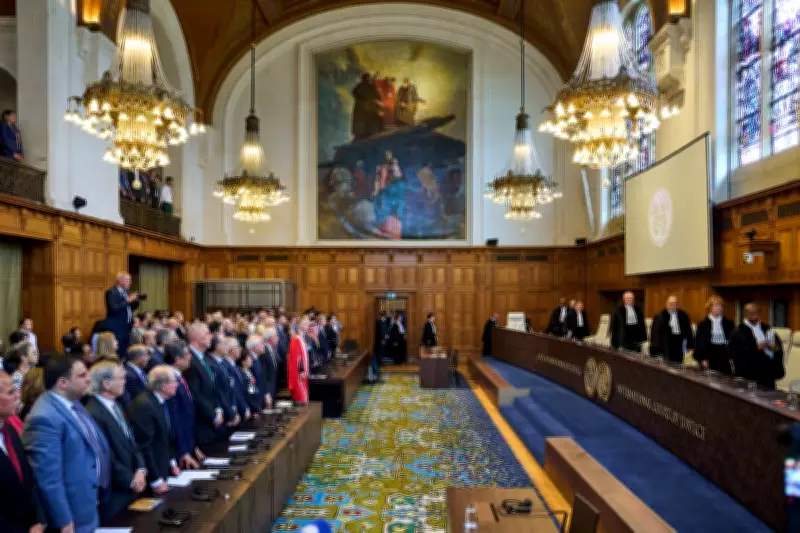
The International Court of Justice, often referred to as the World Court, currently faces a monumental test of its authority and purpose. The historic trial of The Gambia v Myanmar, examining allegations of genocide against Myanmar's Rohingya minority, represents far more than a legal proceeding about one nation's actions. This case stands as a crucial examination of whether international law retains meaningful power to protect vulnerable populations and hold states accountable for systematic atrocities.
A Courtroom Battle with Global Implications
Within the Peace Palace in The Hague, beneath Albert Besnard's symbolic painting "Peace and Justice," legal teams present arguments that will determine not only justice for the Rohingya people but the very credibility of international legal institutions. The Gambia's case alleges that Myanmar's 2017 campaign in Rakhine State constituted genocide under the 1948 Genocide Convention, with evidence documenting the destruction of over 390 villages and the forced displacement of more than 700,000 Rohingya into Bangladesh.
Evidence of Systematic Atrocities
Testimony and documentation presented to the court paint a harrowing picture of coordinated violence. Survivors have described soldiers throwing infants into fires, burning people alive, systematic sexual violence, and widespread mutilation of victims. Investigative work by organisations including Fortify Rights has documented evidence suggesting the military prepared months in advance for what became a devastating campaign against the Rohingya population.

Myanmar's defence claims violations were minimal excesses within legitimate counter-terrorism operations against the Arakan Rohingya Salvation Army militant group. The state's representatives have refused to acknowledge the Rohingya by their name, instead referring to them as "Bengali Muslims" - a linguistic erasure that reflects decades of discriminatory policies stripping this minority of citizenship and basic rights.
The Central Question of Intent
The legal heart of this case revolves around establishing genocidal intent. The Gambia's legal team argues that intent can be inferred from patterns: the systematic nature of killings, the strategic use of sexual violence designed to destroy families and prevent births, the comprehensive razing of villages, and long-standing state policies that systematically deprived Rohingya of fundamental rights necessary for survival.
Evidence presented includes dehumanising rhetoric from Myanmar's state organs, including inflammatory speeches by Senior General Min Aung Hlaing, commander-in-chief of Myanmar's armed forces. An affidavit from a senior Meta executive detailed how the company banned Min Aung Hlaing's Facebook page and numerous military-linked accounts for promoting anti-Rohingya hate and violence.
Broader Implications for International Justice
This trial unfolds against a backdrop of growing global cynicism about international law's effectiveness. Powerful states increasingly flout legal norms, conflicts proliferate with apparent immunity from accountability, and faith in legal institutions' ability to restrain violence diminishes. The ICJ's handling of this meticulously documented genocide claim will either reinforce or further undermine confidence in international justice mechanisms.
A Test of Legal Institutions' Legitimacy
Matthew Smith, chief executive of Fortify Rights and part of The Gambia's delegation, observes that what distinguishes The Gambia's approach is its disciplined, evidence-based argumentation - precisely the qualities international justice requires to command legitimacy rather than provoke outrage. The contrast with Myanmar's defence, which has advanced arguments described as implausible and in bad faith, highlights the fundamental challenge facing international courts: maintaining procedural integrity while confronting states that may not engage in good faith.
Myanmar has suggested, without evidence, that tens of thousands of hate-promoting messages posted from military infrastructure over years occurred without authorisation - a claim The Gambia's counsel Arsalan Suleman called "unimaginable" given the military's rigid hierarchy and control.

The Stakes Beyond This Case
Should the world's highest court fail to credibly adjudicate this extensively documented genocide claim, the symbolic promise embodied in the Peace Palace painting begins to fade. Besnard's work, painted in 1914 on the eve of the First World War, represents more than courtroom decoration; it embodies the foundational idea that peace must be argued into being through careful legal judgement.
This case tests whether that ideal can withstand contemporary challenges to international law. With the Rohingya now living in what has become the world's largest refugee camp in Bangladesh, and with Myanmar's military continuing to exercise power, the outcome carries existential implications both for the victims and for the international legal order designed to prevent such atrocities.
The International Court of Justice's decision in The Gambia v Myanmar will reverberate far beyond The Hague, potentially strengthening or irreparably weakening the mechanisms of international justice at a time when they face unprecedented challenges to their authority and effectiveness.