Researcher Unveils 'Paradigm-Shifting' Evidence of Ancient Global Civilization
For generations, conventional archaeologists have firmly rejected the notion that an advanced civilization predated recorded history by tens of thousands of years. Now, an independent investigator asserts he has discovered compelling proof of a sophisticated lost society that deliberately embedded a complex code within ancient monuments worldwide to preserve its wisdom against catastrophic events.
Global Symbolic Network Uncovered
Matthew LaCroix revealed to Daily Mail that his groundbreaking investigation, initiated by a recent Egyptian discovery, has identified interconnected symbols spanning multiple continents that date back an astonishing 38,000 to 40,000 years. According to LaCroix, this prehistoric civilization meticulously tracked cosmic cycles, anticipated global disasters, and encoded profound teachings about human origins, universal structure, and divine existence into sacred sites and monumental architecture across the globe.
The research commenced when LaCroix noticed recurring patterns in ancient stone carvings worldwide, including giant T-shaped formations, three-level indentations, and distinctive step pyramids. "These specific symbols that are built in different size proportions, and the symbols are found in ancient stones around the world, are not supposed to exist; no cultures are supposed to have any cross-platform," LaCroix explained emphatically.

Eastern Turkey as the Origin Point
LaCroix identifies eastern Turkey's Lake Van region, specifically a site called Ionis, as the probable origin of this global symbolic system. He describes Ionis as the earliest source of the civilization's architectural motifs, symbolic language, and esoteric teachings, dating it to approximately 40,000 years old. This location, he argues, preserves the original blueprint that was subsequently transported to distant locations including Egypt's Giza Plateau and South America's Tiwanaku.
Recurring motifs appear at Ionis in their most concentrated form before repeating at geographically separated sites worldwide. These include giant T-shapes, step pyramids, inverted pyramids, lion representations, and intricate sacred geometry. Nearby, the Kefkalesi site provides one of the clearest examples of these symbols preserved in stone.
The Kefkalesi Relief Connection
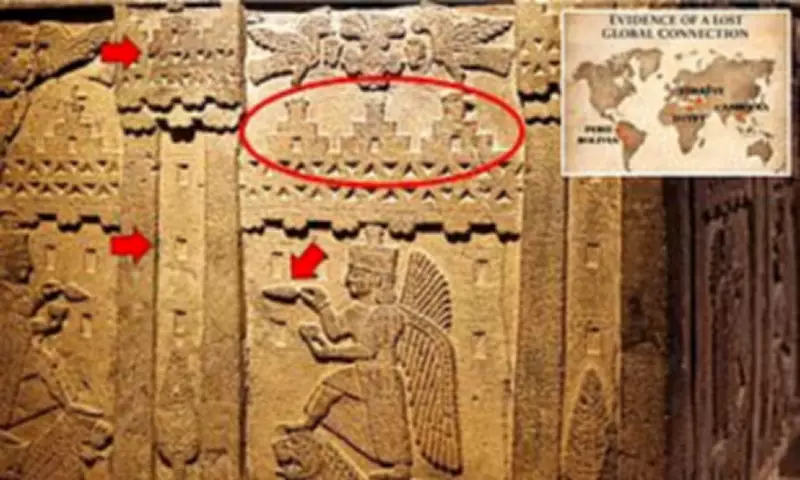
The four-foot-by-four-foot basalt carving known as the Kefkalesi relief contains complex iconography that directly mirrors symbols found at Ionis, Giza, and various South American locations. "This relief became one of the most important artifacts for my research," LaCroix stated. "It connects Egypt back to this region and lets us back-engineer the global pattern."
He highlighted the repeating elements: "Here are the T-shapes, repeating over and over. Here's your step pyramid with three doors and the lion right here. These same elements appear repeatedly across sites worldwide." Regarding the lion symbol, he added, "The lion is a guardian, and its placement helps explain the structure of the code."
LaCroix asserts that the Kefkalesi relief solidified his interpretation of the symbols and accelerated his analysis of similar structures at Egypt's Sphinx Temple. However, mainstream archaeologists date known Lake Van sites to the Urartian period thousands of years later and maintain there is no evidence supporting a pre-Ice Age global civilization. No peer-reviewed research currently supports LaCroix's proposed dating.
Egyptian Breakthrough and Astronomical Dating
LaCroix's breakthrough moment occurred in November 2025 when he re-examined a framed photograph of Egypt's Sphinx Temple he had possessed for eight years. The image, showing the Sphinx Temple positioned before the statue and closed to the public, revealed what he believes is an inverted step pyramid embedded within the structure.
"There, in front of me. It was like I had never seen it before. There was the inverted step pyramid, but the right side had been broken off," he recounted. This realization prompted LaCroix to thoroughly analyze the entire Giza Plateau, where he identified repeated appearances of inverted step pyramids and giant T-shapes in the Sphinx Temple, Valley Temple, and the mortuary temples of Khafre and Menkaure.

Using astronomical precession—the slow wobble in Earth's axis—and the Sphinx's proposed alignment with the constellation Leo, LaCroix narrowed the construction date to either approximately 12,000 years ago near the end of the last Ice Age, or 38,000 years ago, one full precessional cycle earlier. He dismissed the younger date, citing theories of catastrophic flooding that would have destroyed surface structures, and instead placed the Great Pyramids, Sphinx, and Valley Temple at roughly 38,000 years old.
South American Parallels and LiDAR Evidence
LaCroix claims the same architectural layout appears in South America at Tiwanaku and Puma Punku. "The temple layout of the Acapana Pyramid, which is in Tiwanaku, is the exact same shape as the stone in those designs themselves, as the temple layout," he explained. LiDAR scans of Puma Punku revealed a massive T-shaped design that LaCroix says reinforces his theory of a shared architectural template across continents.
"So, Puma Punku and Tiwanaku are like a mirror of Egypt in South America," he stated. He also identified step pyramid designs inside the mortuary temples of Khafre and Menkaure, patterns he insists should not exist across unrelated cultures, suggesting a shared origin rather than independent development.
The Cosmogram and Philosophical Implications
At the center of LaCroix's interpretation is what he terms a cosmogram—an ancient geometric model representing the structure of the universe. According to his analysis, symbols such as three-level step pyramids, inverted pyramids, and T-shapes encode layered realities: the non-physical underworld, the physical realm, and the celestial realms.
"The left door represents the realm of reality called the underworld, or non-physical realm of reality," he elaborated. "Its counter, on the opposite, is the right door, which is the celestial realms of reality, where the angels are." The central vertical axis of the T symbol represents the 'middle door' that balances the system, a concept often referenced in ancient cosmology as the axis mundi, or central point connecting all realms.
"They're showing us how all of reality works, and how it all balances," LaCroix said. He connected this framework to preserved Egyptian traditions, particularly Hermeticism—an ancient spiritual and philosophical system attributed to Hermes Trismegistus that emphasizes humanity's connection to the cosmos, the divine, and hidden knowledge.
LaCroix believes the ancient code was deliberately concealed to preserve knowledge that humanity later inverted. Speaking philosophically, he added: "Guess what, spoiler alert, we're doing everything basically the inverse opposite of what we're supposed to." He warned that the evidence suggests humans were once understood as divine beings interconnected with all existence.
"We have ancient proof that shows that we're a divine being that's connected to the all, and a part of everything... we're supposed to be living in harmony with the Earth and the universe," LaCroix concluded, presenting a vision of human potential drawn from what he claims are messages left by a civilization lost to time.