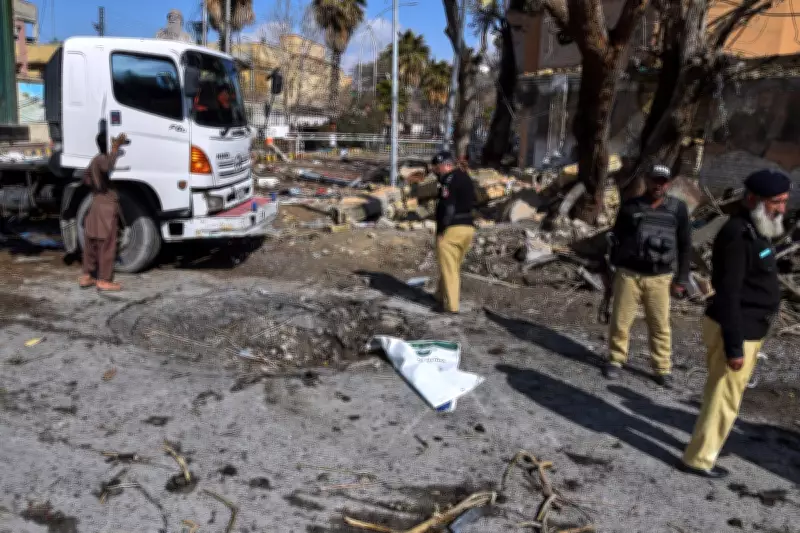
Pakistan Announces Major Counter-Terrorism Success in Restive Balochistan Province
Pakistani security forces have conducted a series of intensive counter-terrorism operations across the southwestern province of Balochistan, resulting in the deaths of 145 individuals described by authorities as "Indian-backed terrorists." This significant military action was launched in direct response to a devastating wave of coordinated suicide and gun attacks that claimed the lives of 33 people, predominantly civilians, on Saturday.
Swift Response to Deadly Assaults
The raids commenced early on Saturday across multiple locations within Balochistan, a region long plagued by separatist insurgency. Provincial Chief Minister Sarfraz Bugti, addressing reporters in Quetta, confirmed the high casualty figure among militants, stating it represented the highest number killed in decades. He identified the targeted group as "Fitna al-Hindustan," a term used by the Pakistani government to refer to the outlawed Baloch Liberation Army (BLA), which it alleges receives backing from India.
"The bodies of these 145 killed terrorists are in our custody, and some of them are Afghan nationals," Bugti declared. He praised the swift and coordinated response of the military, police, and paramilitary forces in repelling the assaults. Senior government official Hamza Shafqat, who often oversees such counter-insurgency operations in the province, joined Bugti in commending the security personnel.

Details of the Initial Attacks and Civilian Toll
The militant attacks that precipitated this forceful response erupted in a resource-rich region where Pakistan is actively seeking to attract foreign investment, particularly in mining and minerals. The initial violence resulted in a tragic loss of life, with authorities reporting that 18 civilians—including five women and three children—and 15 security personnel were killed.
Residents described scenes of chaos and fear. "(It) was a very scary day in the history of Quetta," said local resident Khan Muhammad. "Armed men were roaming openly on the roads before security forces arrived." Bugti provided harrowing details of one assault, noting that militants stormed the home of a Baloch labourer in Gwadar, killing five women and three children—an act he strongly condemned.
Accusations Against Neighbouring Nations and Regional Tensions
Bugti repeatedly levelled accusations against India and Afghanistan, claiming they back the assailants. He asserted that senior leaders of the BLA, which claimed responsibility for the latest attacks, were operating from Afghan territory. Both the governments in Kabul and New Delhi have consistently denied such allegations.
The provincial chief minister referenced the 2020 Doha agreement, under which Afghanistan's Taliban pledged not to allow their soil to be used for attacks against other countries. "Unfortunately, the Afghan soil was still being used against Pakistan," Bugti stated. Tensions between Pakistan and Afghanistan have remained high since early October, when Pakistan conducted airstrikes on alleged Pakistani Taliban hideouts inside Afghanistan.
Context of the Balochistan Insurgency
Balochistan has endured a protracted separatist insurgency led by ethnic Baloch groups demanding greater autonomy or outright independence from Pakistan's central government. The BLA, banned in Pakistan, has been responsible for numerous attacks in recent years, frequently targeting:
- Pakistani security forces
- Chinese interests and nationals
- Critical infrastructure projects
Authorities maintain that the group operates with support from the Pakistani Taliban, known as Tehrik-e-Taliban Pakistan (TTP). The TTP is a separate entity allied with Afghanistan's Taliban, who regained power in August 2021. The latest violence underscores the complex and volatile security challenges facing the region, even as Pakistan endeavours to promote economic development and attract international investment.