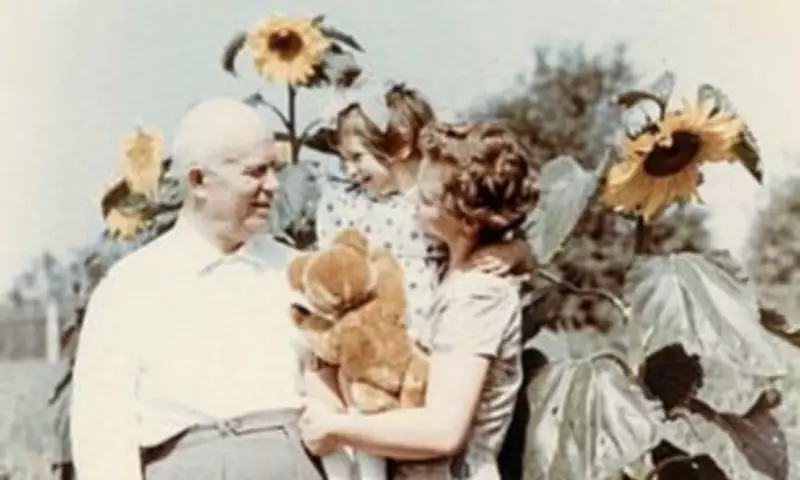
Nina Khrushcheva's Personal Memories of Her Grandfather Nikita Khrushchev
One of Nina Khrushcheva's earliest recollections of her grandfather dates back to a dinner party when she was about four or five years old. He was hosting the event at his dacha, a country house in rural Moscow, for the urban elite of 1960s Russia. The gathering included world-renowned poets, writers, and theatre directors engaged in what Khrushcheva describes as 'boring adults having boring adult conversations'. To capture attention, she began slurping her chicken soup loudly until everyone paused and looked at her. Her mother was furious, but her grandfather intervened with a playful challenge. 'We are going to have a competition. You slurp, I slurp, and the person who slurps loudest wins. If I win, we all stop slurping, and if you win, everyone at the table will slurp,' he said. He won the contest, sparing the guests from further noise.
Warm Family Moments and Historical Identity
Khrushcheva's memories of her 'lovely, fantastic grandfather' are filled with stereotypically warm anecdotes. She recalls his insistence that she and her younger sister Ksenia help him plant vegetables in his garden, which she found 'torture'. During visits, she would sneak into his office and bounce on his sofa, amused by its 'best springs', much to her grandfather's delight. He was never strict, unlike her mother, who often told her to 'sit up straight'. However, his identity is far from ordinary: he was Nikita Khrushchev, the former premier of the Soviet Union.
For those unfamiliar with history, Khrushchev rose to power after Stalin's death in 1953 and was ousted in 1964, leading to his cultural erasure from Soviet records. His legacy is complex and contradictory. Seventy years ago, he delivered the 'Secret Speech', which denounced Stalin's purges, ushered in a less repressive era, and closed the Gulag labour camps that had killed approximately 1.6 million Russians. Yet, just eight months later, he sent Soviet soldiers to crush Hungary's democratic uprising, resulting in around 4,000 deaths and displacing a quarter of a million people.

The Cuban Missile Crisis and Family Life
In 1962, Khrushchev's decision to send atomic weapons to communist Cuba, as explored in the BBC podcast The Bomb co-hosted by Khrushcheva and Max Kennedy, triggered the Cuban Missile Crisis and nearly caused global nuclear annihilation. Khrushcheva, now 63, did not grasp these events until later, partly due to familial bias and because her grandfather was 'eradicated' from Soviet culture after his ousting. His rivals criticized his 'weakness' on Cuba and 'damaging' reforms, but to maintain the myth of Communist infallibility, the Soviet system quietly erased him from history.
Born in Moscow in 1962 to Yulia, Khrushchev's adopted daughter, Khrushcheva split her time between the city and the rural dacha where her grandfather lived in forced retirement. Despite their 'disgraced' status, the family enjoyed comforts like a generous pension, five staff, a chauffeured limousine, and special food and healthcare privileges, though they were monitored by the KGB.
Growing Up with Doublespeak and Academic Pursuits
As a child, Khrushcheva's favourite book was George Orwell's 1984, which mirrored the 'doublespeak' of her life. Intellectuals in Moscow, appreciative of Khrushchev's loosened press restrictions, would visit the dacha, praising him as a 'giant of politics'. Yet, at school, history books omitted his name entirely. 'He was deleted from the curriculum, newspapers, public records – everything. So, you know your grandfather is an important man, the country's former leader... and then you go to school and he doesn't exist,' she recalls.
While her mother and aunt mourned his lost position, Khrushcheva believes her grandfather found happiness in retirement. 'He was 70. He could write his own memoirs. He could take a car and go to the theatre. He could spend time with us. He could garden. Those final six years, they were happy,' she says. Today, as a Professor of International Affairs at The New School in New York City and a Khrushchev expert, she aims to dispel myths about his legacy.

From Circus School to Academic Career
Khrushcheva's path to academia was unconventional. As a teenager, she aspired to be a clown and briefly attended circus school, finding it 'quite fun but didn't last long'. She studied Russian Literature at Moscow University and, inspired by Gorbachev's open borders in the mid-80s, sought to travel. After a short, early marriage ended in divorce, she applied to American graduate schools, defying naysayers. 'People were telling me, "You can't do it," but I was gutsy. I passed the tests and off I went,' she explains. Initially disliking New York for its 'skyscrapers and pollution', she quickly adapted, noting that the American curriculum felt easy compared to her prior readings.
Navigating Identity and Political Critique
Now a naturalised US citizen, Khrushcheva's decision sparked debate in Russia, with school textbooks questioning its morality. She maintains privacy about her family life, responding sharply to personal inquiries. With a PhD from Princeton and roles at Columbia University, she contributes to major newspapers like The New York Times and The Wall Street Journal. When discussing politics, she separates her grandfather from familial ties. 'When people ask me about Khrushchev, I always say Khrushchev. I very rarely say "my grandfather" when I'm talking about politics. In my work, he is a historical, not familial, figure,' she clarifies.
This distinction was evident during her work on The Bomb podcast with Max Kennedy, nephew of John F Kennedy, where she avoided personal references. 'Max always says "my uncle", "my family". I almost never do that,' she says, citing a desire to avoid bragging and maintain objectivity. In contrast, she is vocal about modern Russia, condemning Vladimir Putin's invasion of Ukraine as 'embarrassing' and something her grandfather would find 'despicable'. Despite this, she feels nostalgic for Russia, considering relocation during Covid and visiting Moscow frequently. 'New York is my home, but Russia is my motherland. I'm a New Yorker, but I'm also, always, a Russian,' she concludes.