Italy's Ladin Community Feels Excluded from Winter Olympics in Their Ancestral Home
The Winter Olympics have returned to the stunning Dolomite mountains of northern Italy, but for the region's ancient Ladin minority, the 2026 Games represent a profound disappointment rather than a celebration of their unique heritage. As the world's attention turns to Cortina d'Ampezzo and surrounding Olympic venues, members of this ethnolinguistic group feel conspicuously absent from the official narrative.
A Millennium of History Overlooked
The Ladin people have inhabited the dramatic limestone peaks of the Dolomites for over two thousand years, with their distinctive Romance language developing from a blend of Latin and ancient Rhaetic tongues. Today, UNESCO classifies Ladin as endangered, with only around 35,000 speakers remaining across five valleys spanning three of Italy's Olympic territories: Veneto, Alto Adige, and Trentino.
"We are cut out, as if we don't exist," lamented Elsa Zardini, head of Cortina's Ladin community, where approximately half the population identifies as Ladin. This sentiment echoes across the 17 Ladin towns whose mayors collectively petitioned Olympic organizers for representation, only to receive no response.

Olympic Opening Ceremony Exclusion
Despite precedents set by previous host cities—from Lillehammer's celebration of Arctic Sami culture to Beijing's showcase of China's ethnic minorities—the Milan Cortina organizing committee confirmed that Ladin culture will not feature in the 2.5-hour opening ceremony on February 6th. Instead, the event will focus on Italian fashion, design, and music that have achieved global recognition.
Marco Balich, creative director of the ceremony, explained to The Associated Press: "We want to celebrate those elements that have been exported all over the world." This decision has left Ladin leaders feeling their distinct local identity has been sacrificed for a more generic national presentation.
Limited Official Recognition
Throughout official Olympic events, Ladin representation will be minimal. A pair in traditional dress attended the Olympic torch arrival in Cortina, though they were absent from organizing committee imagery. Before the opening ceremony, a small procession of costumed Ladins will parade through Cortina, but this footage will not be broadcast to the global audience watching the main event.
"It's really not much," acknowledged Zardini. "Yes, there will be someone in our costume, our costumes will be seen. We had other goals, to highlight that we are a linguistic minority and to explain our culture, but that is not the case."
Taking Matters Into Their Own Hands
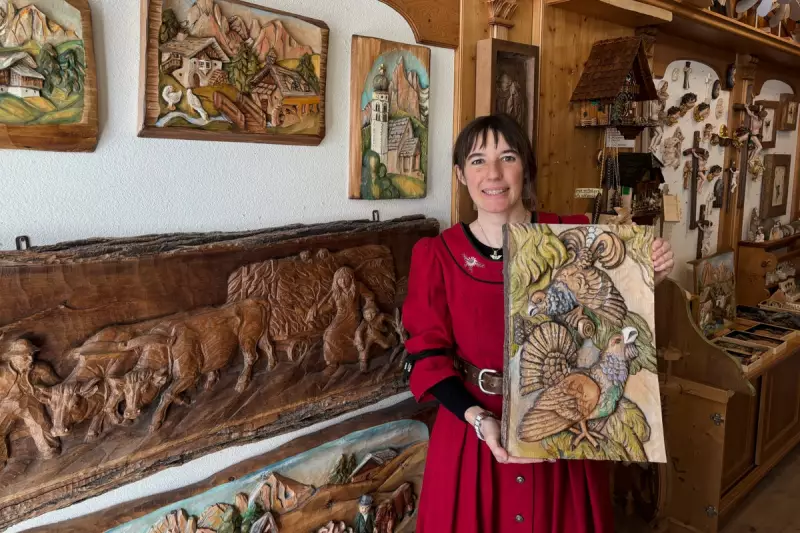
Faced with this official neglect, Ladin communities across the Dolomites have launched independent initiatives to share their heritage with Olympic visitors. Zardini is distributing Ladin flags—azure, white, and green representing sky, snow, and meadows—to anyone wishing to display them during the Games.
"It isn't so much a protest as a welcome," she explained, "so visitors realize that a people living here speaks a certain language and has its own traditions. That is our intention. And then, some have of course displayed it in protest."
Cultural Preservation Efforts
The General Ladin Union of the Dolomites has produced mini-dictionaries translating Ladin terms into five languages for visitors, with Roland Verra, the group's president, noting that "Winter Games" translates to "Juesc Olimpics da d'ivern" in Ladin. They've also created an educational video with English subtitles detailing Ladin history from Roman conquest through to the region becoming part of Italy in 1919, which will play continuously outside Cortina's Town Hall.
In Trentino, Ladins are preparing events featuring traditional music and literature, hoping tourists will discover their culture independently. "This is a great opportunity to represent the ancient legends that would certainly be very well seen, very spectacular," Verra observed.

Broader Cultural Challenges
The current Olympic exclusion compounds existing challenges facing Ladin communities. Since Cortina first hosted the Winter Games in 1956, transforming from a Ladin-majority town to a luxury resort, cultural preservation has become increasingly difficult. Rising property values and inheritance taxes make it challenging for families to retain ancestral homes, while many young Ladins move away for economic opportunities, further straining cultural continuity.
Despite these challenges, Ladin athletes continue to excel on the world stage. Slalom skier Alex Vinatzer will compete in these Games, joining the ranks of Ladin Olympians like figure skater Carolina Kostner (bronze medalist in 2014) and downhill skier Kristian Ghedina, a five-time Olympian who witnessed the celebration of Arctic Sami culture at Lillehammer in 1994.
As the Olympic flame burns in the Dolomites, the Ladin people find themselves in a paradoxical position: physically present in their ancestral homeland yet symbolically absent from the global celebration occurring there. Their grassroots efforts to share their language, traditions, and history represent both a welcome to visitors and a quiet assertion of identity in the face of institutional oversight.