This week in history, spanning from the 2nd to the 8th of February, has witnessed a remarkable array of transformative events that have reshaped nations, societies, and our understanding of the cosmos. From political revolutions on Earth to celestial explosions in distant galaxies, these dates mark turning points captured vividly on the front pages of The Independent, offering a retrospective glimpse into moments that defined eras.
A Week of Political and Social Transformation
The period from early February has consistently served as a catalyst for profound change across the globe. In the United Kingdom, a landmark parliamentary vote on the 6th of February 2013 saw the House of Commons decisively legalise same-sex marriage after hours of impassioned debate. This historic move, backed by 400 votes to 175, reflected a significant shift in social attitudes and paved the way for the first ceremonies in 2014, marking a milestone in the country's journey toward equal rights.
Global Political Watersheds
Elsewhere, political landscapes were being redrawn. On the 8th of February 1990, the Soviet Union took a decisive step toward reform as the Communist Party voted to abandon Article Six of the constitution, ending its guaranteed monopoly on power after more than seven decades. This move, backed by the Central Committee, signalled a dramatic shift toward multi-party democracy in a state long dominated by single-party rule.

Simultaneously, South Africa reached a political watershed on the 3rd of February 1990 when President FW de Klerk unexpectedly lifted the ban on the African National Congress. This action ended decades of repression against black political movements, with reforms including the removal of restrictions on anti-apartheid organisations, the freeing of political prisoners, and the imminent unconditional release of Nelson Mandela. These changes set the nation on a path toward dismantling apartheid and establishing democratic rule.
Struggles for Freedom and Expression
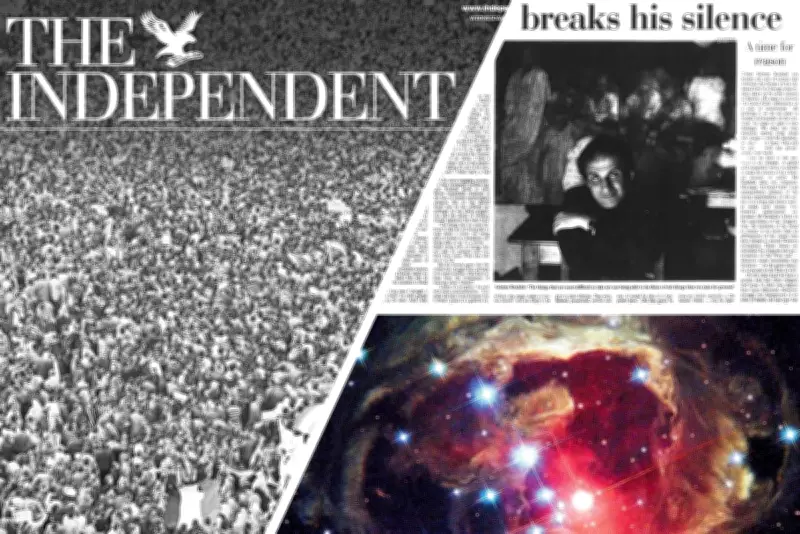
The fight for liberty and creative expression also featured prominently during this week. In Cairo, on the 2nd of February 2011, massive crowds gathered as protests against President Hosni Mubarak entered a decisive phase, part of the wider Arab Spring uprisings calling for political reform and an end to authoritarian rule. The Independent's Robert Fisk reported from the ground as a million people took to the streets demanding change.
In the realm of literature, Salman Rushdie broke his silence on the 4th of February 1990, speaking publicly for the first time in a year to defend his novel The Satanic Verses following the fatwa issued against him in 1989. In an exclusive essay for The Independent on Sunday, Rushdie rejected accusations of blasphemy, reflected on the controversy's impact on race relations, and called for dialogue and understanding after months in hiding.
Scientific Milestones and Tragedies
Beyond Earth, scientific exploration yielded both wonder and sorrow. On the 4th of February 2005, the Hubble Space Telescope released striking images of a red supergiant star exploding approximately 20,000 light years from Earth. This captured a searing pulse of light racing through deep space, offering scientists a rare glimpse of a supernova unfolding across the vast interstellar void.
Tragically, on the 2nd of February 2003, the space shuttle Columbia broke apart during re-entry over the United States, killing all seven astronauts on board and bringing a 16-day mission to a devastating end. NASA confirmed the loss of contact shortly before the scheduled landing, with debris scattered across several states. The disaster prompted the grounding of the shuttle fleet and a major investigation, which later concluded that damage to the heat shield during launch led to the catastrophe.
Regional Conflicts and Withdrawals
In Afghanistan, turmoil ensued on the 6th of February 1989 as President Mohammad Najibullah ordered the mobilisation of 30,000 fighters amid vows to resist the mujahideen. This came as the last Soviet troops prepared to leave Afghanistan, ending a decade-long military intervention. Although Najibullah's government survived for several years with continued Soviet support, it collapsed in 1992 after that backing ended, plunging the country into further civil war.

All these events, from political revolutions to cosmic explosions, are vividly documented on the front pages of The Independent, providing a compelling retrospective on a week of turning points that have indelibly shaped our world and beyond.