The Guardian's Iraq War Reporting: Witness to Shock, Awe, and Chaos
In spring 2003, the fall of Saddam Hussein was met with a brief wave of exuberance, but this swiftly gave way to a deadly descent into chaos. Whether operating independently or embedded with military forces, Guardian reporters provided firsthand accounts of the violence unfolding on the ground, documenting the human cost and complex realities of the conflict from its very inception.
The Onset of Hostilities and Early Reports
The allied attack on Iraq commenced on 20 March 2003. The Guardian's early edition on 21 March featured the headline "Land, sea and air assault," with reports from Julian Borger in Washington and Rory McCarthy in Qatar detailing the ground war's initiation. British and American marines stormed Gulf coast beaches near Basra, while Baghdad endured a heavy bombardment by cruise missiles, lighting up the night sky. Tragically, the first British fatalities occurred shortly after when a US helicopter crashed in Kuwait.
Suzanne Goldenberg's front-page dispatch from Baghdad revealed that Saddam Hussein had made a defiant television appearance merely two hours after a targeted decapitation strike. A Guardian leader editorial critically noted that this initial "surgical strike" had missed its mark, warning that state-ordered assassination set an abominable precedent. The editorial emphasised that the legal and moral grounds for the war were already very shaky, urging caution from the US.

The "Shock and Awe" Campaign and Journalistic Perspectives
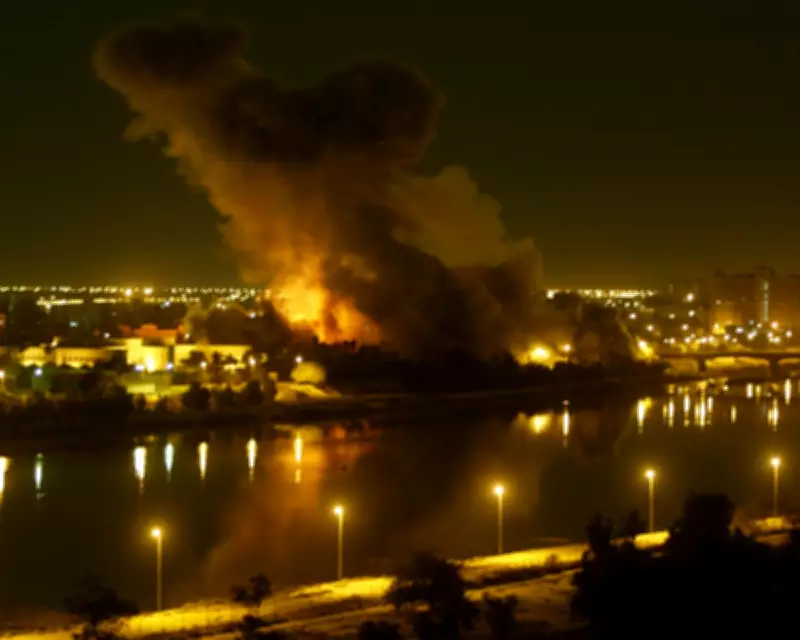
The violent "shock and awe" assault on regime infrastructure in Baghdad followed that same night. Reports described successive waves of aerial attacks targeting symbols of Saddam's power, with the presidential complex on the Tigris River razed in just over ten minutes. Photographer Sean Smith, known for chronicling war's brutalities, captured poignant images of Baghdad's final normalcies—a racetrack meeting, a football match, a wedding party—before the invasion closed in.
Goldenberg and Smith observed the bombardment from the Palestine hotel, with Goldenberg likening the scene to "watching a gigantic video game." Iraqis, reduced to spectators, watched in shock as the regime that controlled their lives was eliminated. Meanwhile, James Meek reported from Safwan in southern Iraq, describing a day of death, joy, and looting, where mixed messages from civilians ranged from gratitude to fear.
Embedded and Unilateral Journalists: Navigating the Conflict
The war saw journalists adopting different approaches. Embedding with US and British forces offered unprecedented access but came with military oversight. Jamie Wilson, embedded with the Royal Navy, had his communications monitored. Audrey Gillan, with the Household Cavalry's D Squadron, faced criticism for potential assimilation but provided vivid accounts of camaraderie and loss, including friendly fire incidents and tank accidents.
In contrast, unilateral journalists like James Meek operated independently, gaining easier access to Iraqi citizens. Meek noted that despite being free-range, he often relied on army units for assistance, highlighting the blurred lines in journalistic roles during the conflict.
Civilian Casualties and Cultural Destruction
Despite prewar pledges to minimise civilian harm, disasters ensued. A bomb struck a Baghdad market less than a week into the war, killing 14 people, with the Guardian publishing a graphic photograph that drew both praise and criticism. The threat to Iraqi antiquities also emerged, with reports of looting at museums in Mosul and Baghdad, despite Pentagon promises of protection.
Human casualties left the deepest impression. Suzanne Goldenberg's moving dispatch on 9 April 2003 described the overwhelming flow of casualties at al-Kindi hospital, where a family lay dead, reducing nurses to tears. The toppling of Saddam's statue in Firdos Square symbolised the regime's collapse, but Goldenberg noted ensuing lawlessness and looting in Saddam City, revealing the chaos beneath the symbolism.

Post-Invasion Reflections and Iraqi Voices
Polls showed rising support for the war in Britain, but Guardian leaders cautioned that Iraq was not yet free, with Saddam and his weapons remaining elusive. The paper attempted to memorialise all war dead impartially, sparking mixed reactions from readers.
Iraqi voices gained prominence through the "Baghdad Blogger" Salam Pax, whose web diary offered irreverent, relatable insights in perfect English, and Ghaith Abdul-Ahad, who began as an interpreter and became an award-winning journalist. Initially supportive of the intervention, Abdul-Ahad's perspective shifted over time as he witnessed sectarianism and violence, leading him to regret the war a decade later, preferring a genuine Iraqi collapse over foreign intervention.
Throughout the conflict and beyond, Guardian reporters like Abdul-Ahad continued to cover global conflicts, embodying the paper's commitment to witnessing and reporting on some of the world's most distressed areas with courage and eloquence.