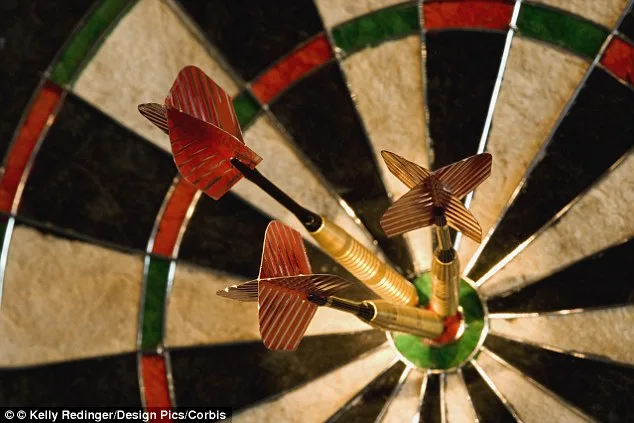
Amateur darts players may improve their game by using their poor aim to their advantage, according to research from the University of Nottingham. Professor Graham Kendall explains that while professionals should aim for the treble 20, less accurate players can achieve better scores by targeting different areas of the board.
The standard darts board, designed by Brian Gamlin in 1896, places large numbers next to small ones to penalise mistakes. For example, aiming for 20 but hitting the adjacent arc scores five or one. However, statistician Ryan Tibshirani's analysis suggests that players with an accuracy of only 60mm (about two inches) can maximise their score by aiming at a large spot around the centre, specifically to the lower-left of the bullseye.
Tibshirani's research shows that a poor player aiming for treble 20 averages just 10.2 points per throw, worse than the 12.8 points from throwing randomly. Players accurate to within 25mm (one inch) should aim at treble 19, near the border with the seven. The findings are detailed in a scientific paper that also provides a method for determining accuracy: throw several darts at treble 20, measure the average distance from the target, and adjust strategy accordingly.
Kendall also advises players to leave a score that is a power of two (2, 4, 8, 16, 32) when finishing a game, as this gives more options if they miss the final double. For instance, on a score of 32, aiming for double 16 allows a fallback if only 16 is hit.