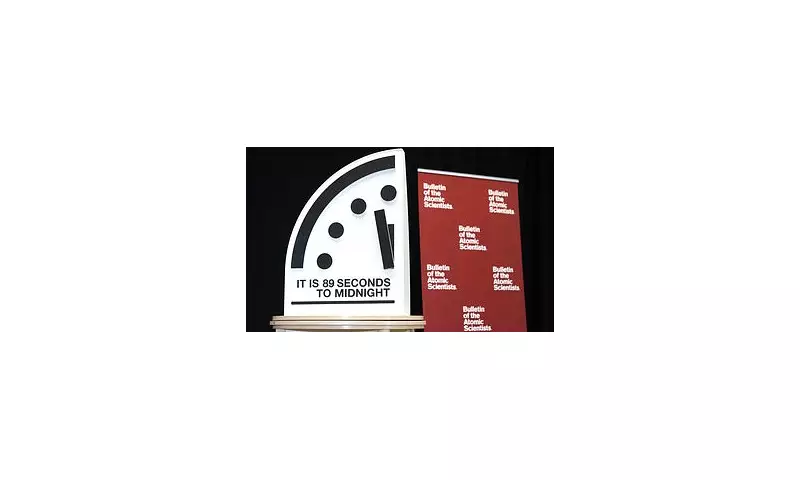
Humanity stands on the precipice of an ominous revelation as scientists prepare to update the symbolic Doomsday Clock tomorrow. The new time for this chilling timepiece, which ticks ever closer to midnight as we approach potential annihilation, will be unveiled at 15:00 GMT on 27 January. This announcement comes with profound implications for our collective future.
The Doomsday Clock: A Symbol of Impending Catastrophe
The Doomsday Clock represents a powerful symbolic measurement of how near the world is to a human-made global catastrophe, as assessed by leading experts. Its origins trace back to June 1947 when US artist Martyl Langsdorf was commissioned to design a cover for the Bulletin of the Atomic Scientists journal. Created against the backdrop of widespread public fear surrounding atomic warfare just two years after World War II ended, the clock aimed to "frighten men into rationality," according to Eugene Rabinowitch, the journal's first editor.
Each year, the Bulletin of the Atomic Scientists (BAS), a nonprofit organisation based in Chicago, updates the clock based on their assessment of humanity's proximity to total destruction, represented by midnight. When the clock moves forward toward midnight, it signals that humanity has edged closer to self-destruction over the past year. Conversely, if it moves backward away from midnight, it suggests we have reduced global catastrophe risks. Some years see no movement at all, indicating the global situation remains unchanged.

Current Position and Historical Context
Since last year, the Doomsday Clock has remained at 89 seconds to midnight – the latest time in its 78-year history. This precarious position reflects mounting concerns about multiple existential threats facing humanity. Looking back over the decades, the clock has fluctuated significantly: from 7 minutes to midnight in 1947-48, down to just 2 minutes during the tense years of 1953-59, reaching its safest point at 17 minutes in 1991-94 following the Cold War's end, before steadily advancing closer to midnight in recent years.
Expert Predictions: Why the Clock Will Likely Advance
Ahead of tomorrow's crucial announcement, specialists in existential risk have offered sobering predictions about the Doomsday Clock's likely movement. Their consensus suggests the hands will inch closer to midnight, reflecting heightened global dangers across multiple fronts.
Nuclear Threats Escalating
Alicia Sanders-Zakre, head of policy at the International Campaign to Abolish Nuclear Weapons, anticipates the clock moving forward by at least one second. "Our biggest concern is the existential threat posed by the more than 12,000 nuclear weapons in the world today," she explains. During 2025, nuclear weapons spending reached $100 billion, while conflict between nuclear-armed neighbours India and Pakistan served as a chilling reminder of persistent risks.
"While the risk of nuclear use has been an existential threat for 80 years, it has increased in the last year," Sanders-Zakre adds, citing "skyrocketing investments in nuclear arms, increasingly threatening nuclear rhetoric and actions, and the increasing application of artificial intelligence in militaries."
Dr SJ Beard, researcher at the Centre for the Study of Existential Risk at the University of Cambridge, predicts an even more dramatic nine-second advance. "Personally, I am no longer so worried about nuclear weapons being used in a proxy war like Ukraine, but I am more worried than I have ever been about direct nuclear conflict between the world's superpowers," Dr Beard states.
He points to the collapse of the multilateral world order and the emergence of a "multi-polar reality where all countries are having to pick a side between authoritarian strong men." With the New START Treaty set to expire in three weeks without a clear renewal framework, nuclear arms control architecture faces fundamental breakdown.

Artificial Intelligence: A New Existential Risk
For the first time, artificial intelligence may receive "equal billing to nuclear weapons" in the Doomsday Clock assessment, according to Dr Beard. The rapid integration of AI into military decision-making systems creates alarming risks that conflicts might escalate beyond human control. Furthermore, AI technology potentially enables non-state actors to engineer dangerous biological weapons by providing tools to manipulate viruses and proteins.
As companies like OpenAI and Anthropic pursue advanced artificial general intelligence, AI has become "an existential risk driver in its own right," Dr Beard warns. Hamza Chaudhry, AI and national security lead at the Future of Life Institute, believes these developments warrant moving the Doomsday Clock five to ten seconds forward.
Climate Change Continues to Worsen
Professor Andrew Shepherd, a climate scientist from Northumbria University, expects the clock to change once again due to environmental pressures. "Sadly, the past year has been another one of climate extremes for our climate," he observes. Notable changes include "a return to rapid ice loss in Greenland and a continuation of the rapid decline in sea ice in the Southern Ocean," with consequences including sea level rise and global warming through reductions in planetary albedo.
Factors Driving the Clock Forward
Multiple interconnected threats contribute to the likely advancement of the Doomsday Clock:
- Expanding national nuclear arsenals, particularly China's rapid growth toward matching US and Russian ICBM numbers by decade's end
- Increased conflict between global superpowers amid a collapsed multilateral order
- Fractured cooperation over Ukraine and Russia's growing willingness to deploy nuclear-capable weapons like the Oreshnik missile
- Imminent expiration of the New START nuclear arms treaty without replacement framework
- Rapid acceleration of AI technology integration into military and security systems
- Increasing pressure from extreme weather events driven by climate change
Tomorrow's Crucial Announcement
The Bulletin of the Atomic Scientists will reveal this year's Doomsday Clock time during a livestream beginning tomorrow at 15:00 GMT (10:00 ET). As humanity awaits this symbolic assessment of our collective vulnerability, experts agree the outlook appears grim. The convergence of nuclear escalation, artificial intelligence risks, and climate deterioration creates a perfect storm of existential threats that will likely push the symbolic hands closer to midnight than ever before in human history.
While the Doomsday Clock serves as a warning rather than a prediction, its movement tomorrow will provide a stark measure of how dangerously close humanity has come to self-annihilation. The world watches with bated breath as scientists prepare to deliver their verdict on our species' precarious position in an increasingly perilous global landscape.