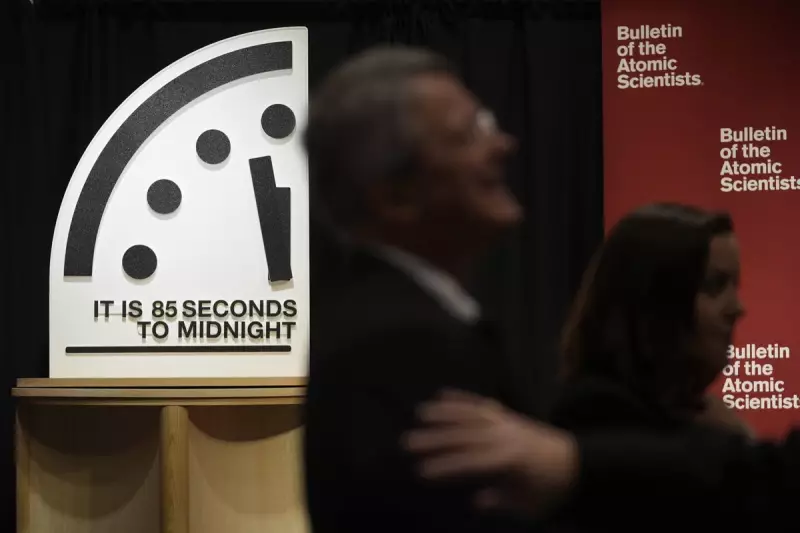
The symbolic Doomsday Clock has been adjusted to its most alarming position in history, now standing at a mere 85 seconds to midnight. This represents a significant shift from last year's setting of 89 seconds, which was already the closest the clock had ever been to the symbolic point of global catastrophe.
Unprecedented Global Threats
The Bulletin of the Atomic Scientists, the organisation responsible for maintaining the clock since its creation in 1947, pointed to multiple converging crises that have prompted this sobering adjustment. Experts highlighted the dangerous combination of escalating nuclear tensions, accelerating climate change, and the uncontrolled development of artificial intelligence as primary drivers behind their decision.
Nuclear Dangers Escalating
Alexandra Bell, the Bulletin's president and CEO, emphasised that nuclear risks have been moving in entirely the wrong direction throughout 2025. "Nothing in 2025 trended in the right direction," Bell stated, pointing to the collapse of longstanding diplomatic frameworks and the return of explosive nuclear testing threats.

The Bulletin specifically cited several flashpoints that have increased global instability:
- Russia's ongoing war in Ukraine with no end in sight
- US and Israeli military actions against Iran
- Border clashes between India and Pakistan
- Continuing tensions on the Korean Peninsula
- China's increasing threats toward Taiwan
Diplomatic Breakdowns
The international security landscape has deteriorated significantly, with the last remaining nuclear arms pact between the United States and Russia, the New START treaty, set to expire on February 5th. While Russian President Vladimir Putin proposed extending the treaty's limits for another year, US President Donald Trump has not formally responded to this offer, creating uncertainty about future nuclear arms control.
Bell noted that "Russia, China, the United States and other major countries have become increasingly aggressive and nationalistic," creating a "winner-takes-all great power competition" that undermines essential international cooperation.
Multiple Converging Crises
Beyond nuclear threats, scientists expressed deep concern about other existential dangers facing humanity. Climate change continues to accelerate at an alarming rate, while the rapid development of artificial intelligence systems presents new, unpredictable risks that could potentially spiral out of control.
Information Warfare Concerns
Maria Ressa, a 2021 Nobel Peace Prize recipient who participated in the announcement, highlighted the critical role of information warfare in the current global crisis. "We are living through an information Armageddon - the crisis beneath all crises," Ressa stated, emphasising how "extractive and predatory technology" spreads misinformation faster than facts and profits from societal division.
Historical Context and Significance
The Doomsday Clock was originally created to track Cold War tensions, reaching its previous closest point of two minutes to midnight in 1953. Since then, it has reflected periods of optimism, moving as far away as 17 minutes from midnight in 1991 following the end of the Cold War.
However, the trend since then has been almost relentlessly toward midnight, with the clock moving closer in three of the last four years. The Bulletin's scientists have been forced to measure the danger in seconds rather than minutes, reflecting the unprecedented level of global risk.
Bell emphasised that "the Doomsday Clock is about global risks, and what we have seen is a global failure in leadership." She warned that "a shift towards neo-imperialism and an Orwellian approach to governance will only serve to push the clock toward midnight."
The four-second movement this year follows last year's single-second adjustment, which scientists described as sending "a stark signal" that even minimal movements should be interpreted as indications of extreme danger. Each second of delay in addressing these global threats, they warned, increases the probability of catastrophic outcomes for humanity.