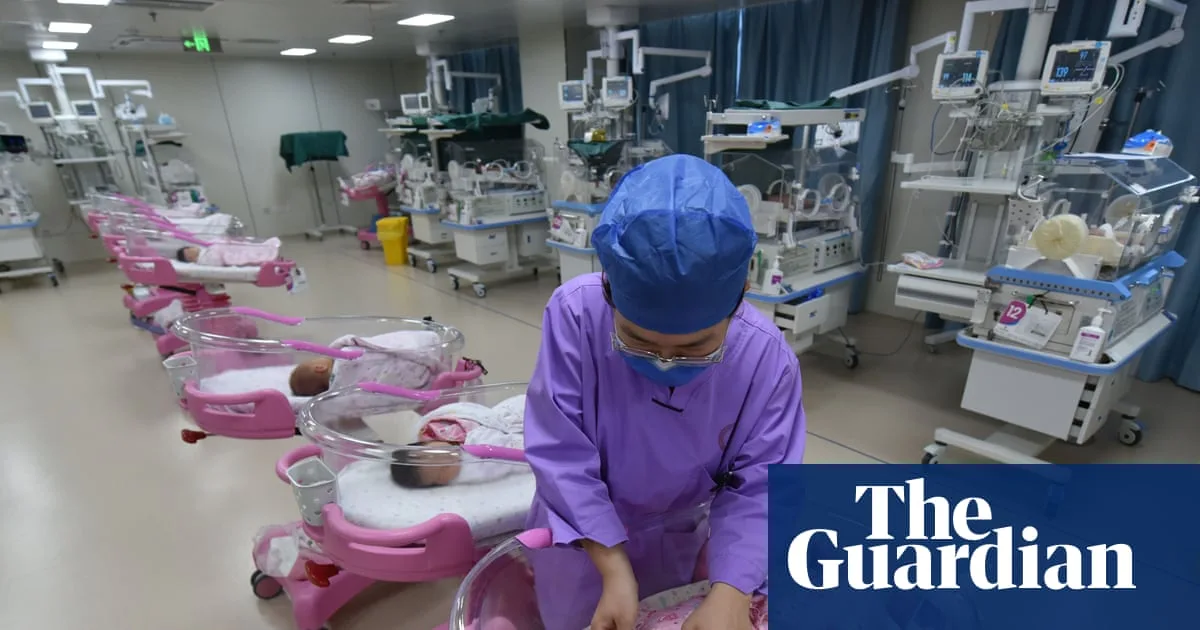
China's population declined for the fourth consecutive year in 2025, with the birthrate dropping to a record low despite government efforts to encourage childbearing. Registered births fell to 7.92 million, down 17% from 9.54 million in 2024, the lowest since records began in 1949, according to the National Bureau of Statistics (NBS).
The population decreased by 3.39 million to 1.405 billion, a faster decline than in 2024, while deaths rose to 11.31 million from 10.93 million. Demographer Yi Fuxian of the University of Wisconsin-Madison noted that births in 2025 were roughly equivalent to levels in 1738, when China's population was about 150 million.
The falling birthrate persists despite policies such as a 90bn yuan (£9.65bn) childcare subsidy programme and plans to cover all childbirth-related expenses, including IVF, under national healthcare insurance. However, high costs remain a barrier: raising a child to age 18 costs an average of 538,000 yuan, over 6.3 times GDP per capita, compared to 4.11 times in the US and 4.26 times in Japan.
The legacy of the one-child policy, in effect from 1980 to 2015, has conditioned many to prefer single-child households, and the shrinking pool of child-bearing age adults exacerbates the trend. Meanwhile, China removed condoms from VAT-exempt items, imposing a 13% tax, though free contraceptives remain available through government programmes.
China's death rate of 8.04 per 1,000 population in 2025 was the highest since 1968. Over-60s now account for about 23% of the population, a figure projected to reach 400 million by 2035. Retirement ages have been raised, with men retiring at 63 instead of 60, and women at 58 instead of 55.
Marriages, a leading indicator for births, plunged by a fifth in 2024 but rose 22.5% year-on-year in the third quarter of 2025 after a rule change allowing couples to marry anywhere in the country. Demographers expect a temporary increase in births as a result.