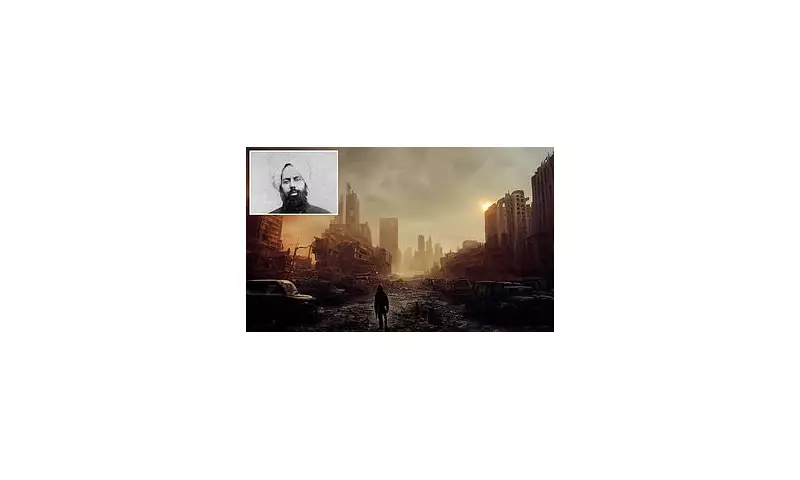
Century-Old Prophetic Poem Sparks Modern Apocalyptic Fears
A remarkable poetic prophecy composed over twelve decades ago by a revered Islamic religious leader has dramatically resurfaced in contemporary discourse. Some interpreters now suggest its vivid descriptions of global catastrophe may be ominously relevant to today's geopolitical tensions and natural disasters.
The 1905 Vision of Hazrat Mirza Ghulam Ahmad
Hazrat Mirza Ghulam Ahmad, known to his followers as the Promised Messiah and Imam Mahdi, penned this apocalyptic poem in 1905, just three years before his passing in 1908. The work presents startling imagery that some believers now connect to modern events including potential global conflict and seismic activity.
The poem contains several striking passages:

'A sign will come some days hence, which will turn over villages, cities and fields. Wrath of God will bring a revolution in the world, the undressed one would be unable to tie his trousers,' Ahmad wrote.
He continued with even more dramatic language: 'Suddenly, a quake will severely shake, mortals, trees, mountains and seas, all. In the twinkling of an eye, the land shall turn over, streams of blood will flow like rivers of water.'
Modern Interpretations and Connections
Contemporary readers have drawn parallels between Ahmad's century-old words and current global situations. The mention of calamity befalling the Czar of Russia has been interpreted by some as foreshadowing modern Russian conflicts, including the ongoing war in Ukraine and persistent tensions with NATO nations.
Additionally, the poem's description of massive earthquakes and widespread destruction has been connected to recent seismic events, such as the significant earthquake that struck Myanmar in March 2025. The imagery of 'streams of blood flowing like rivers' and celestial phenomena 'beyond scientific explanation' has fueled speculation about potential future conflicts.
The Prophet's Background and Legacy
Born in 1835 in Qadian, India, Hazrat Mirza Ghulam Ahmad founded the Ahmadiyya Movement in Islam, dedicating his life to defending Islamic teachings against criticism from other faith traditions. He claimed to receive numerous divine revelations throughout his lifetime.
His followers believe he was divinely appointed as the guided leader anticipated in Islamic End Times prophecies. Despite the apocalyptic nature of some predictions, Ahmad primarily sought to present Islam as a peaceful, tolerant, and rational religion grounded in Quranic teachings and the example of Prophet Muhammad.
Divergent Interpretations Within the Ahmadiyya Movement
Following Ahmad's death, the movement split into two main branches due to theological disagreements about their founder's exact status:
- The Ahmadiyya Muslim Community views Ahmad as a subordinate prophet under Muhammad
- The Lahore Ahmadiyya Movement regards him strictly as a religious reformer without prophetic status
Both branches acknowledge the existence of the 1905 poem and its cataclysmic predictions, though they interpret its fulfillment differently:
- The Lahore branch has traditionally interpreted the prophecy as referring to World War I, which began in 1914
- The Ahmadiyya Muslim Community has suggested the earthquake predictions described major seismic events in India
Contemporary Relevance and Scientific Context
The prophecy's resurgence coincides with significant developments in global risk assessment. Scientists in the United States are preparing to update the symbolic Doomsday Clock, which visually represents humanity's proximity to man-made global catastrophe, particularly nuclear conflict.
As of last year, the clock has remained at 89 seconds to midnight – the closest it has ever been to the symbolic apocalypse in its 78-year history. This scientific assessment of global risk provides a sobering backdrop to the renewed interest in Ahmad's century-old predictions.

In his earlier work Barahin-e-Ahmadiyya, written in the late 1800s, Ahmad wrote that 'a warner came unto the world, but the world accepted him not,' which believers interpret as suggesting disasters and wars would follow humanity's rejection of divine guidance.
Similarly, in The Philosophy of Divine Revelation from the early 1900s, Ahmad warned: 'There will be death on such a large scale that streams of blood will flow. Even birds and grazing animals will not escape this death. Those days are near, indeed they are at the door, when the world shall witness the spectacle of a doomsday.'
The poem also contains passages that some modern readers interpret as describing missile warfare: 'The terror of it will exhaust everyone, the great and the small, even the Czar will be at that hour in a state of the utmost distress. It will be a glimpse of wrath, that heavenly sign, the sky shall draw its dagger to attack.'
Despite these dramatic predictions, Ahmad's primary legacy remains his establishment of a movement emphasizing Islamic teachings of peace, tolerance, and rationality – a contrast to the apocalyptic imagery that continues to capture global imagination more than a century after his death.