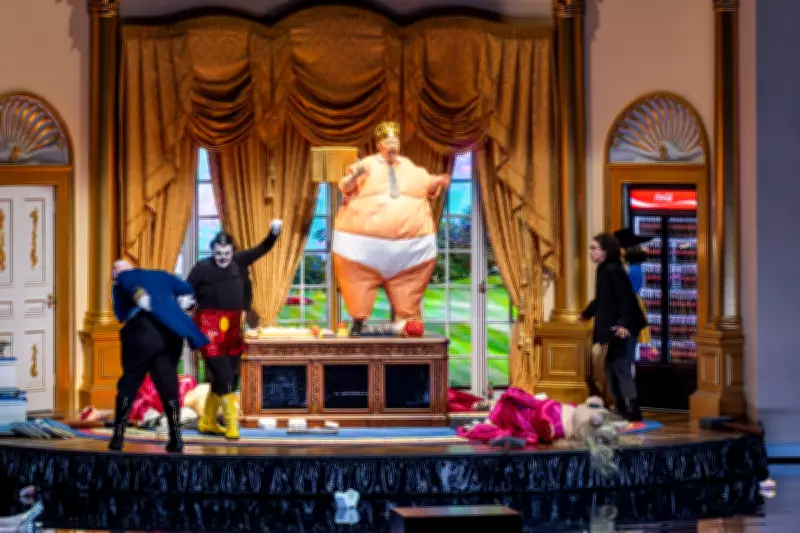
Satirical Opera 'Monster's Paradise' Debuts with Trump-Lampooning President-King
The Hamburg State Opera has unveiled the world premiere of Monster's Paradise, a provocative new opera by Austrian collaborators Olga Neuwirth and Elfriede Jelinek that directly lampoons former US President Donald Trump through its central character, a gluttonous, insatiable President-King. Artistic director Tobias Kratzer expressed astonishment at how the satirical work has increasingly mirrored political reality, remarking that "the metaphor has become a reality."
Operatic Collaboration After Two Decades
This production marks the first collaboration in twenty years between Nobel laureate Jelinek, who penned the German-language libretto, and Neuwirth, who composed the music. The opera represents a significant cultural moment, with Neuwirth having made history three years ago as the first woman composer to have a work presented at the Vienna State Opera.
Attendees experienced an immersive theatrical environment featuring chorus members dressed as zombies roaming the foyers alongside Disney-styled princesses and dancing hot dogs. The production commenced with a striking Las Vegas-style LED sign, establishing a distinctive visual tone that blends political commentary with theatrical spectacle.

Nineteenth-Century Satire as Inspiration
The opera draws inspiration from Alfred Jarry's 1896 play Ubu Roi, a profane, scatological work that caused controversy in its own time. Neuwirth and Jelinek have adapted aspects of Jarry's characters into what they describe as a Grand Guignol opera, with the production scheduled for a six-performance run through February 19 before moving to Zurich Opera and later to Austria's Oper Graz.
Jelinek revealed in an emailed statement that she immediately thought of Jarry's play when Trump came to power, noting the parallels between the fictional monarch and contemporary political figures. The opera unfolds over five scenes spanning two hours and forty-five minutes, featuring vampires Vampi and Bampi as avatars of the authors who frame the action in a manner reminiscent of Wagner's mythological characters.
Outlandish Portrayal and Political Commentary
The President-King, sung by Georg Nigl, enters in a gilded Oval Office complete with a Coca-Cola filled refrigerator and a golden crown on his desk. Rainer Sellmaier's set and costume design features the character growing to huge dimensions while wearing a diaper and golden necktie, with the President-King planting a golf club on Gorgonzilla's rock in a scene reminiscent of the White House AI photo of Trump landing on Greenland.
Nigl acknowledged the character's proximity to reality, stating: "I'm not playing the American president, but it's very close. I am playing a misogynist. I am playing a braggart. I am playing a fraudster, a despiser." The singer previously portrayed Russian President Vladimir Putin in another operatic production, bringing experience with political satire to this challenging role.
Contemporary References and Characterisations
Kratzer revealed that the President-King's adjutants Mickey and Tuckey, sung by countertenors Andrew Watts and Eric Jurenas, were patterned after Elon Musk and Mark Zuckerberg. These characters sing lines such as "Nobody has such high numbers as you," blending corporate and political commentary within the operatic framework.
Charlotte Rampling appears in several projected videos as The Goddess, a character who defends nature and civilization against the President-King's excesses. The opera concludes with video of the vampires drifting on a platform along the Elbe while playing Schubert on a Bösendorfer piano, expressing concern that Earth has been destroyed by its leaders.
Musical Innovation and Theatrical Risk
Neuwirth composed for a Mozart-sized orchestra while adding contemporary elements including an electric guitar and drum kit. Characters often employ Sprechstimme, a spoken-word singing technique that bridges dialogue and traditional operatic delivery. Conductor Titus Engle successfully melded Neuwirth's diverse musical genres into a cohesive theatrical experience.

The composer addressed the political risks of such satire, noting: "People of power are always afraid of humor. For example, Hitler was so afraid of Charlie Chaplin's The (Great) Dictator—he watched it secretly in his room in Berlin—because they are afraid to be laughed at."
Creators' Perspectives and Potential Repercussions
Neuwirth expressed some concern about potential repercussions from the US administration, stating: "I'm kind of a little bit afraid because I want to still enter the United States." In contrast, Jelinek remained unconcerned, describing herself as "a small, unimportant European woman" in her emailed responses.
Despite the opera's successful premiere, Neuwirth vowed "I'm never going to write an opera again," promising to reveal her reasons at a later date. This declaration adds another layer of intrigue to what has already become a significant cultural and political statement within the contemporary opera world.
The production continues to explore the boundaries between satire and reality as it prepares for its international tour, offering audiences across Europe an opportunity to engage with this provocative commentary on contemporary politics through the medium of opera.