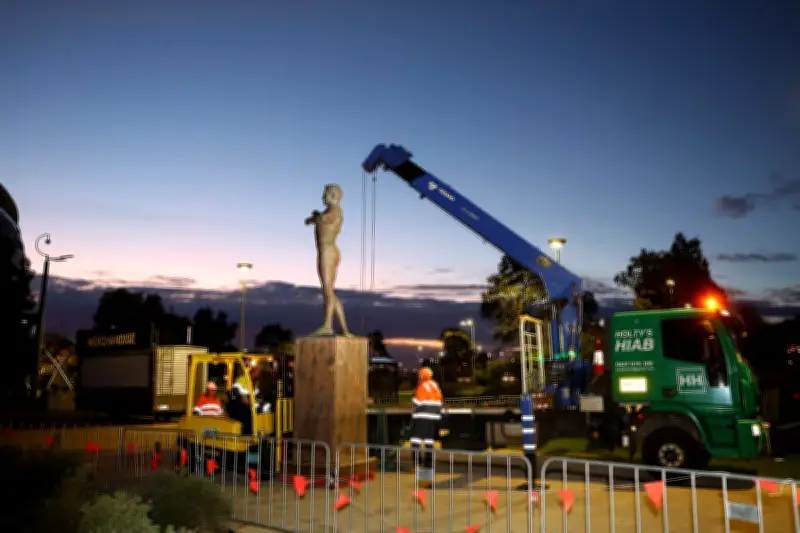
The statue of former AFL player Nicky Winmar, erected to honor his defiant response to racist abuse during a 1993 match, was removed from outside Optus Stadium in Perth just two days after he was found guilty of domestic violence charges in a Victorian court. The decision by the Western Australian government has ignited a heated debate about whether the monument should have been taken down or preserved as a symbol of the fight against racism.
Background of the Statue
The statue, unveiled in July 2022 by then-Premier Mark McGowan, captured the moment Winmar lifted his St Kilda jersey and pointed at his skin after enduring racial taunts from spectators at Victoria Park in 1993. The gesture is widely credited with forcing the AFL to establish its first official code of conduct. Winmar, a Noongar man who played 251 games from 1987 to 1999, was inducted into the AFL Hall of Fame in 2022.
Assault Conviction and Immediate Removal
On 17 July 2025, the 60-year-old was found guilty at Bendigo Magistrates Court of two counts of common assault and one count of unlawful assault, relating to an incident in May 2025 in Cohuna, northern Victoria. He was acquitted of intentionally causing injury. The court heard that Winmar grabbed the woman’s arm, twisted it, dragged her by the hair, pushed her against a wall, and bashed her head repeatedly into a wooden door. A pre-sentencing hearing is scheduled for August.

Premier Roger Cook ordered the statue’s immediate removal, stating that violence against women is unacceptable and that a strong message must be sent to the community. The WA government declared it was “no longer appropriate for that statue to be displayed,” and it is now stored by VenuesWest pending a decision on its future. The AFL is also reviewing Winmar’s Hall of Fame status.
Mixed Reactions from Indigenous Leaders
Jill Gallagher, a Gunditjmara woman and CEO of the Victorian Aboriginal Community Controlled Health Organisation, emphasized that the statue represents more than Winmar himself. “The Nicky Winmar statue is more than a statue of a footballer, it’s a statue against racism,” she said, calling for more consultation before removal. Muriel Bamblett, director of Our Ways Strong Together, an Indigenous-led anti-family violence organization, agreed: “The thing what Nicky stood up for was the level of racial violence that he was experiencing. Not being able to visually see that, or understand how important that lifting of the jumper was at that time, is disappointing.”
However, Professor Marcia Langton, a Yiman and Bidjara woman from the University of Melbourne, supported the removal. “His conviction for an assault against a woman requires that he is not celebrated in public in this way,” she said, adding that keeping the statue would have been “highly offensive to women, to AFL fans and the wider AFL community.”
Comparisons with Colonial Statues
AFL historian Matthew Klugman, co-author of a biography of Winmar, criticized the government’s inconsistency, noting that statues of colonial figures like James Stirling, who led the 1834 Pinjarra massacre, remain in place. “You’ve got to have some broad overarching approach,” Klugman said. “If the Winmar statue is coming down, why hasn’t Stirling’s statue come down immediately?” Langton countered that the two issues are distinct, arguing Australia must come to terms with its colonial history separately.
Ongoing Impact
The removal has sparked broader conversations about how society balances condemning violence against women while preserving symbols of anti-racism. The AFL’s review of Winmar’s Hall of Fame status, and the lack of similar scrutiny for other players with convictions, such as Wayne Carey, has also drawn attention. The debate continues as the statue remains in storage, its future uncertain.