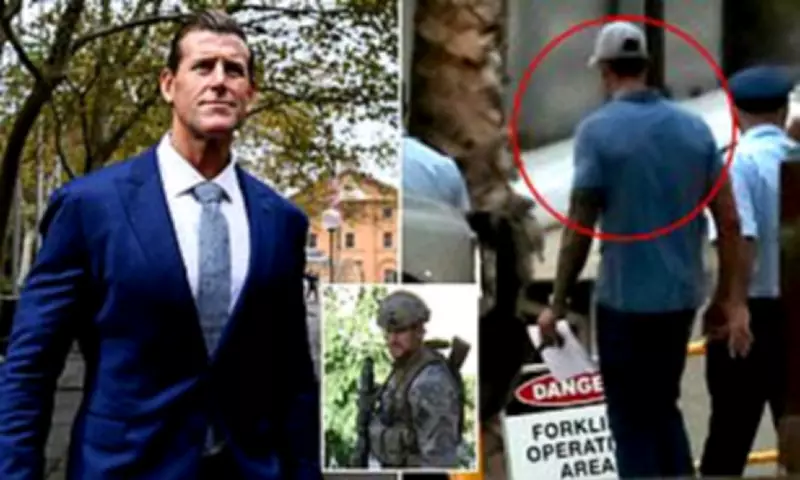
A 24-page court document has revealed disturbing details of five alleged murders committed by Victoria Cross recipient Ben Roberts-Smith during his service in Afghanistan. The 47-year-old father-of-two, who has consistently denied any wrongdoing, was granted bail on Friday after spending ten days in custody following his arrest on April 7.
Court Releases Statement of Facts
Judge Greg Grogin of Sydney's Downing Centre Local Court granted media access to the statement of facts, citing the importance of open justice. The document outlines each incident that led to Roberts-Smith being charged with five counts of war crime murder, each carrying a maximum penalty of life imprisonment.
The Whiskey 108 Compound Incident
The first charge relates to events at the Whiskey 108 compound in Uruzgan Province on April 12, 2009. Following an airstrike, Special Air Service Regiment soldiers cleared the compound and discovered a tunnel containing Mohammad Essa and his son Ahmadullah, who wore a prosthetic leg.

According to the statement of facts: "Mohammad Essa and Ahmadullah were handcuffed and then taken away by Roberts-Smith to an adjoining area within the Whiskey 108 compound. Ahmadullah was carried by Roberts-Smith outside the walls of the compound, thrown to the ground, and shot multiple times by Roberts-Smith with a belt-fed machine gun."
Several Australian Defence Force members reportedly witnessed this action while providing a protective cordon outside the compound.
The document further alleges that Roberts-Smith then directed another soldier to provide a firearm suppressor to a colleague identified as Person 4. "Roberts-Smith grabbed Mohammad Essa, placed him on his knees in front of Person 4, and said to Person 4, 'Shoot that c***'," the statement claims. "Person 4, understanding this to be an order, shot Mohammad Essa in the head, killing him."
The Darwan Village Killing
The second murder charge involves the death of Ali Jan at Darwan village on September 11, 2012. Roberts-Smith and fellow SAS troopers were on a mission to locate an Afghan National Army sergeant who had killed three Australian soldiers.
After lawfully killing a Taliban insurgent, the patrol captured several Afghans as "persons under control." Among them was Ali Jan, who was allegedly subjected to tactical questioning that involved Roberts-Smith "punching and physically assaulting detainees whilst they were handcuffed."
The statement describes how Ali Jan was taken to a cliff edge by Person 11: "Whilst he was still cuffed and physically restrained, Roberts-Smith kicked him, causing him to fall approximately 10m and causing injuries including the loss of teeth."
Roberts-Smith then allegedly ordered Person 11 to drag Ali Jan to a large tree. Shortly after, Person 4 heard shots that sounded like they came from an M4 rifle and turned to see Person 11 standing with their rifle on their shoulder. While both soldiers carried M4 rifles, the prosecution alleges Person 11 fired the fatal shots that killed Ali Jan.
The Syahchow Village Executions
The final two murder charges stem from events at Syahchow village on October 20, 2012. Roberts-Smith commanded a patrol that engaged and killed two armed insurgents. However, a post-mission report claiming two additional insurgents were killed has been disputed by patrol member Person 66, who was on his first operational mission.
Person 66 alleges Roberts-Smith called him to accompany him and a handcuffed prisoner, PUC 1, to open space outside a compound. They were joined by a second prisoner, PUC 2, under the control of Person 68, the patrol's second-in-command.
"At the end of the cornfield, PUC 1 and PUC 2 were lined up next to each other," the statement details. "PUC 1, in front of Person 66, was blindfolded and handcuffed. Both PUC 1 and PUC 2 were unarmed."
Person 66 reportedly heard a shot and observed that PUC 2 had been shot. Roberts-Smith then allegedly cut the handcuffs from PUC 1, removed his blindfold, and pushed him to the ground.
"Roberts-Smith said, 'Shoot him.' Person 66 believed this to be an order from Roberts-Smith," the document states. "Person 66 paused for a moment and then shot PUC 1 two to three times in the chest, killing him."

It is further alleged that Roberts-Smith threw a grenade toward the dead prisoners to support a false claim they had been killed in legitimate action within the rules of engagement.
Common Themes in Allegations
The statement of facts identifies five common themes across all alleged murders:
- Each victim was unarmed and present in locations where Roberts-Smith could reasonably have suspected insurgents to be located.
- Each offence occurred when there was no active engagement with enemy forces and ADF personnel controlled the environment.
- Evidence was planted or falsely associated with each deceased to enhance reporting that the killings were within lawful rules of engagement.
- Each deceased was handcuffed, detained for a period, and questioned prior to execution.
- None of the deceased was killed in situations where the ADF lacked effective control of the battlespace.
Roberts-Smith's arrest followed a five-year joint investigation by the Australian Federal Police and the Office of the Special Investigator. After posting $250,000 bail on Friday evening, he was released from Silverwater Correctional Complex. His case is next listed in July.