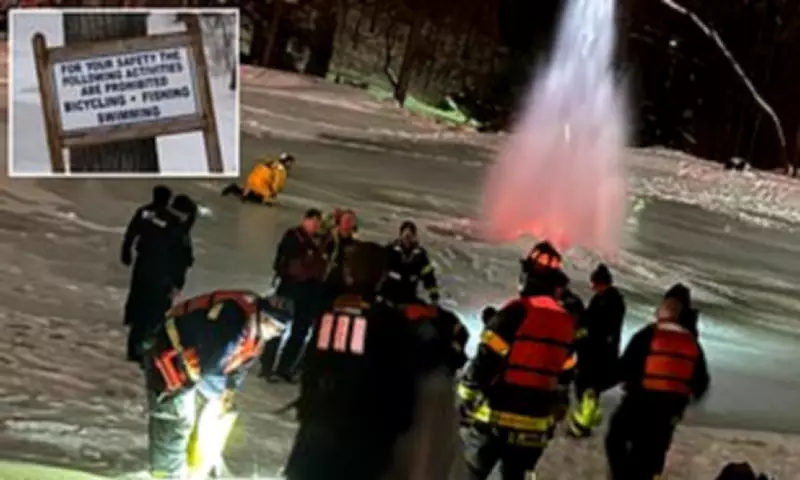
Photographer's Perilous Plunge: Icy Pond Selfie Attempt Turns Into 30-Minute Fight for Survival
A photography enthusiast found himself in a life-threatening situation that could have ended in tragedy after venturing onto a frozen pond for what he believed would be the perfect photograph. The 35-year-old man, whose identity remains undisclosed, was submerged in icy water for nearly half an hour when the frozen surface of Holcomb Gardens pond on Butler University's campus in Indiana unexpectedly gave way beneath him on February 2.
The Fateful Decision That Led to Disaster
Despite visible water showing through significant sections of the frozen pond, the man reportedly thought the scene presented an excellent photographic opportunity. Officials later noted his determination to capture an image of the pond's colorful fountain, which continued operating despite the freezing conditions. On that bitterly cold evening, with temperatures plummeting to just 19 degrees Fahrenheit, the man left his car running as he made his way toward the water feature.
As he approached the fountain, the ice suddenly cracked, plunging him into water approximately ten feet deep. The bone-chilling conditions created a potentially fatal scenario that would test both his resilience and the capabilities of emergency responders.

Remarkable Presence of Mind During Crisis
Displaying extraordinary composure under extreme duress, the man managed to keep his head and arms above water by grasping onto the surrounding ice. Even more remarkably, he maintained hold of his mobile phone throughout the ordeal and used it to dial emergency services. This crucial call initiated a chain of events that would ultimately save his life.
Butler University police officers James Hoeing and Jimmy Laws were first to arrive at the scene. They immediately attempted to pull the man to safety using a rope, instructing him to secure it under his arms. However, the victim's physical condition and the extreme cold prevented him from properly fastening the rope, and his attempts to simply hold onto it proved insufficient for extraction.
Specialised Rescue Operation
The Indianapolis Fire Department arrived shortly afterward, with responders sprinting toward the precarious scene. A trained rescuer carefully made his way onto the unstable ice surface and successfully secured the man using a specialised ice rescue sling. Officials later noted that the victim's physical stature made extraction particularly challenging, even for tactical rescue personnel pulling on the rope.
Through coordinated effort, the emergency teams managed to haul the man from the water within just three minutes of their arrival at the pond's edge. Remarkably, despite his prolonged exposure to freezing conditions, the victim remained coherent enough to inform officials that he had been alone on the ice at the time of the incident.
Medical Aftermath and Official Warnings
The rescued man was transported to Methodist Hospital in critical condition, though he has since been upgraded to stable status. Medical professionals and emergency responders estimated he had been submerged for between 20 and 25 minutes in water temperatures that could induce hypothermia within minutes.
'He is extraordinarily fortunate he survived the deadly conditions he put himself in,' stated the Indianapolis Fire Department in their assessment of the incident. The department emphasised the extreme danger of venturing onto frozen bodies of water, particularly when water is visibly present beneath the ice surface.
Broader Context of Ice-Related Dangers
This alarming incident highlights a significant public safety concern, particularly during winter months. According to public records cited by the Cottleville Fire District, approximately 250 people die annually after falling through frozen bodies of water across the United States.
Emergency officials strongly advise that if someone falls through ice, witnesses should not attempt a direct rescue, which could result in multiple victims. Instead, they should remain on solid ground, call for professional help immediately, and attempt to keep the victim calm while awaiting rescue teams.

The incident in Indiana follows another recent ice rescue in Missouri, where firefighters successfully saved a dog that had fallen into an icy lake during temperatures as low as 9 degrees Fahrenheit. That January 19 operation required specialised marine rescue teams to navigate frozen conditions and carefully extract the animal, which subsequently made a full recovery.
These parallel incidents serve as stark reminders of the hidden dangers presented by frozen water surfaces and the importance of exercising extreme caution around ice-covered lakes, ponds, and rivers during winter conditions.