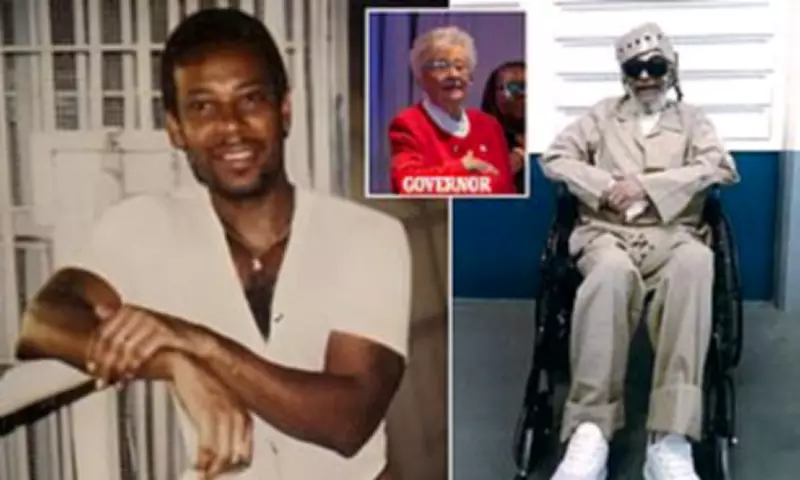
In a dramatic eleventh-hour intervention, Alabama Governor Kay Ivey has commuted the death sentence of a 75-year-old inmate, sparing him from execution just two days before he was scheduled to die. Charles 'Sonny' Burton, who has spent over 33 years on death row, will now serve life imprisonment without the possibility of parole.
Last-Minute Clemency Decision
Governor Ivey announced her decision on Tuesday, halting Burton's planned execution by nitrogen gas set for Thursday. The move came in response to the 1991 murder of Doug Battle during a botched robbery at an AutoZone store in Talladega, located approximately an hour outside Montgomery. Burton was involved in the crime alongside five other suspects, including Derrick DeBruce, who was identified as the actual shooter.
Disparity in Sentencing
Under Alabama law, individuals participating in a robbery that results in death can be convicted of murder, even if they did not commit the killing. Both Burton and DeBruce were found guilty of murder, but DeBruce had his death sentence reduced to life without parole in 2014 before his death in 2020. Governor Ivey emphasized the injustice of executing Burton while the triggerman avoided the death penalty.

'I cannot proceed in good conscience with the execution of Mr. Burton under such disparate circumstances,' Ivey stated. 'I believe it would be unjust for one participant in this crime to be executed while the participant who pulled the trigger was not.'
Victim's Daughter and Public Outcry
The governor's rare clemency decision followed intense public pressure, including demonstrations near the governor's mansion and a poignant opinion essay by Tori Battle, the victim's daughter. Tori, who was only nine years old when her father was killed, openly opposed Burton's execution, arguing that it defied reason.
'No one from the State has ever sat with me to explain why Alabama believes it must execute a man who did not kill my father,' she wrote in The Montgomery Advisor. 'My voice should matter. My love for my father does not require another death, especially one that defies reason. Mercy does not dishonor him. It honors the values he taught me.'
Support from Unlikely Sources
Priscilla Townsend, a juror in Burton's sentencing trial, later expressed regret over her decision, acknowledging that she did not fully understand the implications at the time. 'Mr. Burton was not inside the AutoZone at the time of the murder. He was not the shooter, and yet the state sought and secured a death sentence against him anyway,' she said, according to the Death Penalty Information Center.
Reactions and Reflections
An Instagram account dedicated to advocating for Burton, 'life4sonnyb', celebrated the governor's decision, stating, 'This decision ensures that the ultimate and irreversible punishment will not be carried out.... Today is a reminder that mercy remains an essential part of justice.' Burton himself expressed gratitude, saying, 'She has proven to the people of Alabama, and the world, that she is a responsible governor. And I thank her.'
Over the years, Burton has suffered from severe rheumatoid arthritis, requiring him to use a wheelchair in prison. He has also reflected on his crime, writing a letter to the Battle family to apologize. 'I sincerely apologize for taking so long to say this. I have struggled with this for years,' he told them, adding that he never anticipated the robbery would end in murder and was horrified when it did.
The case highlights ongoing debates about justice, clemency, and the application of the death penalty in Alabama, particularly in instances where defendants did not directly cause the victim's death.