Michigan Judge Confronts Woman Appearing in Zoom Court Hearing While Driving
A Detroit-area judge delivered a stern rebuke to a woman who appeared to be driving while video-calling into a court hearing this week, resulting in a contentious exchange and a default judgment against her.
Late Arrival and Immediate Suspicion
Kimberly Carroll was scheduled to appear before Judge Michael K McNally in the Woodhaven district court on Monday afternoon via Zoom. Attorney Brian Groen had already moved to default her for $1,921.85 when Carroll joined the call late. According to reports, McNally was about to grant the default judgment when the court clerk notified him that an unknown iPhone was attempting to join the Zoom session.
Once officials realized it was Carroll, the judge instructed her to turn on her camera and ensure her name was displayed on her account. The defendant attempted to justify her tardiness, stating, 'I was sitting in some room or something and then I didn't know I was just staring at myself. I'm sorry.'

Driving Revelation and Denial
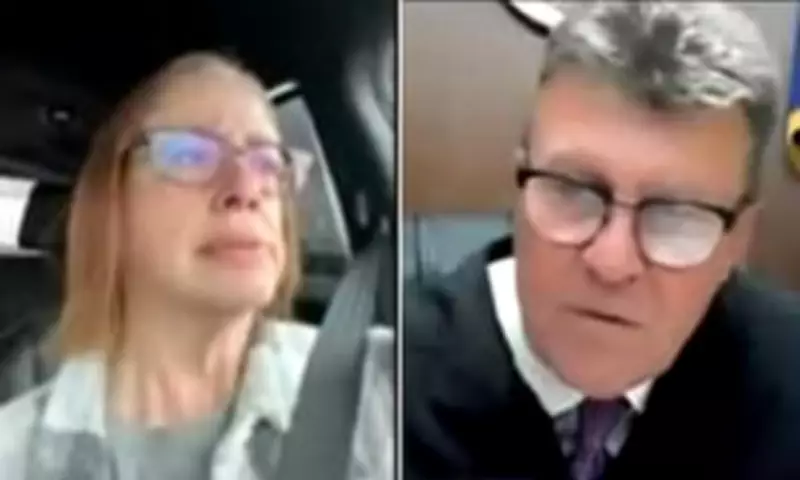
When Carroll activated her camera, she was seen sitting on the left side of a vehicle, apparently driving. Judge McNally immediately intervened, telling her, 'You cannot be driving ma'am. What are you doing?' Carroll claimed she was a passenger, explaining she was 'going out of town for a family member' and would ask her driver to pull over.
However, McNally, the longest-serving judge of Michigan's 33rd District Court, remained skeptical. 'Am I crazy, or does it not look like you're driving that car?' he questioned. Carroll insisted she was a passenger, prompting the judge to lean in for a closer look at her stream.
Inconsistent Answers and Growing Frustration
McNally then asked which side of the car she was on, to which Carroll replied the left side—the driver's side in the United States. 'How would you be on the left-hand side if you're a passenger in the front seat? Am I missing something?' the judge pressed. Carroll became flustered, quickly correcting herself: 'Left-hand, right-hand side. I'm sorry, I've been sitting in a room. I don't know.'
The judge noted that the seatbelt appeared to be coming from the driver's side, accusing her of lying. Carroll continued to deny driving, leading McNally to demand to see the driver. She requested a moment to get the driver's permission to be on camera, but the judge insisted immediately.
Vehicle Exit and Default Judgment
Instead of producing a driver, Carroll exited the vehicle, with a window visible behind her, confirming she was in the front seat. 'Do you think I'm that stupid?' McNally asked, announcing he would end the hearing and grant the default judgment. He stated he would not hear cases from 'people driving or sitting in cars' and instructed the clerk to record that Carroll 'was not available at the time and then was driving a car and telling the court she was not.'
When Carroll reentered the vehicle and argued she had signed in on time, McNally responded, 'You got an attitude with you, I'll tell you that. You got an attitude. Good luck to you.'
Carroll's Apology and Reflection
Carroll later released a statement taking responsibility for her actions. 'Appearing on a Zoom court hearing while I was driving was poor judgment and I regret that decision,' she said. 'I panicked in the moment and made the wrong call instead of pulling over or asking to reschedule. For that I am truly sorry.'
She added that the incident had escalated into a 'viral spectacle' affecting her reputation and family, questioning whether the response was proportional. 'I am human. I made a mistake, I own that mistake and I am willing to accept the consequences,' Carroll concluded. 'But I hope people will also consider whether the response has been about accountability, or about turning a moment into something far bigger than it needed to be.'

Historical Context of Similar Incidents
This is not the first instance of a Michigan resident facing trouble for driving during a virtual court hearing. In 2024, Corey Harris called into an Ann Arbor court hearing to address charges from a traffic stop while reportedly having a suspended license. Judge Cedric Simpson expressed disbelief at Harris appearing behind the wheel.
It was later revealed that Harris never possessed a driver's license; his driving privileges were suspended, and he held a non-driving state ID. Simpson remarked, 'He has never had a license, ever! And [he] has never had a license in any of the other 49 states or commonwealths that make up this country.'
The Carroll case underscores ongoing challenges with virtual court proceedings, highlighting the importance of adherence to legal protocols and the consequences of misconduct in digital settings.