Federal Agents Kill ICU Nurse in Minneapolis: Second Fatal Shooting Amid ICE Protests
The frozen streets of Minneapolis witnessed another tragic shooting on Saturday morning, as federal immigration officers shot and killed 37-year-old Alex Jeffrey Pretti during ongoing protests against Immigration and Customs Enforcement operations. This marks the second fatal shooting involving federal agents in the city within weeks, following the death of Renee Good earlier this month.
Contradictory Narratives Emerge
The White House, through deputy chief of staff Stephen Miller, has labelled Pretti as a "would-be assassin" who attempted to murder federal law enforcement officers. However, this claim has been made without presenting any supporting evidence to the public. In stark contrast, Democratic leaders across Minnesota have called for calm while demanding the immediate withdrawal of federal agents from their state.
Governor Tim Walz has stressed that state and local law enforcement are working to de-escalate tensions, while accusing Homeland Security agents of causing "chaos and violence" through their presence. Minnesota officials have taken legal action against the administration, alleging that the operation represents a politically motivated and unconstitutional attack on their state.

How the Shooting Unfolded
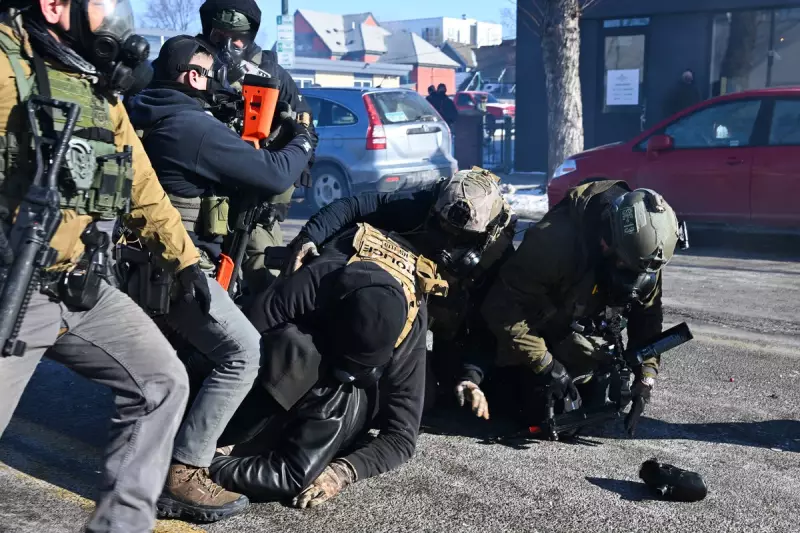
Multiple bystander videos from the scene on Nicollet Avenue in south Minneapolis show Pretti filming officers with his phone alongside other protesters and observers. The footage reveals a chaotic sequence where at least seven officers surround Pretti, with one appearing to strike him near the head with a canister while others attempt to restrain him.
As officers struggle with Pretti, a single shot rings out, followed by at least nine more shots in rapid succession while Pretti lies motionless on the street. Witnesses captured the horrifying moment, with one woman screaming "what the f*** did you just do?" and another voice from a nearby storefront saying "Not again. Are you f***ing kidding me? That guy's dead."
The Minnesota Bureau of Criminal Apprehension, the state's chief investigative agency, has reported being denied access to the scene, raising further questions about transparency and accountability.
Who Was Alex Pretti?
Alex Pretti was a registered nurse working in intensive care units, having obtained his state nursing license in 2021 with validity through March 2026. He graduated from Green Bay Preble High School in 2006 and attended the University of Minnesota, where he worked as a "junior scientist" at the university's medical school starting in 2012.
His father, Michael Pretti, described his son as someone who "cared about people deeply" and was "very upset with what was happening in Minneapolis and throughout the United States with ICE." He revealed that the family had warned Alex to be careful while protesting, advising him to "go ahead and protest, but do not engage, do not do anything stupid."
Minneapolis Police Chief Brian O'Hara confirmed that Pretti was a 37-year-old white man and "lawful gun owner" with no serious criminal history, having only minor parking violations on his record. The Department of Homeland Security claims Pretti was armed with a 9mm semi-automatic handgun and two magazines of ammunition at the time of the shooting.
Political Fallout and Escalating Tensions
President Donald Trump responded to the incident on his Truth Social platform, posting a photo of the alleged gun and accusing Democratic officials in Minnesota of corruption and fraud. He claimed the state has "stolen" billions of dollars from the federal government and suggested that local police had been prevented from protecting ICE officers.
The Department of Justice has launched a criminal investigation into Governor Walz, Minneapolis Mayor Jacob Frey, and other Democratic officials in the state, accusing them of obstructing federal operations. Minnesota officials have vehemently rejected these allegations, defending their response to what Mayor Frey has called "chaos and danger" brought on by the Trump administration.

Growing Resistance and National Implications
This latest shooting occurs within the context of Homeland Security's largest immigration enforcement operation to date, with officers facing allegations of unlawfully targeting both immigrants and citizens while clashing violently with protesters. The Twin Cities, home to approximately 80,000 people of Somali ancestry, have become a focal point in Trump's nationwide mass deportation campaign.
Federal immigration officers have fired on people more than a dozen times since Trump returned to the presidency last year, resulting in at least five fatalities including Pretti and Good. At least seven people have been injured in shooting incidents over the past year, with countless deployments of riot control weapons including rubber bullets, pepper balls, and chemical sprays.
The Pentagon has reportedly been preparing more than 1,500 troops for possible deployment to Minnesota following the president's recent threats to invoke the Insurrection Act to suppress protests against his immigration agenda.
Minnesota's Response and Calls for Withdrawal
Governor Walz has directly called on President Trump to "remove this force from Minnesota," warning that law enforcement officials in the state are maintaining records of clashes for potential "future prosecution of ICE agents and the officials responsible for this." The Minnesota National Guard remains on standby throughout the federal surge.
Mayor Frey posed poignant questions during a separate press conference: "How many more residents, how many more Americans need to die or get badly hurt for this operation to end? How many more lives need to be lost before this administration realizes that a political and partisan narrative is not as important as American values?"
Minnesota's Democratic U.S. senators, Amy Klobuchar and Tina Smith, have joined the chorus of voices urging ICE to leave the state immediately, with Klobuchar stating emphatically that Trump and Republicans must "Get ICE out of our state NOW."
As protests against the immigration crackdown continue across Minneapolis, the city remains deeply divided between federal authorities implementing aggressive enforcement measures and local officials demanding the restoration of peace and normalcy to their communities.